


From Wikipedia, the free encyclopedia
Content deleted Content added
|
|
|
||
| Line 6: | Line 6: | ||
|
| authority =(Möllendorff, 1887) |
| authority =(Möllendorff, 1887) |
||
|
| synonyms = |
| synonyms = |
||
|
* ”Aulacospira (Aulacospira) mucronata” <small>Zilch, 1984</small> |
|||
|
* ”Aulacospira (Micropetasus) mucronata” <small>(Möllendorff, 1887)</small> · alternative representation |
* ”Aulacospira (Micropetasus) mucronata” <small>(Möllendorff, 1887)</small> · alternative representation |
||
|
* ”Helix mucronata” <small>Möllendorff, 1887</small> (original combination) |
* ”Helix mucronata” <small>Möllendorff, 1887</small> (original combination) |
||
| Line 31: | Line 32: | ||
|
==External links== |
==External links== |
||
|
* {{cite journal |last1=Möllendorff |first1=O.F. von |title=Verzeichnis der auf den Philippinen lebenden Landmollusken |journal=Abhandlungen der Naturforschenden Gesellschaft zu Görlitz. |date=1898 |volume=22 |page=150 |url=https://biodiversitylibrary.org/page/58468236 |access-date=3 February 2026}} |
* {{cite journal |last1=Möllendorff |first1=O.F. von |title=Verzeichnis der auf den Philippinen lebenden Landmollusken |journal=Abhandlungen der Naturforschenden Gesellschaft zu Görlitz. |date=1898 |volume=22 |page=150 |url=https://biodiversitylibrary.org/page/58468236 |access-date=3 February 2026}} |
||
|
* [https://pmc.ncbi.nlm.nih.gov/articles/PMC6517363/pdf/zookeys-842-067.pdf Páll-Gergely, Barna, et al. “A review of Aulacospira Möllendorff, 1890 and Pseudostreptaxis Möllendorff, 1890 in the Philippines (Gastropoda, Pupilloidea, Hypselostomatidae).” ZooKeys 842 (2019): 67] {{Source-attribution-CC BY 4.0}} |
|||
|
{{taxonbar|from=Q106612361}} |
{{taxonbar|from=Q106612361}} |
||
Latest revision as of 14:08, 4 February 2026
Species of gastropod
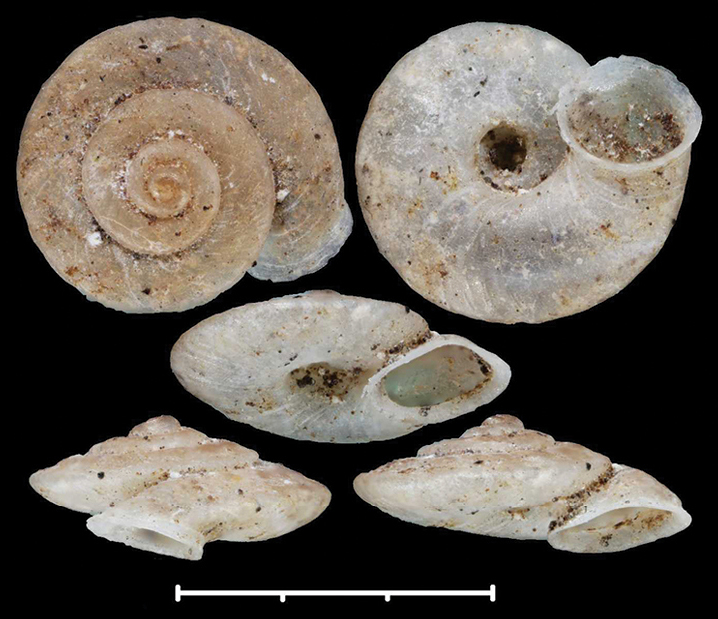
Aulacospira mucronata is a species of small land snail with an operculum, terrestrial pulmonate gastropod mollusc in the family Cyclophoridae. [1]
The height of the shell attains 1 mm, its diameter 3 mm.
(Original description in Latin) The shell is perspectively umbilicated (this indicates a wide, funnel-shaped hollow at the base that allows you to see the internal coils of the whorls all the way to the top), strongly depressed, and discoid in shape. On its upper surface, it is sculpted with very minute, oblique, and somewhat distant riblets; however, the base is only finely striated and nearly smooth. The entire shell is a pale horn color. The spire is only very slightly elevated, ending in a mamillary apex that is somewhat prominent.
There are four slightly convex whorls, which are separated by a deep suture and are hollowed out by a sufficiently deep spiral groove. The body whorl is angular at the periphery, flattened at the base, and turns downward briefly at the aperture.
The aperture is extremely oblique and angularly elliptical in shape. The peristome is thin, continuous, and detached (a key identifying feature); it is expanded on all sides but is not reflected. [2]
It is endemic to Licos and Uling islands, the Philippines, occurring on limestone rocks.
- Zilch, A. (1984). Die Typen und Typoide des Natur-Museums Senckenberg, 74: Mollusca: Pupillacea (4): Chondrinidae: Gastrocoptinae, Hypselostomatinae, Aulacospirinae. Archiv für Molluskenkunde. 115 (1/3): 151–177, Taf. 1–2. Frankfurt am Main
- Páll-Gergely, B., Schilthuizen, M., Örstan, A. & Auffenberg, K. (2019). A review of Aulacospira Möllendorff, 1890 and Pseudostreptaxis Möllendorff, 1890 in the Philippines (Gastropoda, Pupilloidea, Hypselostomatidae). ZooKeys. 842: 67–83.




