
From Wikipedia, the free encyclopedia
Content deleted Content added
|
|
|||
| Line 30: | Line 30: | ||
|
==External links== |
==External links== |
||
|
* {{cite journal |last1=Guérin-Méneville |first1=F.E. |title=Description d’une nouvelle espèce de mollusque du genre Cyclostome, découverte par M. J. Itier pendant la mission de France en Chine |journal=Revue Zoologique, par la Société Cuvierienne |date=1847 |volume=10 |page=2 |url=https://www.biodiversitylibrary.org/page/2271612 |access-date=31 January 2026}} |
* {{cite journal |last1=Guérin-Méneville |first1=F.E. |title=Description d’une nouvelle espèce de mollusque du genre Cyclostome, découverte par M. J. Itier pendant la mission de France en Chine |journal=Revue Zoologique, par la Société Cuvierienne |date=1847 |volume=10 |page=2 |url=https://www.biodiversitylibrary.org/page/2271612 |access-date=31 January 2026}} |
||
|
* [https://www.nhm.ac.uk/our-science/data/tropical-land-snails/taxa.dsml Naggs, F. & Raheem, D. (2000). Land snail diversity in Sri Lanka. An illustrated guide prepared for the launch of the Darwin Initiative programme. Photography by Harold Taylor. The Natural History Museum, London. pages i-xiii, 1-203. 246 coloured plates. ISBN 0565091514 (printed version), ISBN 0565091565 (compact disc).] |
|||
|
{{Commons category}} |
{{Commons category}} |
||
Latest revision as of 13:46, 31 January 2026
Species of gastropod
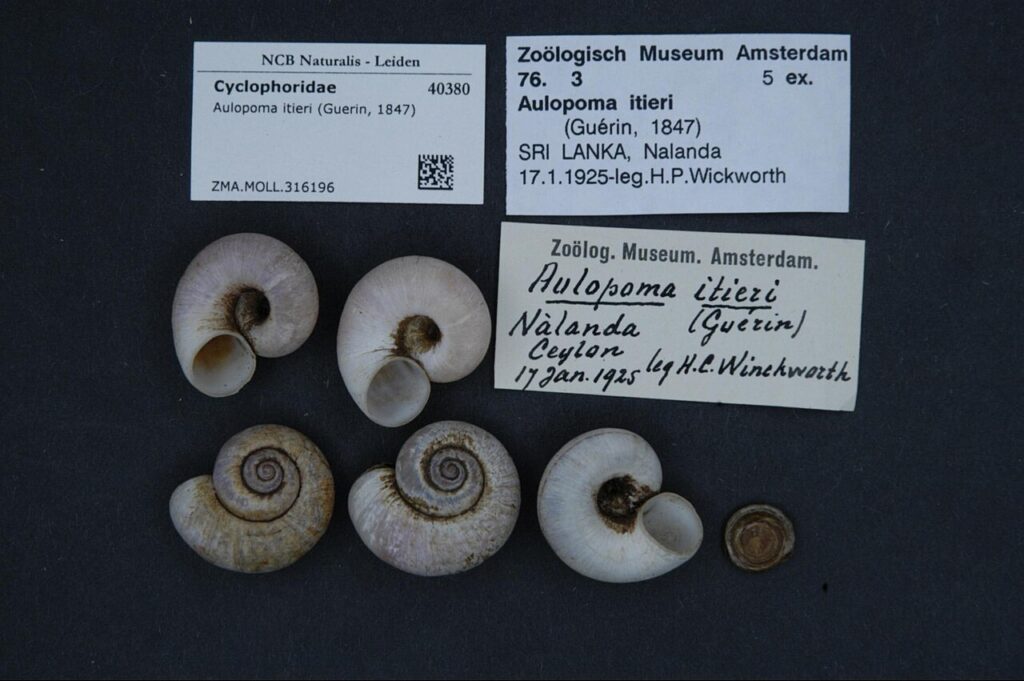
Aulopoma itierii is a species of small land snail with an operculum, terrestrial pulmonate gastropod mollusc in the family Cyclophoridae. [1]
It is endemic to Sri Lanka.[2][3]
It is about 11-22mm in length.[4]
(Description in German by Kobelt) The height of the shell attains 11 mm, its diameter 22 : 18 mm
The shell is widely umbilicate, nearly disc-shaped, thick-walled, and striated. It is whitish in color, with the upper side mottled in chestnut brown; the periostracum is usually preserved and olive-brown in hue. The apex is needle-like and blue-black. There are 4 to 4 ½ cylindrical whorls. The body whorl is detached at the front and descends. The aperture is oblique and circular, with a peristome that is continuous, straight, and sharp. The operculum is quite thick and consists of 5 widely striated whorls. [5]

