
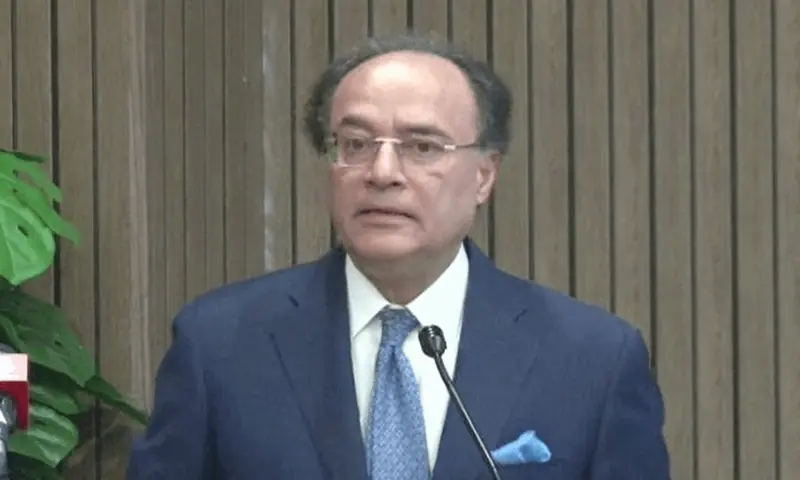
PESHAWAR: Finance Minister Mohammad Aurangzeb highlighted on Thursday that climate change and population growth pose significant challenges for Pakistan.
Speaking at the Pakistan Business Summit, he noted that issues such as child stunting, poverty, and climate change were directly affecting the country’s long-term productivity and global standing.
The summit, held under the patronage of Khyber Pakhtunkhwa Governor Faisal Karim Kundi, brought together policymakers, business leaders, and corporate executives to discuss Pakistan’s economic outlook, innovation, and global competitiveness. It was co-hosted by Nutshell Group and Al Baraka Bank, with the Overseas Investors Chamber of Commerce and Industry (OICCI) as a strategic partner.
The finance minister emphasised the government’s commitment to fostering an environment where the private sector could drive economic growth. He stated that the government’s role is to ensure macroeconomic stability, implement structural reforms, and create the right conditions for business and investment.
Outlines steps to foster private sector growth, boost remittances
Reviewing recent economic developments, Senator Aurangzeb highlighted a significant drop in financing costs following a reduction in the policy rate, an improvement in foreign exchange reserves, and stability in the exchange rate. These factors, he said, had bolstered investor confidence and facilitated the repatriation of dividends and profits.
The minister also reported a notable increase in remittances, which reached $38 billion last year and were projected to rise to between $41bn and $43bn in the current fiscal year. He pointed out that Pakistan had successfully repaid $500 million in Eurobond obligations in September, without causing market disruption, and was well-positioned to meet the upcoming $1.3bn repayment in April 2026.
Aurangzeb reaffirmed the government’s commitment to comprehensive tax reforms, aiming to separate tax policy from tax administration in order to restore credibility and consistency for investors. He also stressed that reforms in state-owned enterprises, privatisation efforts, and energy pricing were critical elements of the country’s economic agenda.
The minister further discussed Pakistan’s export-led growth strategy, tariff reforms to reduce duties on raw materials and intermediate goods, and measures to attract foreign direct investment (FDI). He cited recent engagements in Beijing, Riyadh, Washington, and New York as signs of renewed investor confidence, which included the signing of 24 joint venture agreements with Chinese companies.
He concluded by stressing that Pakistan’s path to sustainable growth hinges on increased competitiveness, private sector dynamism, and stronger coordination between the federal and provincial governments.
He also highlighted the importance of effectively utilising the Rs4.3tr national development budget, particularly for infrastructure, health, and education.
Minister Aurangzeb affirmed the government’s resolve to guide Pakistan toward sustainable economic recovery, global competitiveness, and resilience.
Published in Dawn, October 3rd, 2025

