
Among these, the Bali Nyonga which is the largest kingdom claims descent from the Chamba-Leko migrants, and while the people of Bali Nyonga speak the Mungaka language (a Grassfields Bantu variety) the ceremonial institutions such as the Lela and Voma festivals point to Chamba antecedents.
Among these, the Bali Nyonga which is the largest kingdom claims descent from the Chamba-Leko migrants, and while the people of Bali Nyonga speak the Mungaka language (a Grassfields Bantu variety) the ceremonial institutions such as the Lela and Voma festivals point to Chamba antecedents.
Linguistic links are also evidenced by close lexical affinities between languages of the Chamba-Leko group and the so-called Nyong dialect cluster spoken in some Bali-affiliated communities; for example the Nyong language shares about 85 % lexical similarity with the Chamba language.
Linguistic links are also evidenced by close lexical affinities between languages of the Chamba-Leko group and the so-called Nyong dialect cluster spoken in some Bali-affiliated communities; for example the Nyong language shares about 85 % lexical similarity with the Chamba language.
●”’Population and Settlements”’
●”’Population and Settlements”’
●”’Language Revival”’
●”’Language Revival”’
A significant cultural movement among the Bali Nyonga is the relearning of their original language, [[Chamba Leko|Mubako]]. Also Known as [[Nyong|Daganjonga]] which is still spoken by their sister tribes [[Balikumbat (village)|Balikumbat.]] But Over generations, external influences had reduced the fluency of Mubako, but recent efforts in education, storytelling, and community gatherings have rekindled interest in preserving and using the language. This revival is not only a linguistic endeavor but also a reclamation of cultural identity and historical memory.
A significant cultural movement among the Bali Nyonga is the relearning of their original language, [[ |Mubako]]. Also Known as [[Nyong|Daganjonga]] which is still spoken by their sister tribes [[Balikumbat (village)|Balikumbat.]] But Over generations, external influences had reduced the fluency of Mubako, but recent efforts in education, storytelling, and community gatherings have rekindled interest in preserving and using the language. This revival is not only a linguistic endeavor but also a reclamation of cultural identity and historical memory.
[[File:Part of Bali Cameroon.jpg|thumb|right|300px|View of Bali Nyonga region, Cameroon, ca. 1890]]
[[File:Part of Bali Cameroon.jpg|thumb|right|300px|View of Bali Nyonga region, Cameroon, ca. 1890]]
[[File:Fragment de pilier, Bali‑Nyonga, Musée du quai Branly.jpg|thumb|right|300px|Carved pillar fragment from Bali Nyonga, Cameroon (≈1905)]]
[[File:Fragment de pilier, Bali‑Nyonga, Musée du quai Branly.jpg|thumb|right|300px|Carved pillar fragment from Bali Nyonga, Cameroon (≈1905)]]

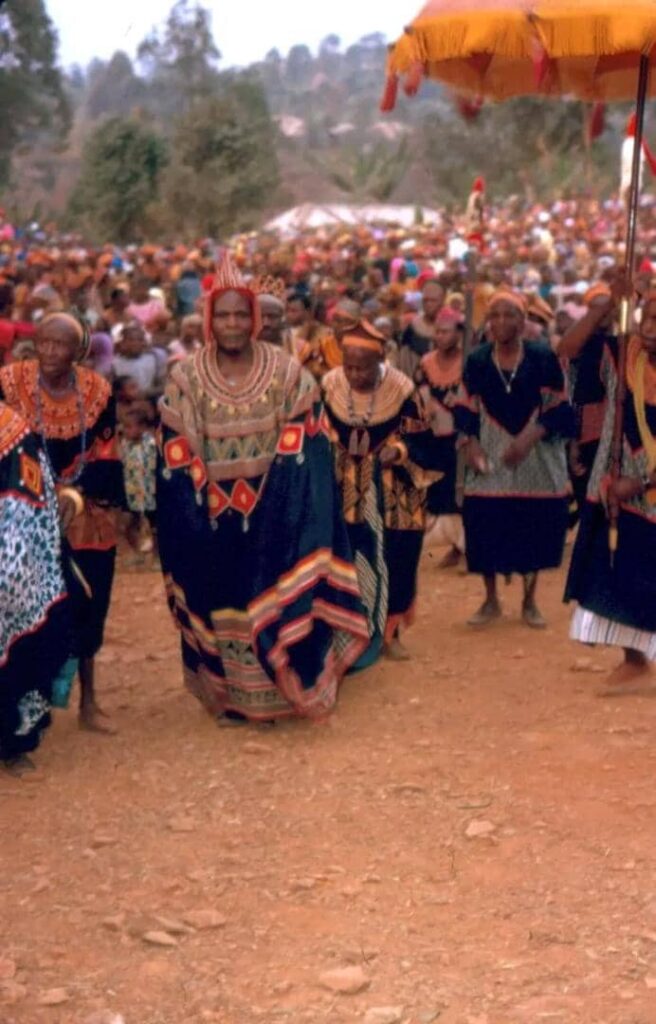
Bali Nyonga is a town in the Northwest Region of the country Cameroon on the West Central borders on the continent of Africa. It is the home of the Bali Nyonga, a people of the Chamba Leko group – an entity that migrated from Chamba around 1600. Their language is known as Mungaka The Chamba-Leko cluster, speaking a language of the Leko–Nimbari family, originated in the border region of what is now Nigeria and Cameroon.
One branch of this group migrated southwards during the 19th century and founded a number of “Bali” fondoms in the Bamenda Grassfields of Cameroon.
Among these, the Bali Nyonga which is the largest kingdom claims descent from the Chamba-Leko migrants, and while the people of Bali Nyonga speak the Mungaka language (a Grassfields Bantu variety) the ceremonial institutions such as the Lela and Voma festivals point to Chamba antecedents.
Linguistic links are also evidenced by close lexical affinities between languages of the Chamba-Leko group and the so-called Nyong dialect cluster spoken in some Bali-affiliated communities; for example the Nyong language shares about 85 % lexical similarity with the Chamba language.
●Population and Settlements
Today, the Bali Nyonga population is estimated at approximately 50,000 to 70,000 individuals, primarily residing in the Northwest region of Cameroon. They live in closely-knit villages, maintaining communal traditions, governance, and cultural practices that echo their historical roots.
●Language Revival
A significant cultural movement among the Bali Nyonga is the relearning of their original language, Mubako. Also Known as Daganjonga which is still spoken by their sister tribes Balikumbat. But Over generations, external influences had reduced the fluency of Mubako, but recent efforts in education, storytelling, and community gatherings have rekindled interest in preserving and using the language. This revival is not only a linguistic endeavor but also a reclamation of cultural identity and historical memory.

●The Split and the Creation of Bali Nyonga
The succession crisis following the death of Fon Gawulubi (also referred to as gowalbe in some accounts) was a turning point in Bali Nyonga history. Gawulubi died without naming a clear successor, leaving his sons and clans in dispute over the throne. This led to a split, resulting in the formation of multiple chiefdoms. Princess Nyonga, Gawulubi’s eldest child, emerged as a unifying figure, consolidating loyal clans and establishing the Bali Nyonga chiefdom for her son, Fon Nyongpasi. During this period, the Bali Nyonga secured their new homeland by defeating and absorbing several neighboring tribes along their migration route. Their victories over the Bamileke, Mbam, and other smaller communities helped them solidify control over the Grassfields. The throne, representing both political authority and spiritual continuity, became a symbol of unity, while Princess Nyonga’s leadership ensured the survival and stability of the Bali Nyonga chiefdom.

