
If pursued with clarity, the SMDA could be remembered not just as a security commitment, but as the moment Islamabad and Riyadh truly began to reshape their economies together through integration.
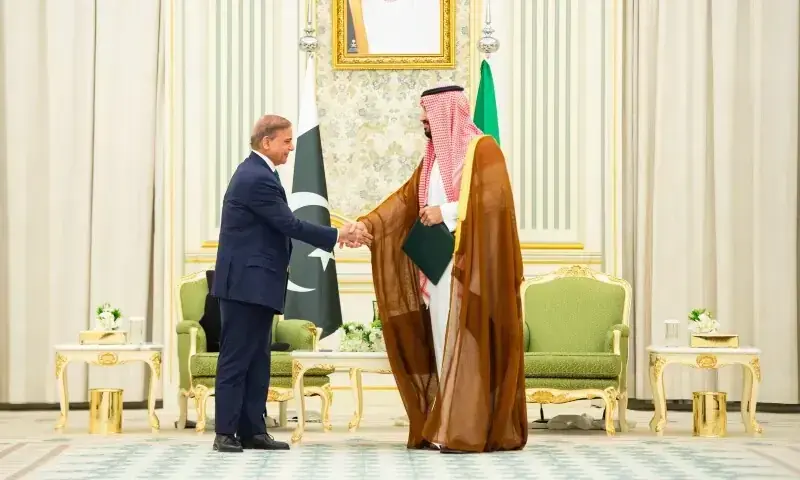
Pakistan and Saudi Arabia’s Strategic Mutual Defence Agreement (SMDA), signed at Al Yamamah Palace on Sept 17, is an inflection point for the bilateral relationship as well as the broader region.
The pact’s core commitment is unambiguous: an attack on one will be treated as an attack on both. That collective-defence clause matters in a region recalibrating its security architecture and hedging against external shocks.
But the real test of this agreement lies in how Islamabad and Riyadh can pivot from security symbolism to a joint economic mission anchored in reform, productivity and strategic integration across the security, industrial, and technological domains.
This requires Pakistan and Saudi Arabia working across multiple pillars to pursue economic, defence, and technological integration between the two economies. The strategy should be anchored in a clear economic agenda aligned with both countries’ need to reorient their economies.
On the Saudi side, this reorientation requires investments in building a competitive industrial and digital ecosystem, and on the Pakistani side, the goal is to generate economic growth through sectors that expand the country’s ability to sustainably earn foreign exchange.
Given this need, a Pakistani strategy that chases cheap loans, deferred oil payments or one-off discounts from Saudi Arabia in lieu of the SDMA would be futile and disastrous. The Saudis have clearly signalled that the era of handouts is over, and Pakistani policymakers should pay heed to this signalling.
The need of the hour therefore is to pursue a strategy that plugs Pakistan into Saudi Arabia’s investment, technology and supply-chain ambitions. This would require doing the hard work at home to direct Saudi capital into sectors that deliver mutually beneficial outcomes for both nations.
The big picture
Within this context, the defence track can be a bridge to industrial cooperation and economic integration. As Dr Jamal Al Harbi, the Saudi Media Attaché in Islamabad put it in a recent article, the pact “includes defence industry collaboration, with potential for technology transfer and co-production of military equipment, as well as capacity building and training, building on the longstanding tradition of Pakistani military personnel working with Saudi forces.”
This perspective points to a broader state of play between Saudi Arabia and Pakistan, and if pursued effectively, the SDMA is likely to lead to a strategic embrace that links security with industrial production, technology cooperation, and defence integration.
The first area of focus must be Pakistan’s energy markets, which remain trapped in a cycle of inefficiency, political paralysis, and circular debt. An ambitious deregulation programme to open the entire energy value chain, including oil, gas, refineries, and battery energy storage, would help attract Saudi capital under clear, rules-based frameworks.
For this to work, Islamabad would need to commit to time-bound reforms, ensure predictable contract enforcement, and empower regulators while disempowering the administrative state that insists on running the energy ecosystem, to disastrous effects. This initiative should also look at emerging technologies in energy, including electric vehicles, battery energy storage, and decentralised grids.
Such a programme would provide Riyadh the opportunity to acquire long-duration assets in Pakistan. It would also align with Vision 2030’s ambition to make Saudi Arabia an international investor in energy and industrial platforms, especially in emerging energy solutions.
For Pakistan, it promises stable supplies, reduced fiscal pressure, and a credible pathway for private capital to flow into a critical sector that is in dire need of reforms. In addition, Saudi capital can support Pakistan to build a future ready clean energy ecosystem paired with electric vehicles and large-scale battery energy storage capabilities.
Secondly, as articulated by Dr Al Harbi, the defence pact should evolve into industrial co-production. Aligning with Saudi Arabia’s defence-localisation targets, Pakistan can set up co-production hubs for drones, conventional platforms, secure communications, and cyber capabilities.
These facilities would need to emphasise local content, testing and qualification labs, and joint research and development. Other partners could also be plugged into this framework — some of this is already being signalled — creating a regional defence industrial ecosystem over the coming years that would allow for diversification of supply-chains and greater interoperability.
For Riyadh, this initiative would help diversify supply chains while advancing sovereign capabilities consistent with Vision 2030. For Pakistan, it provides industrial upgrading, skilled jobs, and technological gains that can spill over into other sectors and bilateral relationships.
The third pillar is investment, particularly through the Public Investment Fund (PIF). In addition to the energy sector, PIF investments can be directed into Pakistan’s emerging critical minerals sectors, including copper, gold, and rare earths, as well as initiatives for defence cooperation. Pakistan is already collaborating with the United States on critical minerals and mining, and bringing in PIF would further diversify interests and investments in Pakistan. As Barrick Mining’s flagship Reko Diq project becomes operational, its success can be leveraged to access PIF investment for processing and value-add capabilities in the mining sector.
For Saudi Arabia, such investments would help secure inputs for electric vehicles, defence systems, and clean-energy supply chains, while creating deal flow for PIF and companies like Ma’aden. For Pakistan, the flow of funds would lead to sustainable exports, adding to overall macroeconomic stability while lowering risk premium for finance and crowding in other investors. In addition, scaling up defence industrial capabilities would add to the country’s overall ability to defend itself and deter its rivals in the region.
The fourth opportunity lies in skills and technology. Both countries need to build their capacities when it comes to artificial intelligence, fintech, cybersecurity, and data processing at scale. This initiative could be led through joint startup accelerators in Riyadh, Karachi, Lahore, and Islamabad, along with reciprocal seed funds to support founders building products for the region.
Such an initiative would help support Riyadh’s needs for securing access to a young and cost-effective talent pool that can power Vision 2030’s execution. For Pakistan, it would add further momentum to the country’s emerging information technology sector, creating middle-class jobs that earn foreign exchange while embedding the country’s technology firms in regional innovation.
Opportunities for fintech
The final pillar should seek to build joint capabilities around financial technology and inclusion. Pakistan is one of the largest recipients of remittances from Saudi Arabia, yet much of these flows remain expensive. A dedicated fintech vertical that is designed to cut financial friction within both economies, as well as in the flow of remittances, would be extremely impactful. In a world where Pakistani talent integrates with Saudi Arabia’s technology ecosystem, the increase in financial flows would require even greater investments in financial integration and innovation.
By linking Saudi fintechs and banks directly with Pakistani institutions, and integrating instant payments, shared e-KYC, and robust AML protocols, both countries could benefit.
Pakistan would see billions of dollars move into the formal economy, stabilising foreign-exchange reserves and improving worker welfare. Saudi Arabia would deepen its fintech ecosystem, while offering faster, more transparent channels for its expatriate community. The additional dividends through the development of credit histories for workers, wage-linked savings, and micro-insurance would create a virtuous cycle of financial inclusion.
All of this, however, will remain aspirational unless anchored in credible execution. What Pakistan needs is the discipline to turn this defence pact into an economic one that advances reform, productivity, and integration into regional value chains. If pursued with clarity, the SMDA could be remembered not just as a security commitment, but as the moment Islamabad and Riyadh truly began to reshape their economies together through integration. But if leveraged to secure access to cheap financial bailouts and discounted oil, the SDMA is likely to lead to disappointing outcomes.
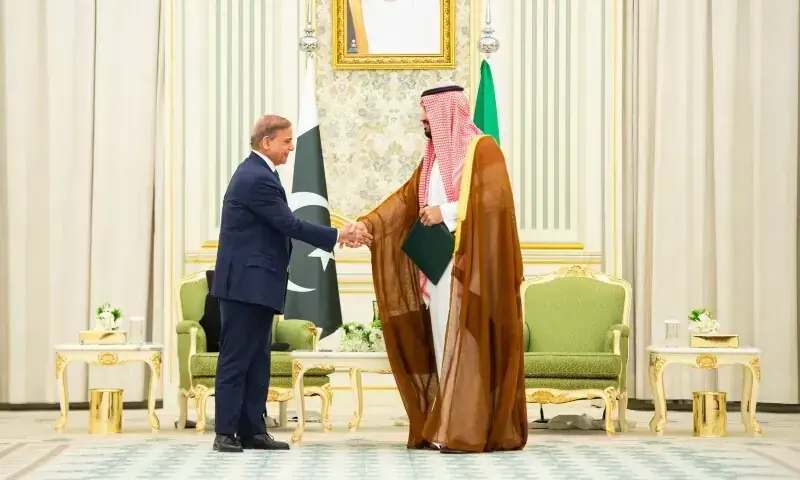
Header image: Prime Minister Shehbaz Sharif and Saudi Crown Prince Mohammed bin Salman shake hands after signing the Strategic Mutual Defence Agreement, Riyadh, Saudi Arabia on Sept 17. — Saudi Gazette/ File

