


Indian former-athlete and coach
Bhogeswar Baruah (born 3 September 1940) is an Indian retired athlete, coach, and military soldier. He was one of the first Assamese to win gold at an international event, winning a gold medal in an 800-metre running event at the 1966 Asian Games. He also won a silver medal in the 4 x 400 metres relay in the 1970 Asian games. He is a recipient of the Arjuna Award and is the first Assamese to obtain the Arjuna award.
Baruah was born on 3 September 1940. He joined the Indian Defence Force in 1960, where he soon after began focusing on running rather than football.
Baruah began his early running career shortly after his entry into the army. He participated in several running events, winning gold in numerous events. In the 1966 Asian Games he won gold by running the 800 metres in 1 minute 49.4 seconds, which set a new record in Asia. In the 1970 Asian Games, he won a silver medal in a 4 x 400 metre relay.
Baruah’s birthday is celebrated on 3 September every year in Assam, which was named the “Abhiruchi Sports Day” in his honor. He also started a sports academy at Dimow in Sivasagar in the early 1990s. But after operating for three years, he had closed it down due to lack of funds. Baruah is considered a sporting icon and household name in Assam.
Early life and education
[edit]
Birth and family life
[edit]

Bhogeswar Baruah was born on 3 September 1940,[2] the sixth of eight children born to Bhodraswar Baruah (c. 1889–1994) and Aikon Baruah (c. 1913–1983). His family’s ancestral village was Thakurpara, which was about a kilometre west of Joysagar Tini-Ali. The Archaeological Survey of India established its first office in Sibsagar in 1935; Baruah’s father, Bhodraswar, joined the Joysagar office as a chowkidar (a Class IV employee). Due to the job, Baruah’s parents moved from Thakurpara and built a small bamboo-and-thatch house by the Joysagar tank. The family received ration benefits because his father’s job was a central government one. The old Thakurpara home was left to his uncles and an aunt, and Baruah was born at the Joysagar Tank house.[3]
Baruah was particularly close with his father, Bhodraswar, while growing up as he would accompany him to the fields and help him in any way. Baruah has described his father a calm and quiet man, who was devoted to his work, and suggested that he too inherited that simplicity from his father. Bhodraswar Baruah was uneducated,[4] but despite having a government job he did all his farming himself. The family’s total land was around fifteen bighas and Baruah’s father also worked on leased land. Their work included ploughing, harvesting, sowing, and carrying bundles of paddy on their shoulders. Baruah’s father was also a local village healer, who treated the sick with traditional Assamese herbal medicine for which he never accepted any money. His father was also fond of sports, and during the time of British rule where football matches and horse racing was often held at Nazira, he would often go to watch football.[5] Baruah’s mother, Aikon, handled both the household chores and farm work. He noted her as an expert weaver who spun yarn, and wove chadors and blankets on the loom. Baruah himself would help her by collecting castor and keseru leaves for the silkworms. He described her in his biography as strict and strong-willed.[5]
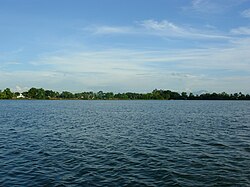
Baruah had two elder brothers, and three elder sisters (two of whom were married before his birth). Two elder paternal uncles and three elders cousins lived near them in Joysagar. Baruah, along with his younger sister and younger brother, were born at the Joysagar house while their older siblings were born at Thakurpara. When his family settled at the new house, Joysagar was mostly surrounded by jungle, with there being almost no neighbours nearby. The large Joysagar tank was beside their home, and from around the age of 3 he taught himself to swim. During his childhood, Baruah enjoyed watching the fish and turtles in the tank, and sometimes swam alone out to the island in the middle of the tank.[3]
Childhood and education
[edit]
Baruah did not initially begin his education straightaway, and in his early years he mostly spent his time in the world of water and open fields where he lived. He was later enrolled at the Meteka primary school, which was the nearest one to him. His attendance at the school was irregular, as reaching the school required him to cross a big stream; bamboo bridges were only put up when it was dry so during monsoon season he had to travel by boat. A few years later, a school opened at Zolagaon, and he transferred there in Class III because it was closer. None of Baruah’s elder sisters went to school, and of his two elder brothers: the older studied up to lower primary and the younger passed high school at Meteka.[3]
From an early age, Baruah had a keen interest in outdoor activity. He played village games such as Tengabol (a game like lemon and spoon), Koi, Kholiguti (marbles), and made shields from taro leaves for mock fights. There were no proper playgrounds where lived so he played volleyball and football on the open ground next to the tank. His swimming ability led to an early local success; when Sibsagar college organised a swimming and boat race in the Joysagar tank, he joined unofficially but finished in first place, and villagers then bestowed a trophy to him. From his school days, he worked regularly in the fields at Thakurpara, and would often run home later to make it to school on time.[3]
After finishing at Zolagaon, Baruah joined Vidyapith school in Sibsagar town. There, he for the first time saw leather footballs and began to have a keen interest in the game. He became a good right-sided defender, and played for the Sibsagar district at an Upper Assam Schools Tournament in Jorhat, where he competed against schools from Dibrugarh, Golaghat, Tinsukia and other areas. His interest in sports grew stronger than his interest in studying, and he later failed his matriculation exams. Around the time of the second world war, he watched American soldiers fish, shoot, and drive; this was his first exposure to firearms and vehicles which would later spark hos interest in jpining the army. He learned to shoot a rifle by helping the American soldiers set up posts in the water, and learned how to drive from observing and copying how they used the clutch and gears in their jeeps.[3]
Baruah’s military career began by chance, despite him having long had ambitions to join the army. In 1960, Baruah was hired to drive two men from Sibsagar to Jorhat, and he dropped them off in front of the Paradise hotel in Jorhat. Near there, in an open field, the army was recruiting and Baruah watched the drills from afar. An army officer noticed him and soon after asked if he wanted to join the army and he immediately agreed. Baruah did not tell his father about the decision, though when he went home the same day he told his mother who accepted the choice when Baruah said that others were also joining.[6]
Baruah was selected to become a driver for the Indian Army Corps of Electronics and Mechanical Engineers (EME) of the Indian Defence Force in November 1960, with the headquarters of the department being located at Secunderabad. During his first two months there, he did not begin training activities such as army drills and parade routines and instead focused on clean-up and maintenance work, such as clearing jungles, cutting grass, sweeping, and whitewashing walls. A temple called Koteswar was being constructed around half a mile from his quarters, and he was often taken there to help with construction work including carrying materials and mixing mortar.[6]
Baruah’s platoon training later started and the first stage in this was basic training. In the basic training, Baruah was taught drill commands and rifle-shooting training. After this initial training, he had to complete the passing-out parade before he was posted to his unit. He did not undergo the full basic training schedule as he was training with the EME football team, and so only practiced for two days. Previously, Baruah observed the Home Guard training camp at the Joysagar tank where he observed the parade drills of the trainees, and had practiced rifle shooting with American soldiers. This meant both tasks were natural to him; without much extra practice he successfully passed the parade. After being confirmed as a soldier, his allowances and facilities were improved.[6]
Baruah did not tell his father about his decision to join the army or ask for his permission as he thought that his father would refuse, as Baruah was his main helper in the fields. Instead, Baruah realised that he would have long annual leave, and decided to divide the time into two parts during the planting season and the harvest season, so that he could return home to help with farming. He did not take leave during festivals such as Bihu. During his eighteen year long military career, he returned home twice every single year in keeping with his promise to his father.[5]
Baruah received his only promotion after three years, which from a constable to a Havildar. Whilst not thinking too much of it initially, towards the end of his career, seeing his peers being promoted far above him while he was not began to trouble him. He subsequently decided to apply for a home-posting near Assam to plan for post-retirement life. His first home posting was in Dimapur, where he drove army trucks to transport supplies to different areas. In Dimapur, Baruah began to further question his job due to him not having promotions, and this combined with his wife being pregnant with their second child led to him after a while deciding to take voluntary retirement to go back to his village and return to farming.[7] He retired at the rank of Havildar.[8]
Early sports career
[edit]
In the early stages of his military career, Baruah was often taken out to play different sports such as running, jumping, kabbadi, volleyball and football. He naturally took to football, and his skills as a right-sided defender began to be noticed by seniors. He began to have aspirations of joining the EME team in Secunderabad, and shortly after increasing the intensity of his training, he was notified that he was selected to join the main EME team. His typical schedule was running in the morning, breakfast, then two hours of football practice, lunch, rest, football practice again and finally a practice match in the evening. The main EME team also held matches against teams from the Air Force, AOC, and the P&T. Tarlok Singh, a former member of the Indian football team which won gold at the 1962 Asian games, was the captain of the team, and as there was no coach of the team, the training was supervised by senior players such as Singh. Baruah was selected at the right-back in the first eleven, but he his weakness was his left foot.[6]
In 1962, the EME Secunderabad team went to Delhi to participate in the Durand cup where Baruah was in the starting eleven. It was the first time he had ever visited Delhi, and the team stayed at an army unity near the Red fort. In the team’s first match, they created a shock by defeating the former champions, the Punjab police team. However, after a few days, the tournament was cancelled due to the Sino-Indian war. Despite this, their success at the tournament greatly encouraged the team. During the tournament, he met Talimeren Ao, captain of the first Indian national football team, and Indian international Sheoo Mewalal, both of whom would later work with Baruah as member of the India sports council. The success at the Duran cup motivated the team, and they began playing practice matches against stronger teams in the area which helped raise their standards even further.[6]
To participate in the Santosh trophy, Baruah attempted to qualify for the Andra Pradesh state team which would allow him to participate in the tournament. For the selection of the state team, a special tournament was organised at the Lal Bahadur Shastri Stadium in Hyderabad, and the state team would be formed based on the performance of players in the tournament. The top five teams in the Hyderabad football league participated, and on the final day Baruah played against the Andra Pradesh police team in an intense match which finished in a draw. After the end of the tournament, Baruah was not selected for the team, which led to arguments outside the Hyderabad football association office due to Baruah’s strong defensive performance in the tournament. Upon hearing the news, Baruah initially accepted the decision but after later reflection he realised that a weakness of team sports is that things such as unfair selection are likely to happen because of players with equal abilities, and he then assessed that individual sport would not have this disadvantage. Shortly after this, he went to a Sai Baba temple with a friend where he vowed to give up football and take up a new individual sport. He later told Singh and his teammates, who encouraged him to stay but accepted his reasoning that he could find greater success in an individual sport. Baruah never returned to football after this.[6]
Transition to athletics
[edit]
After leaving football, Baruah tried numerous other sports. Although football had been his main game, he often entered other events during inter-platoon competitions including 400 metres, relay races, long jump and javelin throw. He also tried boxing and swimming.[9]
Baruah entered a inter-platoon boxing competition, despite having never boxed before, after watching a few practice sessions and learning basic rules. He reached the final of the competition, but his opponent was a trained boxer; Baruah was badly injured in the match and after collapsing was taken to hospital. He woke up the following morning and saw his opponent, who despite winning the match, was almost equally bruised and swollen. They both agreed to never box again.[9]
Baruah then leaned towards taking up swimming, where he met Bengali athelete and services member B.K. Dey. He advised Baruah that, in order to earn his colour service, he should take up athletics, and specifically the 400 metres. Under Dey’s mentorship, Baruah trained rigorously and followed a strict schedule in the off-season.[9]
Baruah began his running career with inter-platoon events, and won numerous 400 metres races. Then he began running in inter-department races between the army, navy and air force, where he again won the 400 metres as well as the relay. He finished second at the southern command meet which earned him a place at the Inter-Command championships in Pune, where the Northern, Eastern and Southern commands also competed. He finished third, earning a bronze medal, behind Makhan Singh who won the race. Baruah was thrilled at winning a medal and his services colour within a year of switching from football.[9]
Baruah’s first national appearance came in 1963 at the All India Open Athletics Meet Relay in New Delhi. He was part of the services team, along with Makhan Singh, Ranjit Singh and another runner from the Jat Regiment, who competed in the 4×400 metres relay. Baruah ran in the first leg and gave his team the lead, and the other maintained the lead and won the race. This was Baruah’s first national gold medal.[9] After returning to Secunderabad, he trained in the off-season under a new coach Surya Narayan, whom Baruah later described as his first true athletics coach. Baruah attributed Narayan in helping him improve his scientific understanding of running and his methods for refining him. In the 1963–64 national games held in Calcutta, Baruah, after making a slow start, failed to qualify for the finals. He was disappointed with the result, but Narayan encouraged him to begin preparing for the 800 metres. He then participated in the 400 metre and 800 metre race at the Open Athletics held in Sri Lanka in 1964, winning gold in both and setting a new Sri Lankan national record in the 800 metres.[9]
In 1964, Baruah participated in the National Athletic Competition held in Chandigarh and in 1965, he participated in the National Athletic Competition held in Bangalore. Notably, he also won a gold medal in these 1964-1965 events.
In 1966, Baruah managed to bring glory to India and the North East, by winning gold in the 1966 Asian Games held in Bangkok in the 800 metres athletics event. Baruah finished in 1 minute 49.4 seconds, which set a new record in Asia by in that time.Not only did Baruah win a gold medal, but he also became the first Assamese to win gold at an international level.[10]
In 1970, Baruah was part of the Indian team that won silver at the 1970 Asian Games in the 400 metre relay.[10][11]
Baruah also was one of the athletes who carried a torch in a relay in the opening of the 2016 South Asian Games.[12]
Later life and career
[edit]
After his retirement from the Indian Army, Baruah found it difficult to maintain his family of five and had to take up the job of a driver in Sibsagar.[13]
Later on, the Assamese sports magazine, Abhiruchi, brought his state to the notice of people and also wrote a letter to the President of India.[13]
As a reaction, ONGC elevated him to the post of Regional Sports Officer in 1983. The Government also sanctioned a petrol pump in his name at Numaligarh later.[13]
Abhiruchi sports day
[edit]
Abhiruchi sports day is celebrated annually in his honour.[14]
Baruah established a sports academy in Dimow in Sibasagar in the early 90s. Through the academy, Baruah shared his experiences and started training the younger generations interested in sports. After three years, the academy was shut down due the lack of funding.[10][15]
In 2019, Chief Minister Sarbananda Sonowal laid the foundation stone of Bhogeswar’s state sports school at the Sports Complex in Guwahati’s Sarusajai. Baruah was present during the occasion and said that he was happy to see a sports institute after his name. “Definitely, it’s a happy feeling for me. I hope the school will help in nurturing a host of young talents who will be able to represent the country in the long run.”[16]
Baruah also served as the brand ambassador of Khel Sivasagar Khel of a sports initiative planned under the Soulful Sivasagar campaign adopted by Sivasagar DC M.S Lakshmipriya in 2020.[10][17][16]
At the age of 34, Bhogeswar Baruah married Renu Baruah, who is former a teacher and homemaker. They have three children together, a daughter and two sons. His youngest son, Debojit Baruah, died after suffering a stroke and from high blood pressure. Baruah has one granddaughter, through his daughter, and one grandson, through his eldest son.[18]
Baruah was admitted to the Hayat hospital in Guwahati in November 2018, after suffering kidney diseases.[19] In January 2023, he was admitted to the Oil and Natural Gas Corporation hospital in Sibsagar due to knee pain which left him unable to walk.[20]
Baruah suffers from amnesia.[21]

Baruah has been praised for being the first player to receive gold at a national level. Balendra Mohan Chakravarty stated that “Baruah is the greatest sportsperson Assam has ever produced. He is a pioneer too, being the first athlete from Assam to bring a gold medal for the country from an international meet.”[13] A biography of Baruah concluded that he has been able to achieve success by acknowledging a lot of hardship and sacrifice by showing his skills through concentration and perseverance which has made him an icon for the new generation. The biography also asserted that Baruah’s hard life struggle proved that having duty, courage concentration intelligence and determination to reach a goal could not hinder any factor. The biography said that Assam would always be proud of Arjun Bhogeswar Baruah’s achievement as an Assamese.[10][22]
Baruah himself considers the best compliment to be from Milkha Singh in 1986 in which Singh said “you are very lucky. I am called the Flying Sikh, but I doubt even my neighbours know when my birthday is. And here in Assam, your birthday is celebrated with so much grandeur. I really envy you.”[13]
On the 36th Abhiruchi Sports day, Chief Minister Sarbananda Sonowal said on Twitter:
“Shri Bhogeswar Baruah is an inspiration for us all and his contribution towards Assam’s sports scenario, both as an athlete and coach, is immense.”
— Sarbanada Sonowal, 3 September 2019
In 2021, the Assam government under Chief Minister Himanta Biswa Sarma announced that Baruah’s birthday would be celebrated as sports day in Assam.[23] On 3 September 2021, at the Sports Pension Awards Ceremony, Baruah was one of the 13 recipients which Sarma formally handed over pension sanction letters to. Governor Jagadish Mukhi and ministers Bimal Bora and Parimal Suklabadiya were also present at the ceremony. Sarma said that Baruah’s life and achievement would continue to inspire upcoming generations.[23]
The Arjun Bhogeswar Baruah sports complex was named after him.[24]
Over Baruah’s career, he has received numerous awards:[10]
- Arjuna Award (1966)
- Lachit Award (2015)
- Bir Chilarai Award (2019), presented by Chief Minister Sarbanada Sonowal[25][26]
Books featuring Baruah
[edit]
- সোণালী দৌৰ, (2019), a biography written by Narayan Bardoloi
- ^ “MEDAL WINNERS OF ASIAN GAMES”. Athletics Federation of India. Retrieved 18 July 2021.
- ^ Case Studies on Individual Elite Players & Athletes; .pdf auto-download: shodhganga.inflibnet.ac.in’; retrieved May 2014
- ^ a b c d e Bardoloi 2019, pp. 23–30
- ^ Raipalli 2018, p. 63
- ^ a b c Bardoloi 2019, pp. 151–158
- ^ a b c d e f Bardoloi 2019, pp. 55–67
- ^ Bardoloi 2019, pp. 182–194
- ^ Bardoloi 2019, pp. 55–66
- ^ a b c d e f Bardoloi 2019, pp. 67–78
- ^ a b c d e f “Biography of Bhogeswar Baruah » Dev Library”. Dev Library. 25 April 2022. Retrieved 10 May 2022.
- ^ Bhogeswar Barua Bonus for Assam; STAFF; Monday, 18 July 2005 article; The Telegraph; accessed May 2014.
- ^ Archiman Bhaduri (6 February 2016). “12th SA Games: Digital touch to opening | More sports News – Times of India”. The Times of India. Retrieved 10 May 2022.
- ^ a b c d e “Making sports a celebration and a tribute – Indian Express”. archive.indianexpress.com. Retrieved 11 May 2022.
- ^ “42nd Abhiruchi Sports Day Celebrated Across Assam with Main Event in Guwahati”. The Sentinel – of this Land, for its People. 4 September 2025. Retrieved 15 October 2025.
- ^ Star Athlete’s Dream Runs Off Track; 23 May 2011, 12.23 PM IST article; Times of India online; accessed May 2014.
- ^ a b Gani, Abdul (26 February 2019). “Assam to have sports school after its first Arjuna awardee Bhogeswar Baruah”. thebridge.in. Retrieved 10 May 2022.
- ^ “Assam CM lays foundation stone of Bhogeswar Baruah Sports School”. NORTHEAST NOW. 25 February 2019. Retrieved 10 May 2022.
- ^ Bardoloi 2019, pp. 158–165
- ^ “Arjun Bhogeswar Baruah admitted to hospital”. www.pratidintime.com. Retrieved 13 October 2025.
- ^ “Arjuna Awardee Bhogeswar Baruah Admitted to ONGC Hospital”. www.pratidintime.com. Retrieved 13 October 2025.
- ^ Karmakar, Sandeep Phukan & Rahul (29 September 2025). “Zubeen Garg: The atheist who became god”. The Hindu. ISSN 0971-751X. Retrieved 13 October 2025.
- ^ “Buried tale of a once-forgotten hero – Indian Express”. archive.indianexpress.com. Retrieved 11 May 2022.
- ^ a b “CM Himanta Biswa Sarma hands over Sports Pension for 2021-22”. Way2Barak. Retrieved 10 May 2022.
- ^ “Sarusajai Stadium renamed after Assam’s sporting legend Bhogeswar Baruah”. India Today NE (in Hindi). 3 September 2025. Retrieved 15 October 2025.
- ^ “Government committed to empower the people of Assam: Sonowal”. NORTHEAST NOW. 9 February 2020. Retrieved 10 May 2022.
- ^ “Bhogeswar Baruah To be Conferred with Bir Chilarai Award”. Pratidin Time. Retrieved 10 May 2022.
- Bardoloi, Narayan (2019). সোণালী দৌৰ [Golden race] (in Assamese). India: Biplab Baruwa.




