


From Wikipedia, the free encyclopedia
Content deleted Content added
|
|
|||
| Line 5: | Line 5: | ||
|
== Remarkable bronzes == |
== Remarkable bronzes == |
||
|
*One striking figure shows one half of a male body |
*One striking figure shows one half of a male body in the middle. Only the genitals are complete. The statue evidently showed that body part that needed healing. Similar examples are so far only known in terracotta. An inscriptions names Gaius Rosciius as donor.<ref>Massimo Osanna, Jacopo Tabolli (eds) (2025), 80</ref> |
||
|
*The largest bronze statue found shows Apollo as an archer, made around 100 BC. The god is depicted naked with his hands once holding a bow and an arrow (both gone now) in the position to shoot.<ref>Massimo Osanna, Jacopo Tabolli (eds) (2025), 71, 103-104</ref> |
*The largest bronze statue found shows Apollo as an archer, made around 100 BC. The god is depicted naked with his hands once holding a bow and an arrow (both gone now) in the position to shoot.<ref>Massimo Osanna, Jacopo Tabolli (eds) (2025), 71, 103-104</ref> |
||
Latest revision as of 09:54, 15 November 2025

In 2022, 24 ancient bronze statues were discovered in San Casciano dei Bagni in Italy. They are regarded as one of the most important archaeological discoveries of 2023 (albeit discovered one year before).[1] Votive objects and over 6000 coins have also been discovered at the site.

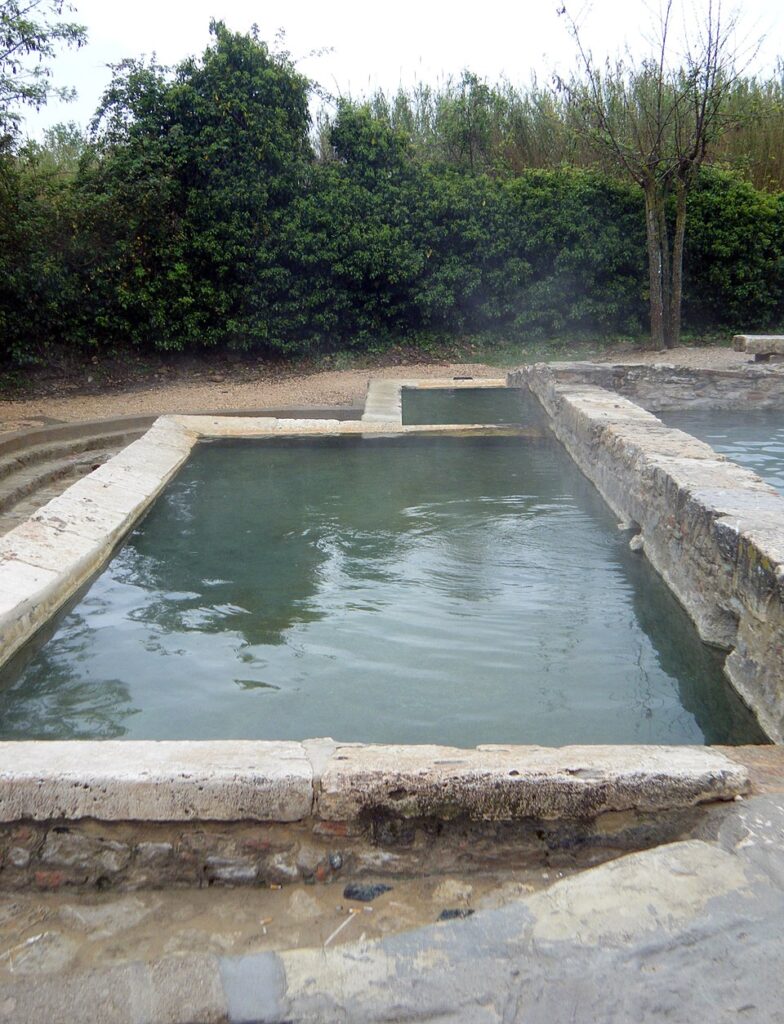
Recent archaeological excavations in the bath started in 2018.[2] The bath was part of a sanctuary that was originally built by the Etruscans at a hot water spring and later extended under the Romans into a spa complex. The sanctuary was in use until the end of the fourth century. It consisted of a temple like structire with two columns and a bath behind. The complex was adorned with marble statues. The largest showed Apollo of the Sauroktonos type. Its head is missing. The god is naked and standing while holding a lizard. Lizards were regarded as healers for eye problems. So this statues shows the god as healer.[3] The spring is still used today and was renovated over the last centuries for several times. Its ancient name was Flere Havens and is mentioned on the inscriptions of altars and statues found. It is also the name of the spring goddess.[4] Fortuna Primigenia and Apollo were the gods that protected the spring. They are mentioned on altar inscriptions as well as on the bronzes found.[5] Many of the bronzes found there show body parts or even the viscera, those body parts that got ill and should have been cured. Many inscription on these bronzes are in Etruscan and Latin and provide the names and origin of the people that came here to be cured.[6] The bronzes were most likely made by local artists.
- One striking figure shows one half of a male body split in the middle. Only the genitals are complete. The statue evidently showed that body part that needed healing. Similar examples are so far only known in terracotta. An inscriptions names Gaius Rosciius as donor.[7]
- The largest bronze statue found shows Apollo as an archer, made around 100 BC. The god is depicted naked with his hands once holding a bow and an arrow (both gone now) in the position to shoot.[8]
- Several statues bear inscriptions in Etruscan. One head was dedicated by Aule Marcni Clantisa. A second head was dedicated by Nufre, son of Aule. He most likley came from the Nufrzna family that was based in the Etruscan town of Perugia.[9]
- One statue shows a naked man. The arms of the person shown are very slim. A foot is malformed. It has been suggested, that this shows an ill man. The inscription names the donor, who was Etruscan and called Lucious Marcius Grabillo. The text mentions also the donation of six further statues and six legs to the spring. Lucious Marcius Grabillo evidently suffered from foot or leg problems.[10]
- A statuette shows a boy or a girl and dates to the 2nd century BC. The child has short hair and wears a tunic. The gender of the child is unclear. The short hair points to a boy, but the jewellery worn rather points to a girl. The child is holding a ball. An Etruscan inscription says that its donor was Arnth Fastntru from Chiusi [11]
- Massimo Osanna and Jacopo Tabolli (eds) (2025)ː The bronzes from San Casciano dei Bagni : a sensation from the mud : James-Simon-Galerie, Museumsinsel Berlin, 5 July – 12 October 2025 in collaboration with Martin Maischberger and Agnes Schwarzmaier, Antikensammlung, Staatliche Museen zu Berlin, ISBN 9783795490423
- ^ Top 10 Discoveries of 2023 Archaeology Magazine
- ^ Massimo Osanna, Jacopo Tabolli (eds) (2025), 48
- ^ Massimo Osanna, Jacopo Tabolli (eds) (2025), 52-53
- ^ Massimo Osanna, Jacopo Tabolli (eds) (2025), 70, 100
- ^ Massimo Osanna, Jacopo Tabolli (eds) (2025), 47-48
- ^ Massimo Osanna, Jacopo Tabolli (eds) (2025), 59-74
- ^ Massimo Osanna, Jacopo Tabolli (eds) (2025), 80
- ^ Massimo Osanna, Jacopo Tabolli (eds) (2025), 71, 103-104
- ^ Massimo Osanna, Jacopo Tabolli (eds) (2025), 68
- ^ Massimo Osanna, Jacopo Tabolli (eds) (2025), 65-67
- ^ Massimo Osanna, Jacopo Tabolli (eds) (2025), 79




