


PESHAWAR: Khyber Pakhtunkhwa has seen a series of jirgas from both the government and opposition sides over the last few months to discuss the precarious law and order situation in the province. However, little has changed on the ground in the face of spiraling terrorism.
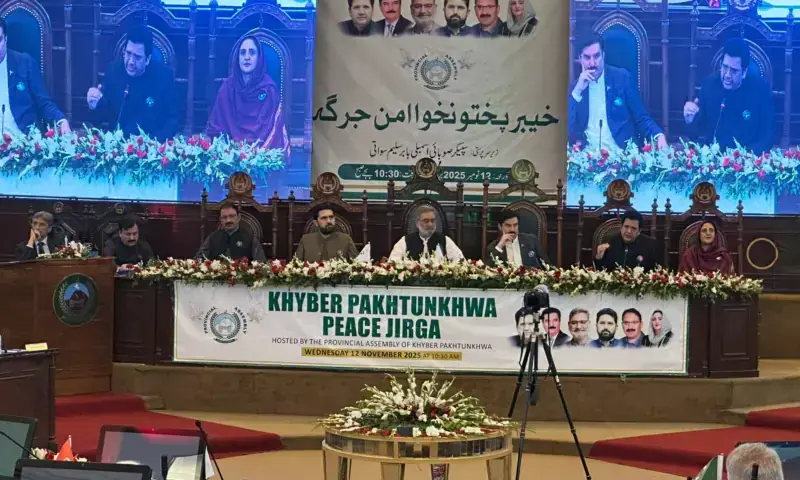
In contrast to the Khyber Pakhtunkhwa Peace Jirga, which was convened by the provincial government at the provincial assembly on Wednesday and attended by all political parties, the previous such gatherings were marred by the bad blood between the government and opposition, resulting in the boycott of each other’s events.
In December last year when the Kurram tribal district was in the throes of a violent conflict, provincial Governor Faisal Karim Kundi convened a jirga. The ruling Pakistan Tehreek-i-Insaf (PTI) boycotted the moot, which took place at the Governor’s House on December 5, accusing the Pakistan Peoples Party of working with the Pakistan Muslim League-Nawaz-led federal government to get it banned. It even got a resolution about it passed by the Balochistan Assembly.
The PTI insisted that unlike the PPP, it had a mandate from residents to rule KP and was performing its duties well.
Analysts insist such gatherings can build pressure but achieve nothing beyond that
Over the next months, as the law and order situation deteriorated, both the government and opposition again sprang into action and announced jirgas and multi-party conferences, yet both stopped short of showing a united front on the existential security issue.
In July this year, the then KP chief minister, Ali Amin Khan Gandapur, convened a multi-party conference.
However, major political parties, including Jamiat Ulema-i-Islam-Fazl, Awami National Party and PPP boycotted the gathering, calling it an eyewash.
The JUI-F arranged its own tribal jirga on July 13 to discuss peace in the region. It also held a similar event in Swat the same month.
Also, the Awami National Party organised the Qaumi Aman Jirga on July 28.
In August, the KP government started holding regional level jirgas to discuss peace in the merged tribal districts.
According to an official, at least four such jirgas with elders from Bajaur, Kurram and North and South Waziristan took place at the Chief Minister’s House.
In the aftermath of these gatherings, the official said that the then chief minister, Ali Amin Khan Gandapur, had planned to hold a grand jirga of tribal elders with the army chief.
However, Mr Gandapur lost the mantle of the province’s chief executive before he could have realised that.
Mohammad Sohail Afridi, after taking over as the chief minister, decided to hold another peace jirga, which, unlike the previous ones, was at least a well-attended one as no party boycotted it.
Though little has changed on the ground due to these jirgas, analysts view them as a tool that can help build pressure and, to some extent, allows people to vent.
Veteran nationalist politician Afrasiab Khattak told Dawn that the jirgas were taking place due to the fact that the government system was not working and people were forced to discuss law and order outside of government forums.
He said that jirgas could help build pressure but could do nothing beyond that.
“The Cold War between the Soviet Union and the West turned into a hot war for this region. Now again, a similar tussle between the United States and China could also result in a hot war for this region,” he said.
Mr Khattak said the state was more focused on international agendas than the local situation.
He added that the PTI, which ruled KP, was more interested in getting its detained founder, Imran Khan, released and was least bothered about what was happening in the province.
The nationalist politician said that he attended a jirga at the Governor’s House last year and found out that even the PML-N leaders were not ready to support the federal government’s stand regarding military operation.
“How a strategy of [military operations] could succeed when it lacks public support,“ he said, adding that the people of KP have grown tired of such operations and are not ready to support them.
Mr Khattak underscored the importance of engagement between KP and federal governments on security issues and dissension among both sides would result in further increasing terrorism.
Dr Faizullah Jan, a journalism professor at the University of Peshawar, noted that the provincial government was shifting its responsibilities to jirgas.
“Upon seeing its rhetoric go nowhere, the PTI is now trying to shift responsibilities. In the presence of parliament, there is no justification for holding jirgas as they lack any constitutional or legal authority,” he said.
Dr Jan questioned what mechanism a jirga had at its disposal to implement its decisions.
“Jirga has neither police nor army to implement its decisions,” he said.
The academic, however, said that the jirgas provided an outlet to alternate views or played a cathartic role by allowing people to vent their frustrations.
Published in Dawn, November 13th, 2025



