


Introduction
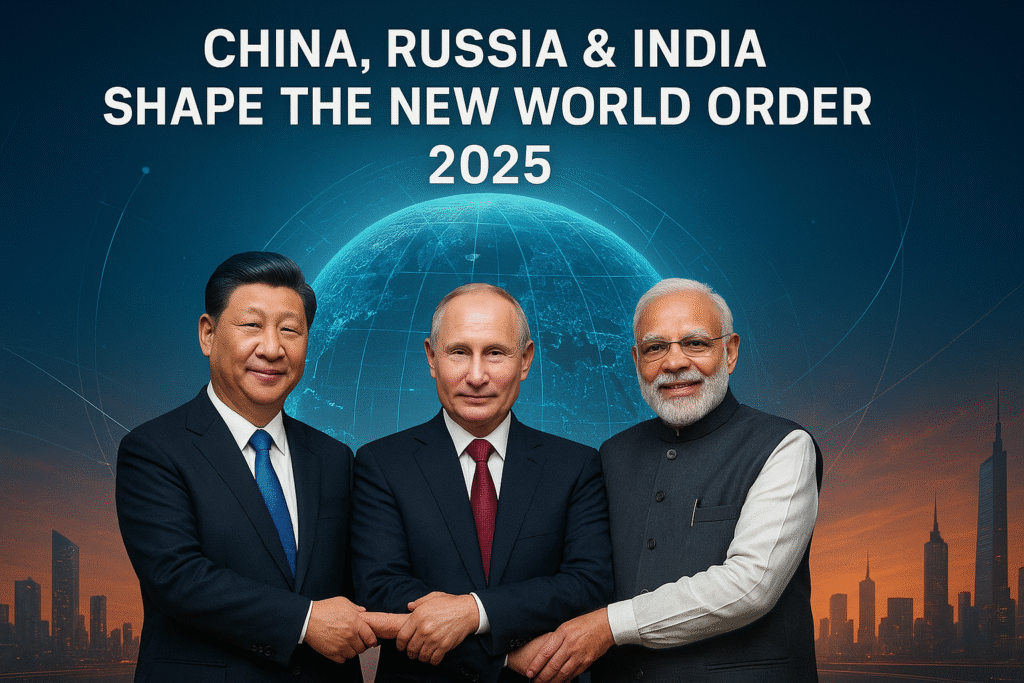
The year 2025 has opened with a dramatic shift in global politics. For decades, the United States and its Western allies dominated international institutions, trade, and military frameworks. But today, China, Russia, and India are positioning themselves as the core of a new world order—an alternative model built on multipolarity and strategic independence. This transformation is not just about political symbolism; it represents a deep restructuring of economic systems, alliances, and governance models that could redefine the next century.
China’s Ambition: From Regional Power to Global Architect
China has long pursued the goal of establishing itself as a global superpower, but 2025 marks a new phase. By hosting major summits under the Shanghai Cooperation Organization (SCO), Beijing has promoted ideas of multipolar governance and financial sovereignty.
At the latest summit, China pushed for:
- A new SCO development bank to reduce dependency on Western financial institutions.
- Digital infrastructure integration, linking Asia, Africa, and Eastern Europe.
- Expanded cooperation in artificial intelligence, 5G, and green energy projects.
President Xi Jinping’s narrative is clear: Western dominance is outdated, and emerging powers deserve an equal voice.
Russia’s Revival Through Strategic Alliances
Despite years of sanctions and strained relations with the West, Russia has successfully repositioned itself in 2025. Its partnership with China in energy and defense projects has kept Moscow economically relevant. Additionally, Russia’s inclusion in SCO and BRICS summits gives it the ability to influence global debates instead of being isolated.
Key Russian contributions to the new order include:
- Supplying energy security to Asian nations through pipelines and trade deals.
- Collaborating with China and India on defense technology.
- Supporting de-dollarization policies, reducing global reliance on the U.S. dollar.
This strategy has restored Russia’s seat at the geopolitical table, ensuring it remains a central player despite ongoing challenges.
India’s Balancing Act: Strategic Autonomy in Focus
Unlike China and Russia, India’s role is more complex. Historically aligned with both Western democracies and Asian blocs, India is now choosing strategic autonomy. Prime Minister Narendra Modi has made it clear that India supports a multipolar world but will not accept a China-led order uncritically.
India’s approach includes:
- Building strong ties with the Global South through BRICS and SCO.
- Advocating reforms at the United Nations Security Council to gain permanent representation for emerging economies.
- Promoting fair AI governance and global technology ethics.
This balancing act allows India to work with China and Russia while maintaining partnerships with the United States, Europe, and Japan.
BRICS: The Economic Backbone of the New Order
In 2025, BRICS (Brazil, Russia, India, China, South Africa) expanded with new members like Indonesia and Turkey, making it a dominant bloc in world affairs. Together, BRICS countries now represent:
- Nearly 40% of global GDP (PPP).
- Almost half of the world’s population.
- A strong voice in global trade, energy, and digital innovation.
One of the most significant moves is the de-dollarization initiative. BRICS nations are actively creating payment systems in local currencies, reducing dependence on the U.S. dollar for international trade. This shift directly challenges Western financial dominance.
Multipolar World vs. Western Hegemony
The central debate in 2025 is whether the U.S.-led unipolar world is fading. China, Russia, and India argue that Western institutions like the IMF, World Bank, and NATO no longer reflect global realities.
Differences in Vision
- China wants a governance system centered around Asia, with Beijing at the helm.
- Russia seeks legitimacy and relevance through alliances.
- India supports multipolarity but demands equal participation and transparency.
While they share the goal of reducing Western dominance, their visions differ—making cooperation both necessary and fragile.
Impacts on Global Politics and Economy
Decline of Dollar Dominance
With BRICS and SCO pushing for currency diversification, global trade is slowly moving away from the dollar. This reduces U.S. leverage in sanctions and financial controls.
Rise of the Global South
Countries in Africa, Latin America, and Southeast Asia now see BRICS as a platform to voice their needs, bypassing Western-led forums.
Security Realignments
Defense collaborations, joint naval exercises, and cyber agreements among China, Russia, and India show a shift away from NATO-centric security.
FAQs
Q1: What is the “new world order” in 2025?
It refers to a multipolar global system shaped by China, Russia, and India, challenging U.S.-dominated structures in politics, economy, and security.
Q2: Why are China, Russia, and India important in this shift?
Together, they represent massive economic power, population strength, and military capabilities—making them capable of reshaping international governance.
Q3: How does BRICS fit into this order?
BRICS serves as the economic engine of the new order, promoting trade reforms, de-dollarization, and representation for emerging nations.
Q4: Is Western dominance ending?
Not completely, but it is weakening. The U.S. and its allies remain powerful, yet they no longer enjoy unchallenged influence.
Q5: How does India balance its role?
India supports multipolarity while maintaining ties with Western democracies, ensuring it avoids over-reliance on China or Russia.
Final Thoughts
The China-Russia-India axis in 2025 is reshaping international politics. While challenges remain—such as rivalry between Beijing and New Delhi—their combined efforts mark the decline of a purely Western-led system. The new world order will likely be messy, multipolar, and competitive, but it reflects the realities of a diverse and interconnected global society.
Related : Writozy



