
MOS:NOPIPE, these are redirects
| ← Previous revision | Revision as of 19:20, 15 October 2025 | ||
| Line 31: | Line 31: | ||
|
==Early life==
|
==Early life==
|
||
|
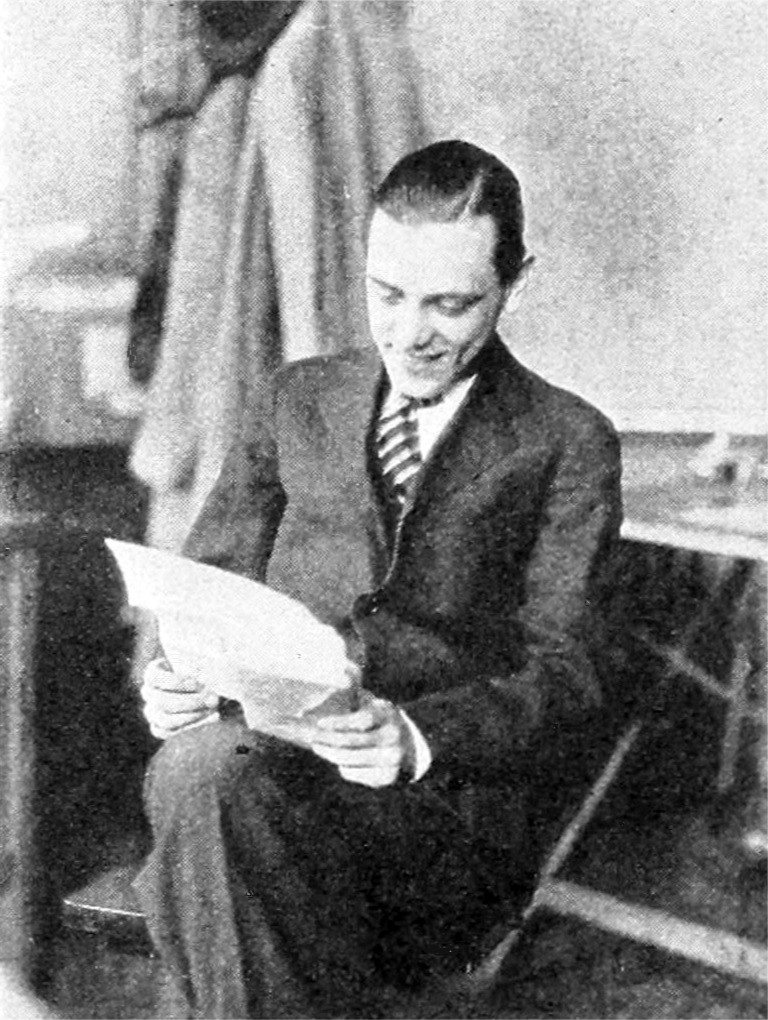
”’Cornelius Michael Maffie”’ was born on September 9, 1903, in [[St. Louis, Missouri]].<ref name=torgan>{{cite journal |last1=Klos |first1=Lloyd E. |date=January 1985 |title=Portrait of Con Maffie |journal=Theatre Organ |volume=27 |issue=1 |pages=13–18 |issn=0040-5531}}</ref> His mother and her family were highly musical: She was a harpist, and six of his uncles played in symphony orchestras.<ref name=torgan /> Uncle Antonio Sarli was for a time head of music at Warner Brothers.<ref name=torgan /> Cornelius began music lessons at the age of five. He studied under Ottmar A. Moll.<ref name=torgan /> His secondary education took place at [[
|
”’Cornelius Michael Maffie”’ was born on September 9, 1903, in [[St. Louis, Missouri]].<ref name=torgan>{{cite journal |last1=Klos |first1=Lloyd E. |date=January 1985 |title=Portrait of Con Maffie |journal=Theatre Organ |volume=27 |issue=1 |pages=13–18 |issn=0040-5531}}</ref> His mother and her family were highly musical: She was a harpist, and six of his uncles played in symphony orchestras.<ref name=torgan /> Uncle Antonio Sarli was for a time head of music at Warner Brothers.<ref name=torgan /> Cornelius began music lessons at the age of five. He studied under Ottmar A. Moll.<ref name=torgan /> His secondary education took place at [[Soldan High School]].<ref name=torgan /> He performed solos with the [[Boston Symphony]], the [[Minnesota Orchestra]], and the [[St. Louis Symphony]] when he was a teenager.<ref name=torgan /> He first studied organ with [[Charles Henry Galloway]], who was considered the “dean of St. Louis organists”.<ref name=torgan />
|
||
|
== Career ==
|
== Career ==
|
||
|
He moved to Chicago, and became a pianist for the [[Chicago Theater]].<ref name=”torgan” /> At this time changed his professional name to “Con Maffie”.<ref name=”torgan” /> He began playing organ for small theaters on [[
|
He moved to Chicago, and became a pianist for the [[Chicago Theater]].<ref name=”torgan” /> At this time changed his professional name to “Con Maffie”.<ref name=”torgan” /> He began playing organ for small theaters on [[Chicago’s south side]], from there progressing to Chicago theaters of increasing stature, including the Indiana Harbor, the [[Admiral Theatre]], the Roosevelt Theater, and the [[Riviera Theatre]].<ref name=”torgan” /> He then commenced a tour for [[Publix Theatres]] across the midwest and west coast.<ref name=”torgan” /> He next held engagements at the [[Paramount Theatre (New York City)|Paramount]] and [[Paradise Theater (Bronx)|Paradise]] theaters in New York.<ref name=”torgan” /> He then began another tour for [[Loews Theaters]] across the East Coast of the United States.<ref name=”torgan” /> In the mid-1930s he was heard over radio station [[WEPN (AM)|WHN]].<ref>{{cite news |author=<!–Staff writer(s); no by-line.–> |title=Sunday Radio Programs |url=http://fultonhistory.com/Newspaper%2018/New%20York%20NY%20Sun/New%20York%20NY%20Sun%201936/New%20York%20NY%20Sun%201936%20-%201676.pdf |work=[[The Sun (New York)|The New York Sun]] |location=New York, New York |date=June 27, 1936 |page=27|via=fultonhistory.com}}</ref> In 1937 he spent several months as the organist at the Loews Theater in [[Rochester, New York]].<ref name=”torgan” /> It was at this time that Maffie made his first [[phonograph record]]s.<ref name=”torgan” />
|
||
|
He moved to California in 1938, bringing his parents with him.<ref name=torgan /> Also moving to California was his Hammond electric organ, but this had to be shipped from New York to California by way of the Panama Canal.<ref name=torgan /> He began to play organ for various [[Golden Age of Radio|radio shows]], which included [[The Cresta Blanca Hollywood Players]], [[House Party (radio and TV show)|House party]], [[The Life of Riley]], [[Mayor of the Town (radio program)|Mayor of the Town]], [[Michael Shayne, Private Detective]] and [[The Passing Parade]].<ref name=torgan /> He formed a partnership with pianist Eugene LePique, creating a duo-piano show that also featured vocalists.<ref name=torgan />
|
He moved to California in 1938, bringing his parents with him.<ref name=torgan /> Also moving to California was his Hammond electric organ, but this had to be shipped from New York to California by way of the Panama Canal.<ref name=torgan /> He began to play organ for various [[Golden Age of Radio|radio shows]], which included [[The Cresta Blanca Hollywood Players]], [[House Party (radio and TV show)|House party]], [[The Life of Riley]], [[Mayor of the Town (radio program)|Mayor of the Town]], [[Michael Shayne, Private Detective]] and [[The Passing Parade]].<ref name=torgan /> He formed a partnership with pianist Eugene LePique, creating a duo-piano show that also featured vocalists.<ref name=torgan />
|
||

