


From Wikipedia, the free encyclopedia
Revision as of 07:58, 3 November 2025
Loneliest star in the Milky Way
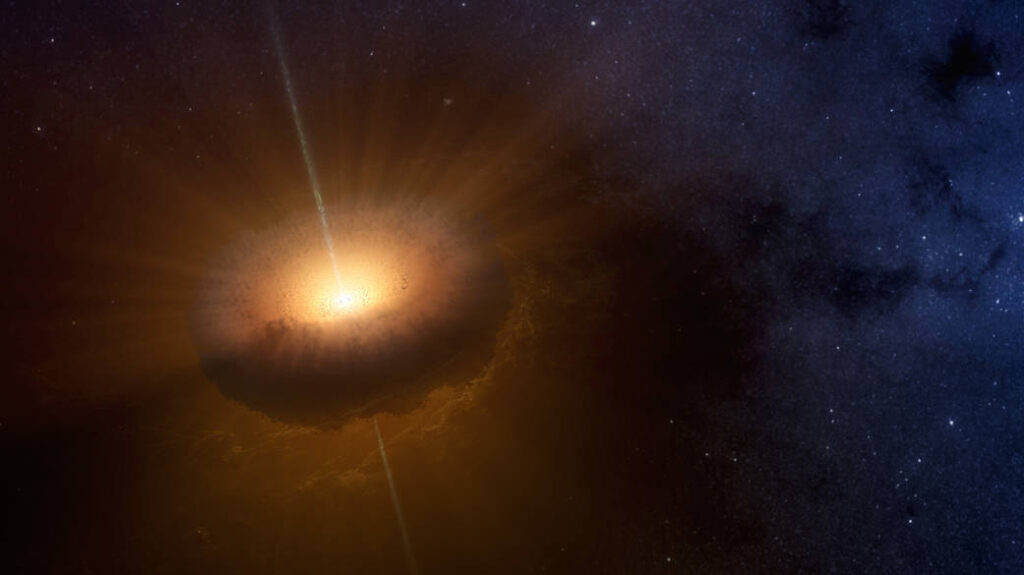
CX330 (also known as CXOGBS J173643.8-282122) is an extremely isolated young stellar object (YSO) located in the central bulge of the Milky Way, approximately 25,000 light-years from Earth. Identified in 2009 through its X-ray emission, it is the most isolated known young star, situated over 1,000 light-years from the nearest star-forming region (nearest star-forming region is NGC 6383 followed by Pipe Nebula and Corona Australis Molecular Cloud).[1] CX330 is a FU Orionis-type protostar undergoing episodic accretion outbursts, making it a unique laboratory for studying star formation in low-density environments.[3][4][5][6][7]
Discovery
CX330 was first detected in 2009 during a deep X-ray survey of the Galactic Center conducted with the Chandra X-ray Observatory. The source, cataloged as CXOGC J174713.2-284648, displayed hard X-ray emission characteristic of magnetically active pre-main-sequence stars.[5][1][8]
Follow-up infrared observations with the Spitzer Space Telescope (2007) and WISE (2010) revealed a dramatic brightening of over 2 magnitudes in the mid-infrared, confirming an accretion outburst.[5][9][10]
References
- ^ a b c d e f Britt, C. T.; Maccarone, T. J.; Green, J. D.; Jonker, P. G.; Hynes, R. I.; Torres, M. A. P.; Strader, J.; Chomiuk, L.; Salinas, R.; Lucas, P.; Contreras Peña, C.; Kurtev, R.; Heinke, C.; Smith, L.; Wright, N. J. (2016-08-11). “Discovery of a long-lived, high-amplitude dusty infrared transient”. Monthly Notices of the Royal Astronomical Society. 460 (3): 2822–2833. doi:10.1093/mnras/stw1182. ISSN 0035-8711.
- ^ “Simbad – Object view”. simbad.cds.unistra.fr. Retrieved 2025-11-01.
- ^ “The Loneliest Young Star – NASA”. Retrieved 2025-11-01.
- ^ “Loneliest Young Star Seen by Spitzer and WISE | aavso”. www.aavso.org. Retrieved 2025-11-01.
- ^ a b c “Loneliest Young Star Seen by Spitzer and WISE”. NASA Jet Propulsion Laboratory (JPL). Archived from the original on 2025-09-28. Retrieved 2025-11-01.
- ^ Staff, News (2016-07-28). “Astronomers Spot Loneliest Young Star | Sci.News”. Sci.News: Breaking Science News. Retrieved 2025-11-01.
- ^ “CX330: Distant (and Isolated) Star Formation | Centauri Dreams”. www.centauri-dreams.org. Retrieved 2025-11-01.
- ^ Strom, Marcus (2016-07-28). “CX330: Galaxy’s loneliest baby star discovered wandering far from stellar nurseries”. The Sydney Morning Herald. Retrieved 2025-11-01.
- ^ Contreras Peña, C.; Lucas, P. W.; Kurtev, R.; Minniti, D.; Caratti o Garatti, A.; Marocco, F.; Thompson, M. A.; Froebrich, D.; Kumar, M. S. N.; Stimson, W.; Navarro Molina, C.; Borissova, J.; Gledhill, T.; Terzi, R. (2017-03-01). “Infrared spectroscopy of eruptive variable protostars from VVV”. Monthly Notices of the Royal Astronomical Society. 465 (3): 3039–3100. doi:10.1093/mnras/stw2802. ISSN 0035-8711.
- ^ Udalski, A.; Szymański, M. K.; Szymański, G. (2015-04-22), OGLE-IV: Fourth Phase of the Optical Gravitational Lensing Experiment, arXiv, doi:10.48550/arXiv.1504.05966, arXiv:1504.05966, retrieved 2025-11-03




