


From Wikipedia, the free encyclopedia
Content deleted Content added
| Line 20: | Line 20: | ||
|
==Taxonomy== |
==Taxonomy== |
||
|
”Cyperus bipartitus” was named and described by the American botanist [[John Torrey]] in 1836.{{r|IPNI:303923-1}} |
”Cyperus bipartitus” was named and described by the American botanist [[John Torrey]] in 1836.{{r|IPNI:303923-1}} |
||
|
==Distribution and habitat== |
==Distribution and habitat== |
||
| Line 31: | Line 31: | ||
|
}} |
}} |
||
|
==Bibliography== |
|||
|
* {{cite journal |last1=Torrey |first1=John |title=Monograph of the North American Cyperaceae |journal=Annals of the Lyceum of Natural History of New York |date=1836 |volume=3 |pages=239–448 |url=https://www.biodiversitylibrary.org/part/201465 |access-date=12 January 2026}} |
|||
|
==External links== |
==External links== |
||
Revision as of 13:03, 2 February 2026
Species of plant endemic to North America
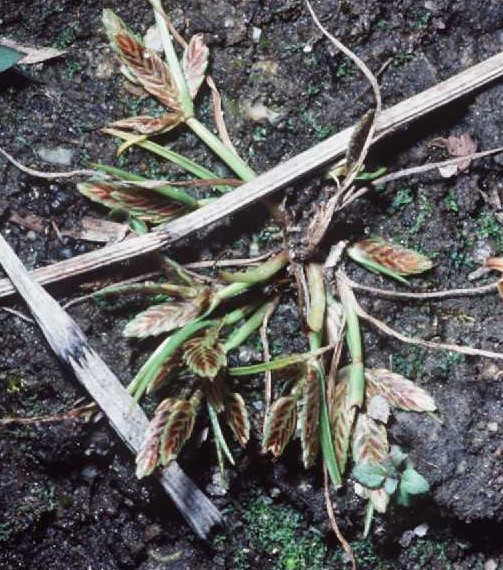
Cyperus bipartitus, commonly known as slender flatsedge, river cyperus, or the shining flatsedge, is a common species of sedge. The name “slender flatsedge” also applies to Cyperus gracilis.
Description
This is a small annual plant with fibrous roots and thin stems rarely exceeding about 25 centimetres (9.8 in) in height. There may be a one to three thin, short leaves around the base of the plant. The inflorescence is one to two centimeters long and holds several flat spikelets. These may be surrounded by long, leaflike bracts. Each spikelet contains flowers covered by dark reddish brown bracts. The achene fruit is a black disc about a millimeter wide.[3][4]
Taxonomy
Cyperus bipartitus was named and described by the American botanist John Torrey in 1836.[1] Its type specimen was collected in New Orleans.
Distribution and habitat
C. bipartitus is native to the Americas, where it is found widely distributed from north to south in wet environments, such as lakes, sandbars, and ditches from elevations of 30 metres (98 ft) to 1,140 metres (3,740 ft).[2][6]




