


From Wikipedia, the free encyclopedia
Content deleted Content added
|
|
|||
| Line 2: | Line 2: | ||
|
{{Speciesbox |
{{Speciesbox |
||
|
| name = Congo Igloo spider |
| name = Congo Igloo spider |
||
|
| image = Diores triarmatus 304468628 548883378.jpg |
|||
|
| image = |
|||
|
| image_caption = |
| image_caption = |
||
|
| image2 = Diores triarmatus 304468628 548882598.jpg |
|||
|
| status = LC |
|||
|
| image2_caption = Female |
|||
|
| status_system = SANBI |
|||
|
| taxon = Diores triarmatus |
| taxon = Diores triarmatus |
||
|
| authority = Lessert, 1929<ref name=”lessert1929″ /> |
| authority = Lessert, 1929<ref name=”lessert1929″ /> |
||
| Line 21: | Line 21: | ||
|
== Description == |
== Description == |
||
|
{{see also|Glossary of spider terms}} |
{{see also|Glossary of spider terms}} |
||
|
<gallery mode=packed heights=140px> |
|||
|
Diores triarmatus 304468628 548883252.jpg|female |
|||
|
</gallery> |
|||
|
Males of ”Diores triarmatus” have a total length of 4.87 mm, while females are larger at 5.62 mm. The [[carapace]], [[chelicerae]], and legs are yellowish-orange, with the sternum being yellow. Males have a dark sepia scutum on the [[opisthosoma]]. Females have similar carapace coloration but lack the scutum, instead having a pale dorsal pattern on a dark background. The sides are sepia with an oblique pale patch, and the venter is pale.<ref name=”jocque1990″ /> |
Males of ”Diores triarmatus” have a total length of 4.87 mm, while females are larger at 5.62 mm. The [[carapace]], [[chelicerae]], and legs are yellowish-orange, with the sternum being yellow. Males have a dark sepia scutum on the [[opisthosoma]]. Females have similar carapace coloration but lack the scutum, instead having a pale dorsal pattern on a dark background. The sides are sepia with an oblique pale patch, and the venter is pale.<ref name=”jocque1990″ /> |
||
Latest revision as of 15:57, 6 October 2025
Species of spider
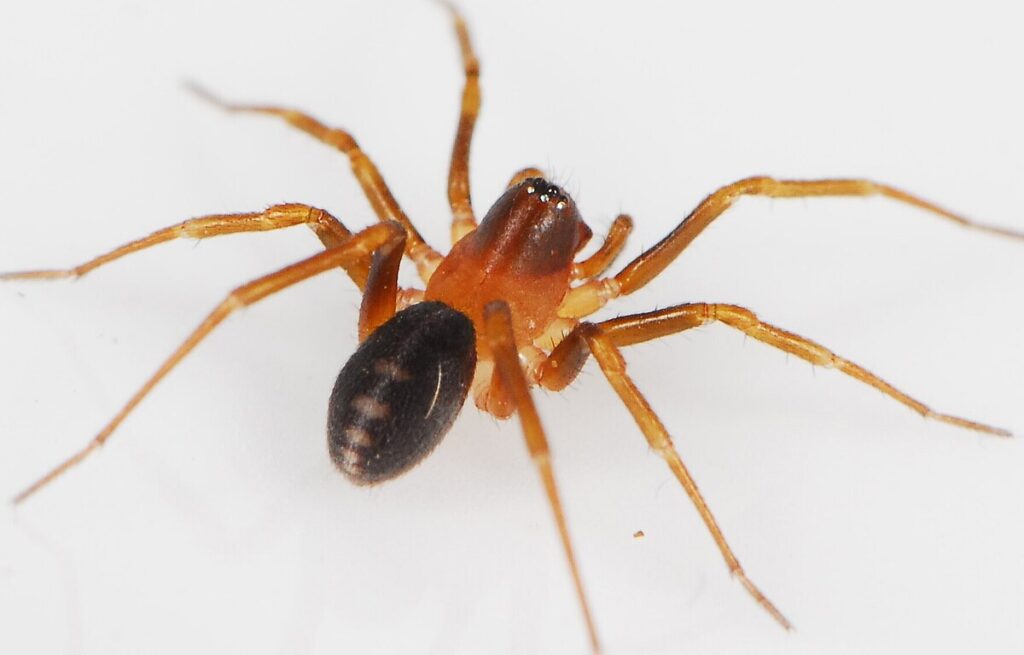
Diores triarmatus is a species of spider in the family Zodariidae.[2] It occurs in Africa and is commonly known as the Congo Igloo spider.[3]
Diores triarmatus is found in Botswana, Democratic Republic of the Congo, Tanzania, Uganda, South Africa, and Zambia.[2] In South Africa, it has been recorded from three provinces: Gauteng, Limpopo, and Mpumalanga.[3]
The species inhabits the Savanna biome at altitudes ranging from 275 to 1124 m above sea level.[3]
-

female

Males of Diores triarmatus have a total length of 4.87 mm, while females are larger at 5.62 mm. The carapace, chelicerae, and legs are yellowish-orange, with the sternum being yellow. Males have a dark sepia scutum on the opisthosoma. Females have similar carapace coloration but lack the scutum, instead having a pale dorsal pattern on a dark background. The sides are sepia with an oblique pale patch, and the venter is pale.[4]
Diores triarmatus are free-living ground-dwellers that construct igloo-shaped retreats with small stones, characteristic behavior of the genus Diores.[3]
The species is listed as Least Concern due to its wide range across Africa. It is protected in Tswaing Nature Reserve, Ben Lavin Nature Reserve, and Kruger National Park.[3]
- ^ Lessert, R. de (1929). “Araignées du Congo recueillies au cours de l’expédition organisée par l’American Museum (1909-1915). Troisième partie”. Revue Suisse de Zoologie. 36 (1): 103–159.
- ^ a b “Diores triarmatus Lessert, 1929”. World Spider Catalog. Retrieved 20 September 2025.
- ^ a b c d e Dippenaar-Schoeman, A.S.; Jocqué, R.; Haddad, C.R.; Foord, S.H.; Lotz, L.N. (2024). The Zodariidae of South Africa. Part 1 (A-D) version 1. South African National Survey of Arachnida Photo Identification Guide. p. 86. doi:10.5281/zenodo.14404920. Retrieved 20 September 2025.

- ^ Jocqué, R. (1990). “A revision of the Afrotropical genus Diores (Araneae, Zodariidae)”. Annales, Musée Royal de l’Afrique Centrale, Sciences zoologiques. 260: 1–81.




