


American poet, historian, and performer
|
Donald Sidney-Fryer |
|
|---|---|
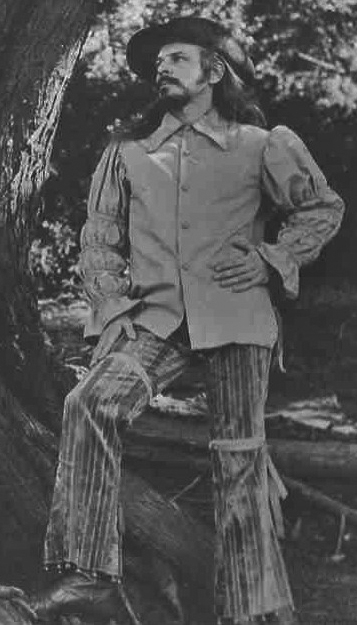
 Donald Sidney-Fryer in troubadour costume, 1971 photo by John Frazer, |
|
| Born |
Donald Sidney Fryer, Junior (1934-09-08)September 8, 1934 |
| Pen name |
|
| Occupation |
|
| Education | |
| Genres | |
| Literary movement | |
| Years active | 1961–present |
| Notable works | |
| Spouse |
Gloria Kathleen Braly (divorced) |
Donald Sidney-Fryer (born September 8, 1934) is an American poet, literary historian, literary critic, ballet historian, and performer. Edmund Spenser and Clark Ashton Smith are his “two poetic mentors.”[1] Sidney-Fryer sees his poetry as part of a “Modern Romanticism” tradition along with Ambrose Bierce, George Sterling, Nora May French, Clark Ashton Smith, and other poets he calls the “California Romantics”.[2] Poet Richard L. Tierney said Sidney-Fryer’s poems “make us see … the ideals that moved us when we were less ‘secure’ and more human: adventure, love of life, and above all, the intricate beauty of a world long vanished—yet not vanished, if only we had eyes to see.”[3] As a literary historian and critic, Sidney-Fryer focuses on California literature and writers. He has been called “the pre-eminent scholar of [Clark Ashton Smith]’s work.”[4] Literary historian Scott Connors elaborated: “Sidney-Fryer not only established the foundations for all future scholarship in this field, but he also wrote some of the most insightful and valuable evaluations of Smith’s oeuvre ever written.”[5] As a historian of ballet, Sidney-Fryer’s major work is The Case of the Light Fantastic Toe, using the fifty-year career of ballet composer Cesare Pugni to tell the history of Romantic Ballet in five volumes, described as “deserv[ing] to be in every college music library.”[6] Sidney-Fryer also promoted poets and poetry by writing and starring in one-man shows throughout the United States and Great Britain, often appearing in an Elizabethan English costume and billing himself as “the last of the courtly poets.”[7]
Marine Corps service and education
[edit]
Sidney-Fryer was born and raised in the Atlantic coastal city of New Bedford, Massachusetts. He was originally named Donald Sidney Fryer, Junior, but early in life dropped the “Junior” and added a hyphen between his middle and last names.[8]
After graduating from high school, Sidney-Fryer could not afford to go to college. He knew the United States G. I. Bill would pay for college after military service, so to further his education he enlisted in the United States Marine Corps in October 1953.[9] In the Marines, in the three libraries at Naval Air Station Jacksonville, Florida, Sidney-Fryer first began reading science fiction.[10] Then he was transferred to the Marine Air Station at Opa-locka (today the Coast Guard Air Station Miami).[11] At the Opa-locka base library, Sidney-Fryer first read the works of Arthur C. Clarke, August Derleth, H. P. Lovecraft, Robert E. Howard, and Clark Ashton Smith. He was especially affected by Smith’s story “The City of the Singing Flame”:
Emotionally and spiritually this last narrative, written in quite a remarkable and highly poetic prose, the like of which I had never encountered before, bowled me over and knocked me down, not just because of the colorful, vivid, and intense imagination that had shaped the story but equally because of the uncommon vocabulary without which the story could not have come into existence. Because I had studied Latin, French, and English each for four years in high school, particularly Latin, the vocabulary per se gave me no real problem. However, I had almost never before encountered such uncommon words, obviously Latinate, employed in a piece of fiction …[12]
On September 5, 1955, Sidney-Fryer was transferred to Marine Corps Air Station El Toro in Orange County, California.[13] In the base library there, he was impressed by The Collected Writings of Ambrose Bierce.[14]
In September 1956, Sidney-Fryer began studies at the University of California, Los Angeles. He initially majored in theatre arts and minored in French. In the evenings he studied ballet under Tatiana Riabouchinska, formerly with the Ballets Russes, and her husband David Lichine. He had performing in mind: “Even if I could not have become a ballet dancer at twenty or twenty-one, I knew the value of rigorous dance training in shaping a capable all-around performer.” After two years, he changed his major to French and minor to Spanish, thinking he would become a teacher of languages.[15]
Early literary work
[edit]
Sidney-Fryer used the libraries of UCLA to investigate the history and creators of Romantic Ballet, which flourished from 1827 to the late 1800s. He took note of composer Cesare Pugni, who wrote symphonies, ten operas, forty masses, and more than three hundred ballet scores. Little had been published about Pugni and his works. Sidney-Fryer began compiling the names of Pugni’s ballet scores and data about them. In addition to his own research, he hired researchers in London and Milan to uncover more information. Sidney-Fryer assembled the information as Cesare Pugni, 180?-1870: Checklist of Ballets and self-published a limited number of copies. A publisher in Italy then paid Sidney-Fryer to include his checklist in volume seven of its Enciclopedia dello Spettacolo in 1961.[16]
On August 26 and 27, 1958, Sidney-Fryer visited Clark Ashton Smith and his wife Carol in their home in Pacific Grove, California. Sidney-Fryer recalled, “when I asked him what poet meant to him what [Smith] meant to me, he turned around to a bookcase behind him and picked out a volume that had a dark blue Art Nouveau cover with a pictorial design and printing etched in silver: The House of Orchids [and Other Poems] (1911), by George Sterling.” Sterling’s verses impressed Sidney-Fryer deeply.[17]
On Friday, September 5, 1959, he returned to the Smiths’ home in Pacific Grove for a second visit. That first night he stayed at a motel, but the Smiths offered for Sidney-Fryer to stay with them for the remainder of his visit. The two men passionately discussed literature for hours. Smith had a copy of an extremely rare bibliography of his fiction, and gave Sidney-Fryer permission to use Smith’s own typewriter in his own study to type a copy of the bibliography for Sidney-Fryer’s use. Sidney-Fryer left the Smiths on September 9. The bibliography Sidney-Fryer typed was Thomas G. L. Cockcroft’s The Tales of Clark Ashton Smith: A Bibliography. Sidney-Fryer corresponded with Cockcroft about Smith’s writings. Then Sidney-Fryer began to research and write a bibliography of all of Clark Ashton Smith’s writings, a project which would take him years to complete. In the autumn of 1960, he met Forrest J. Ackerman, who helped Sidney-Fryer track down many Smith writings published in fantasy and science fiction fan publications.[18]
In February 1961, Sidney-Fryer met Fritz Leiber and his first wife Jonquil, who became close friends and encouraged his Smith research. Leiber urged Sidney-Fryer to read Edmund Spenser’s epic fantasy poem The Faerie Queene, which changed his life:
The Faerie Queene proved a great shock and a great revelation, as great as had the writings of Clark Ashton Smith, but it was the poetry of Spenser that gave me the impetus to write my first poetry since the juvenilia I had composed in late grammar school and early high school. The Leibers encouraged me just as much in my own writing as in my Smith research.[19]
Inspired by The Faerie Queene, in March 1961 Sidney-Fryer began to write poetry. In September 1964 he received his bachelor’s degree in French from UCLA. In addition to English, French, Spanish, and Latin, Sidney-Fryer had also learned German, Russian, and Greek.

He received permission from Clark Ashton Smith’s widow Carol to research and assemble a collection of Smith’s prose poems, which he completed in 1964. For the collection’s introduction he wrote a history of prose poems and Smith’s achievements in that field.[20] In June 1965, Sidney-Fryer’s anthology of Smith’s prose poems was published as Poems in Prose by Arkham House, which had published volumes by H. P. Lovecraft, Robert E. Howard, and Smith.[21]
In the middle of the year he moved to Auburn, California (Clark Ashton Smith’s hometown). That year Sidney-Fryer completed his bibliography of Smith’s writings.[22] In the mid-1960s He found a publisher willing to publish the bibliography, but the publisher would take more than ten years to bring it out.[23]
He moved to San Francisco in January 1966. He would live in San Francisco until 1975. He met and fell in love with dental hygienist Gloria Kathleen Braly. After two years of living together they married in 1969 and lived in an open marriage. After two years of marriage, they divorced.[24]

After the success of the Clark Ashton Smith anthology Poems in Prose Sidney-Fryer edited, he suggested to publisher August Derleth a successor project, a collection of all known uncollected stories by Smith. Publisher Derleth accepted the idea, and the collection was published as Other Dimensions in 1970.[25] For unknown reasons, Sidney-Fryer was not credited as editor in the published book.

After ten years of work, Sidney-Fryer completed his first book of poetry. Songs and Sonnets Atlantean was published by Arkham House in 1971.
“Starting around 1970 or somewhat earlier” Sidney-Fryer wrote and performed one-man shows on literary topics.[26] He gave his first performances in schools and libraries in San Francisco, then expanded to eventually perform his literary dramas more than 100 times across the United States and Great Britain in more than 50 universities as well as in libraries, bookstores and theaters.[27] Sidney-Fryer’s solo performances generated acclaim and coverage in newspapers and magazines.
“It’s a new kind of dramatic literary art,” said Professor Celeste Turner Wright, University of California. “It is not a reading. It is not a play. Instead, this talented young performer becomes, temporarily, each of the characters described in his selections from Spenser’s Faerie Queene.”[28]
Sidney-Fryer’s desire to write and perform solo shows was “… instigated in particular by my desire to demonstrate something of Spenser’s essence by dramatizing selected excerpts from his transcendent epic The Faerie Queene, chiefly parts of “The House of Pride” (Cantos IV and V of Book II) and above all the first half of Canto I of Book I. The latter turned into my most viable dramatization, because it forms a complete narrative or episode with a beginning, a middle, and an end—something comparatively rare in Spenser’s epic.” Another play, based on Cantos XI and XII of Book I of The Faerie Queene, was titled St. George and the Dragon and advertised as “The Greatest Fight of ALL Time!”. It became the most often performed of Sidney-Fryer’s solo performances.[29]
He toured England and Wales, performing for three months ending in “early spring 1972.”[30] After his British tour, he visited Ireland to see the ruins of Kilcolman Castle, where Spenser had lived for ten years in Ireland, and where he wrote The Faerie Queene.[31]
Sidney-Fryer had a Renaissance-style bass lute made so he could incorporate music and songs into his performances. He turned “’Duandon,’ a magical-musical-mystery tour de force (narrative) by George Sterling” into a performance, with success: “How did the audience respond overall? Gratifyingly, with thunderous clamor and loud applause mixed with hoots and hollers of approbation.”[32]
His performance The Golden-Tongued Romantics: Romantic Poetry Past and Present enabled him to dramatize poetry from romantic poets from Spenser, Coleridge, Tennyson, and Swinburne through George Sterling, Clark Ashton Smith, and other California poets, ending with a few poems by Sidney-Fryer himself.[33] He teamed with Fritz Leiber, Margo Skinner, G. Sutton Breiding, and Marie Boker in the joint performance California Romantics.[34]
Sidney-Fryer’s dramatic performances gave thousands of audience members a new appreciation of his literary heroes: Edmund Spenser, William Shakespeare, the English Romantic poets, and the California Romantic poets, especially Clark Ashton Smith and George Sterling.
1978-1990: Clark Ashton Smith scholarship
[edit]
In mid-1975 Sidney-Fryer left San Francisco and moved to the Oak Park neighborhood of Sacramento.[35] He continued to research and write about Clark Ashton Smith, George Sterling, and other writers for a variety of publications, including ten papers for issues of the scholarly annual The Romantist between 1977 and 1986.

In 1978, Sidney-Fryer’s bibliography of the writings of Clark Aston Smith was finally published. Sidney-Fryer titled the book Emperor of Dreams: A Clark Ashton Smith Bibliography after the opening line of Smith’s most famous poem, “The Hashish-Eater”: “Bow down: I am the emperor of dreams.” Sidney-Fryer made Emperor of Dreams a treasury of information about Smith and his writings: “I purposed it as more than just a bibliography: It would also be a compendium of all kinds of information about C.A.S. . . .”[36] He enlisted other writers to write about Smith, including Ray Bradbury, Stanton A. Coblentz, Avram Davidson, August Derleth, Harlan Ellison, Fritz Leiber, Sam Moskowitz, H. Warner Munn, E. Hoffmann Price, and more. Literary critic S. T. Joshi called Emperor of Dreams “a towering work of research,” and Ashton Smith scholars David E. Schultz and Scott Connors considered Emperor of Dreams “The foundation upon which all Smith scholarship rests.”[37]
After Clark Ashton Smith’s death in 1961, his widow Carol had entrusted Sidney-Fryer’s friend Robert A. “Rah” Hoffman with Smith’s private literary notebook, used by the author from 1929 for more than thirty years until his death. Hoffman and Sidney-Fryer spent months deciphering Smith’s handwriting and transcribing the text. Then they wrote introductory material and an index. Sidney-Fryer obtained supplementary material from poet Marvin R. Hiemstra and Smith’s close friend George F. Haas.[38] The resulting book, The Black Book of Clark Ashton Smith, was published by Arkham House in 1979. Although edited by Sidney-Fryer and Hoffman, for unknown reasons they are not credited as editors in the book itself. Smith expert Ron Hilger wrote: “One of the most important research tools available to the Smith scholar … is The Black Book of Clark Ashton Smith.”[39]

A Vision of Doom: Poems by Ambrose Bierce, a collection of poems by Ambrose Bierce edited by Sidney-Fryer, was published in 1980 by Donald M. Grant, Publisher, Inc..
Next Sidney-Fryer edited three collections of Clark Ashton Smith short stories for publisher Pocket Books: The City of the Singing Flame (1981), The Last Incantation (1982), and The Monster of the Prophecy (1983). The Pocket Books collections were mass-market paperbacks of Smith’s fiction, so by editing them Sidney-Fryer expanded Smith’s audience to tens of thousands more readers than his prior publications.
In 1989, Greenwood Press published the anthology Strange Shadows: The Uncollected Fiction and Essays by Clark Ashton Smith. Sidney-Fryer edited the collection with Steve Behrends and Rah Hoffman. They persuaded author Robert Bloch to write an introduction.
In 1990, two Smith-related books edited by Sidney-Fryer were published: The Devil’s Notebook: Collected Epigrams and Pensées of Clark Ashton Smith and an annotated edition of Smith’s best-known poem, The Hashish-Eater. (In 2008, a second edition of the annotated The Hashish-Eater was published that included an audio CD with Sidney-Fryer reciting that poem and others by Smith.) In 1990 a third book, non-Smith-related, also was published. As Green as Emeraude: The Collected Poems of Margo Skinner, edited by Sidney-Fryer, included an introduction in which Sidney-Fryer described Skinner as one of the California Romantics.
1990-2013: poetry, nonfiction, and fiction
[edit]
In the 1950s, Sidney-Fryer began researching composer Cesare Pugni and the history of Romantic Ballet. In 1980 he began writing what he called his “magnum opus” of ballet history, The Case of the Light Fantastic Toe: The Romantic Ballet and Signor Maestro Cesare Pugni. He started writing the massive history in 1980, and focused primarily during the 1990s on writing that project. In August 1998 he moved from Sacramento to Los Angeles to share a home with his friend Rah Hoffman.[40] He continued to perform and to write smaller projects and poetry.
Sidney-Fryer later wrote: “The fifteen years that I passed with Rah in [the Los Angeles suburb of] Westchester turned unexpectedly into the single happiest period in my life, and certainly the most productive.”[41] Hoffman died in February 2013. Sidney-Fryer moved back to Sacramento in June 2013.
While living in Los Angeles, Sidney-Fryer had published his next two books of poetry, Songs and Sonnets Atlantean: The Second Series and Songs and Sonnets Atlantean: The Third Series. The third series volume was published by Phosphor Lantern Press, Sidney-Fryer’s own publishing company. He named his company after a line in a poem by Clark Ashton Smith:
Our phosphor lamps may serve as well as any
Along the rutted roads to Charon’s wharf.
Then in 2008, New York publisher Hippocampus Press released The Atlantis Fragments:The Trilogy of the Songs and Sonnets Atlantean, the three volumes of Songs and Sonnets Atlantean poems into a single omnibus volume. Over the next several years, Hippocampus published a steady stream of books by Sidney-Fryer, becoming his most frequent publisher.
With his friend Alan Gullette, Sidney-Fryer edited The Outer Gate: The Collected Poems of Nora May French. In addition to being the most complete collection of French’s poems, Sidney-Fryer wrote a lengthy 56-page introduction, providing extensive biographical information from Sidney-Fryer’s years-long friendship with Helen French Hunt, Nora May’s sister.[42] Dana Gioia, former chairman of the National Endowment for the Arts, called The Outer Gate “a major addition to the study of California literature.”[43]
British publisher Stanza in 2010 produced Not Quite Atlantis, a collection of Sidney-Fryer’s poems but for one exception not framed as surviving the collapse of the lost continent Atlantis. Most were translations by Sidney-Fryer from French poets or poems that he wrote to individual people, including Edmund Spenser, Clark Ashton Smith, George Sterling, August Derleth, Algernon Charles Swinburne, Ambrose Bierce, and other writers and friends.
In 2011 Sidney-Fryer self-published (under his Phosphor Lantern Press) The Golden State Phantastics: The California Romantics and Related Subjects, an anthology collecting 33 of his literary essays and reviews from the 1960s through the 2000s, plus one new essay about Nora May French and a new foreword. Sidney-Fryer’s goal for this book was “defining in critical terms the survival of not just the Late Romanticism from the 1800s but also the Modern Romanticism of the 1900s on into the twenty-first century.”[44] The book has been frequently cited by other authors writing about California history, literature, and writers. It was successful enough for Hippocampus Press to issue a second edition the next year.
His poetry has continued to appear in a variety of weird fiction and speculative poetry-oriented journals.
Sidney-Fryer’s verse is marked by a strong imagination, and a Francophilic focus. He is a strong believer in “pure poetry,” and practices formalist verse, having developing his own specific poetic form: the ‘Spenserian stanza-sonnet’.
He remains a prolific historian of 19th century ballet, and is an expert on the ballet theatre of the romantic era.
in May 2025, 91-year-old Sidney-Fryer suffered a stroke which necessitated his move to a nursing home.
Donald Sidney-Fryer Fellowship
[edit]
The Bancroft Library at the University of California, Berkeley awards an annual Donald Sidney-Fryer Fellowship to underwrite “scholarly use of primary source materials at The Bancroft Library related to the works of writers, poets, artists and their community collectively referred to as the West Coast Romantics. Notable members of this group, located in Northern California, include Ambrose Bierce, Jack London, Robinson Jeffers, Mary Austin, George Sterling, Clark Ashton Smith, Nora May French, Henry Lafler, James Marie Hopper, Gelett Burgess, Sinclair Lewis, and Xavier Martinez.”
- Songs and Sonnets Atlantean (Sauk City, WI: Arkham House, 1971).
- Songs and Sonnets Atlantean: The Second Series (Holicong, PA: Wildside Press, 2003).
- Songs and Sonnets Atlantean: The Third Series (Los Angeles: Phosphor Lantern Press, 2005).
- The Atlantis Fragments:The Trilogy of the Songs and Sonnets Atlantean (New York: Hippocampus Press, 2008) Omnibus edition of the three volumes of Songs and Sonnets Atlantean.
- Not Quite Atlantis: A Selection of Poems, (Hornsea, England: StanZa Press, 2010).
- Odds and Ends, a hundred-page collection of new poems, is included as an appendix in Hobgoblin Apollo: The Autobiography of Donald Sidney-Fryer (New York: Hippocampus Press, 2016).
- Ends & Odds, an 85-page section of uncollected poems, is included in Aesthetics Ho! Essays on Art, Literature, and Theatre (New York: Hippocampus Press, 2017).
- The Miscellaneon: Poems in Verse and Prose, is included in the 2019 edition of West of Wherevermore and Other Essays (New York: Hippocampus Press).
- Random Lines: Poems in Verse and Prose, a section of poems, is included in Random Notes, Random Lines: Essays and Miscellanea (New York: Hippocampus Press, 2021).
- Astral Debris: A Quiddity in Prose and Poetry (New York: Hippocampus Press, 2023).
- The Atlantis Fragments: The Novel first edition (Los Angeles: Phosphor Lantern Press, 2011); second edition (New York: Hippocampus Press, 2012).
- A King Called Arthor and Other Morceaux (New York: Hippocampus Press, 2020). ISBN 978-1-61498-294-4.
- A Checklist of the Ballet Scores of Cesare Pugni (Enciclopedia dello Spettacolo, Vol VIII, Rome, 1961).
- The Last of the Great Romantic Poets (Albuquerque, NM: Silver Scarab Press, 1973). On Clark Ashton Smith.
- Arthur Machen and King Arthur: Sovereigns of Dream (Albuquerque: Silver Scarab Press, 1976); published as half of Nyctalops double issue 11-12.
- Emperor of Dreams: A Clark Ashton Smith Bibliography (West Kingston, RI: Donald M. Grant, 1978).
- Clark Ashton Smith: The Sorcerer Departs (West Hills, CA : Tsathoggua Press, 1997).
- The Sorcerer Departs: Clark Ashton Smith (1893–1961) (Dole, France: Silver Key Press, 2007).
- The Golden State Phantasticks: The California Romantics and Related Subjects first edition (Los Angeles: Phosphor Lantern Press, 2011); second edition (New York: Hippocampus Press, 2012).
- Hobgoblin Apollo: The Autobiography of Donald Sidney-Fryer (New York: Hippocampus Press, 2016). ISBN 978-1-61498-167-1.
- West of Wherevermore and Other Essays (Auburn: Phosphor Lantern Press, 2016; New York: Hippocampus Press, 2019).
- Aesthetics Ho! Essays on Art, Literature, and Theatre (New York: Hippocampus Press, 2017). ISBN 978-1-61498-201-2.
- The Case of the Light Fantastic Toe: The Romantic Ballet and Signor Maestro Cesare Pugni, as Well as Their Survival by Means of Tsarist Russia [5 volumes plus index volume] (Los Angeles: Phosphor Lantern Press, 2018).
- Random Notes, Random Lines: Essays and Miscellanea (New York: Hippocampus Press, 2021).
- Gaspard de la Nuit: Fantasies in the manner of Rembrandt and Callot by Aloysius Bertrand (Encino, CA: Black Coat Press, 2004).
- Poems in Prose by Clark Ashton Smith (Sauk City, WI: Arkham House, 1965).
- Other Dimensions by Clark Ashton Smith (Sauk City, WI: Arkham House, 1970).
- The Black Book of Clark Ashton Smith (Sauk City, WI: Arkham House, 1979).
- A Vision of Doom by Ambrose Bierce (West Kingston, RI: Donald M. Grant, 1980).
- The City of the Singing Flame by Clark Ashton Smith (New York: Pocket/Timescape, 1981).
- The Last Incantation by Clark Ashton Smith (New York: Pocket/Timescape, 1982).
- The Monster of the Prophecy by Clark Ashton Smith (New York: Pocket/Timescape, 1983).
- (with Steve Behrends and Rah Hoffman) Strange Shadows: The Uncollected Fiction & Essays of Clark Ashton Smith (New York: Greenwood Press, 1989).
- (with Don Herron) The Devil’s Notebook: Collected Epigrams and Pensées of Clark Ashton Smith (Mercer Island, WA: Starmont House, Inc., 1990).
- As Green as Emeraude: The Collected Poems of Margo Skinner by Margo Skinner (Glen Ellen: Dawn Heron Press, 1990).
- The Hashish-Eater by Clark Ashton Smith; first edition (Sacramento: privately issued, 1990); second edition with audio CD (New York: Hippocampus Press, 2008).
- with Alan Gullette: The Outer Gate: The Collected Poems of Nora May French (New York: Hippocampus Press, 2009).
- with Ron Hilger: The Averoigne Chronicles by Clark Ashton Smith. (Lakewood, Colorado: Centipede Press, 2016).
Bibliography of plays
[edit]
Sidney-Fryer wrote and performed most of his solo dramatic performances during the 1970s and 1980s. This list of his one-man plays was compiled from references to them in newspapers, magazines, and Sidney-Fryer’s own writings, especially his autobiography, Hobgoblin Apollo, and “The Spenser Experiment”, his 1976 detailed recounting of creating and performing his first solo dramas.[45] Plays are arranged in chronological order with the years and places of their first known performance.
- title unknown (circa 1970, San Francisco) Half-hour dramatization based on the first half of Canto I of Book I of The Faerie Queene by Edmund Spenser. Sidney-Fryer called it “my most viable dramatization, because it forms a complete narrative or episode with a beginning, a middle, and an end—something comparatively rare in Spenser’s epic.”[46]
- The House of Pride (circa 1970, San Francisco) A two-hour show based on Cantos IV and V of Book II of The Faerie Queene.[47]
- In This the Reign of Elizabeth II (1971, San Francisco) Performances of “excerpts from Spencer and Shakespeare.”[48]
- title unknown (1972, San Francisco) “Developed a two-hour performance with “the first hour consisting of Spenser (excerpts from Cantos I, IV, and V of Book I [of The Faerie Queene]), and the second hour consisting of the California Romantics, ending with myself as the last and nominally modern representative.”[49]
- title unknown (1972, New Ash Green, Kent, England) Entire Proem of Book II of The Faerie Queene followed by poems from California Romantics.[50]
- St. George and the Dragon (1973, San Francisco) “… a two-hour dramatization (with intermission, of course) of Cantos XI and XII, those that end Book I” of The Faerie Queene.[51]
- title unknown (1974, San Francisco) On the poetry of George Sterling.[52]
- title unknown (1975 or 1976, Sacramento) At the Playwrights’ Theatre: “First, I performed the first half of Canto I of Book I from The Faerie Queene …; this occupied the first half-hour. Then I performed “Duandon,” a magical-musical-mystery tour de force (narrative) by George Sterling; this occupied the second half-hour. … How did the audience respond overall? Gratifyingly, with thunderous clamor and loud applause mixed with hoots and hollers of approbation.”[32]
- The Golden-Tongued Romantics: Romantic Poetry Past and Present (1976, Murfreesboro, Tennessee) Dramatization of poems by Edmund Spenser and romantic poets from Coleridge, Tennyson, Swinburne through California Romantics such as George Sterling and Clark Ashton Smith, [33]
- Ringing the Changes (1982, Sacramento) “I gave a special dramatization of the complete ‘Mutabilitie’ Cantos (VI and VII), the sole surviving fragment of Book VII [of The Faerie Queene], and under the legend of ‘Constancy.’ It takes a couple of hours to perform this dramatization.” Sometimes titled The Mutabilitie Cantoes.[47]
- An Elizabethan Hour (1984, Sacramento) Content unknown.[53]
- title unknown (2006, Sacramento) On the poetry of Clark Ashton Smith.[54]
- Four Fables by Clark Ashton Smith (2006, Sacramento).[55]
In addition to these solo plays, Sidney-Fryer wrote the group drama California Romantics, which was performed in 1982 in San Francisco by Sidney-Fryer, Fritz Leiber, Margo Skinner, G. Sutton Breiding, and Marie Boker.[34]
The Hashish-Eater and Other Poems by Clark Ashton Smith read by Donald Sidney-Fryer, music by Graham Plowman (Minneapolis: Fedogan & Bremer, 2018).
Darrell Schweitzer. “An Interview with Donald Sidney-Fryer”. The New York Review of Science Fiction (Aug 2010)
- ^ Quotation of Sidney-Fryer in Nick Glover, “Elizabethan Poet at MTSU: The Days of Dragons and Knights Visited,” “Accent” v. 3, n. 29 (April 15, 1979), pp. 12-13.
- ^ Donald Sidney-Fryer, “Foreword/Forward in a Phantastic Mode,” in The Golden State Phantastics: The California Romantics and Related Subjects first edition (Los Angeles: Phosphor Lantern Press, 2011); second edition (New York: Hippocampus Press, 2012); p. 5.
- ^ The Atlantis Fragmenets dust jacket (New York: Hippocampus Press, 2008).
- ^ David E. Schultz and Scott Connors, eds., Selected Letters of Clark Ashton Smith (Sauk City, Wisconsin: Arkham House, 2003), p. 384.
- ^ Scott Connors, “Introduction,” The Freedom of Fantastic Things: Selected Criticism on Clark Ashton Smith (New York: Hippocampus Press, 2006), p. 9.
- ^ Virginia Musician (March 9, 2019).
- ^ “Courtly Poet to Appear,” Murfreesboro TN Daily News Journal (October 12, 1976), p.8.
- ^ Donald Sidney-Fryer, “Biography of Donald Sidney-Fryer”, Nyctalops, v. 2 nos. 4/5, whole nos. 11/12 (April 1976), p. 57.
- ^ Sidney-Fryer, Hobgoblin Apollo: The Autobiography of Donald Sidney-Fryer (New York: Hippocampus Press, 2016), pp. 82-83.
- ^ Hobgoblin Apollo, pp. 90, 92.
- ^ Hobgoblin Apollo, p. 90.
- ^ Hobgoblin Apollo, p. 93.
- ^ Hobgoblin Apollo, p. 98.
- ^ Hobgoblin Apollo, p. 99.
- ^ Hobgoblin Apollo, pp. 106, 108-109.
- ^ Hobgoblin Apollo, pp. 112-114. Vittoria Ottolenghi, “Principali balletti con mus. Di P. e loro principali riprese,” in Enciclopedia dello Spettacolo v. 7 (Rome: Casa Editrice Le Maschere, 1961), pp. 587-589.
- ^ Hobgoblin Apollo, pp. 116-117, 122. Sidney-Fryer, “A Memoir of Timeus Gaylord: Reminiscences of Two Visits with Clark Ashton Smith, &c.,” Romanticist n. 2 (1978), pp. 1-19; reprinted in Sidney-Fryer, The Golden State Phantastics: The California Romantics and Related Subjects first edition (Los Angeles: Phosphor Lantern Press, 2011), pp. 123-163; second edition (New York: Hippocampus Press, 2012), pp. 117-155.
- ^ Donald Sidney-Fryer, Hobgoblin Apollo: Hobgoblin Run Away with the Wreath of Apollo: A Life of My Own. New York: Hippocampus Press, 2016, p. 126ff.
- ^ Hobgoblin Apollo, pp. 123, 181; “A Memoir of Timeus Gaylord”; Thomas G. L. Cockcroft, The Tales of Clark Ashton Smith: A Bibliography (Melling, Lower Hutt, New Zealand: self-published, 1951).
- ^ Hobgoblin Apollo, pp. 151, 165, 181-182; “A Memoir of Timeus Gaylord”. Sidney-Fryer’s introduction, “Clark Ashton Smith: Poet in Prose (1893-1961),” was reprinted in his 2011 book, The Golden State Phantastics: The California Romantics and Related Subjects.
- ^ June date: Donald Sidney-Fryer, Emperor of Dreams: A Clark Ashton Smith Bibliography (West Kingston, Rhode Island: Donald M. Grant, 1978), p. 244.
- ^ Hobgoblin Apollo, pp. 126ff, 151, 181-182.
- ^ Sidney-Fryer, Hobgoblin Apollo, p. 126.
- ^ Hobgoblin Apollo, pp. 151, 157, 174-177, 179; “A Memoir of Timeus Gaylord”.
- ^ Sidney-Fryer, Hobgoblin Apollo: The Autobiography of Donald Sidney-Fryer (New York: Hippocampus Press, 2016), p. 182.
- ^ Hobgoblin Apollo, pp. 190-191.
- ^ Sidney-Fryer began with three days of performances for English classes at Grace Cathedral School for Boys in San Francisco (Hobgoblin Apollo, p. 191.) More than 100 times: Hobgoblin Apollo, p. 191. More than 50 universities: “Courtly Poet Recites Spenser,” Ukiah Daily Journal (November 21, 1985), p. 6.
- ^ “Poet-Entertainer to Perform at KSC,” Kearney NB Daily Hub (January 16, 1978), p. 3.
- ^ Hobgoblin Apollo, p. 191. Early performance of St. George and the Dragon: “On the Town: Stage,” San Francisco Chronicle and Examiner Datebook (December 9, 1973), p. 3. Advertisement for St. George: Bellingham Washington Herald (March 25, 1979), p. 7F. For a detailed description of writing and performing St. George and the Dragon, see Margo Skinner, “Poetic Primer for Conduct”, San Francisco Examiner and Chronicle Datebook (December 18, 1977), p. 31.
- ^ Hobgoblin Apollo, p. 257.
- ^ Hobgoblin Apollo, p. 200.
- ^ a b Hobgoblin Apollo, pp. 196-197.
- ^ a b “Courtly Poet to Appear”, Murfreesboro Daily News Journal (October 15, 1976), p. 8.
- ^ a b “California Romantics,” San Francisco Chronicle and Examiner Datebook (November 14, 1982), p. 12.
- ^ Hobgoblin Apollo, p. 194.
- ^ Hobgoblin Apollo, p. 126.
- ^ S. T. Joshi, The Dark Eidolon and Other Fantasies (New York: Penguin Books, 2014), p. 366. David E. Schultz and Scott Connors, eds., Selected Letters of Clark Ashton Smith (Sauk City, Wisconsin: Arkham House, 2003), p. 393.
- ^ Hobgoblin Apollo, pp. 190, 221.
- ^ Ron Hilger and Donald Sidney-Fryer, “The Phosphor Lamps of Clark Ashton Smith,” Chronicles of the Cthulhu Codex n. 17 (Winter 2000), reprinted in Donald Sidney-Fryer, A King Called Arthor and Other Morceaux (New York: Hippocampus Press, 2020), p. 133.
- ^ Hobgoblin Apollo, pp. 204, 211.
- ^ Hobgoblin Apollo, p. 226.
- ^ Hobgoblin Apollo, p. 157.
- ^ Hippocampus Press page for The Outer Gate.
- ^ Sidney-Fryer, “Foreward/Forward in a Phantastick Mode,” The Golden State Phantasticks (Los Angeles: Phosphor Lantern Press, 2011), p. 5.
- ^ Donald Sidney-Fryer, “The Spenser Experiment”, Nyctalops, v. 2 nos. 4/5, whole nos. 11/12 (April 1976), pp. 74-77.
- ^ Hobgoblin Apollo, pp. 191, 196-197.
- ^ a b Hobgoblin Apollo, p. 191; “The Spenser Experiment”, p. 77.
- ^ “Last of the Courtly Poets,” San Francisco Examiner (March 20, 1971), p. 8.
- ^ Hobgoblin Apollo, p. 195; “A Birthday Reading of Faerie Queene”, San Francisco Chronicle (September 6, 1972), p. 7.
- ^ Hobgoblin Apollo, p. 199.
- ^ Hobgoblin Apollo, p. 191; “Poet to Perform Dragon Battle at 3 Libraries,” San Francisco Chronicle (December 3, 1973), p. 40; “On the Town: Stage,” San Francisco Examiner and Chronicle Datebook (September 2, 1973), p. 3. Described in detail in “The Spenser Experiment”, pp. 75-77. The title is sometimes spelled out as Saint George and the Dragon, “The Spenser Experiment”, pp. 75, 77.
- ^ “Stage Tonight,” San Francisco Examiner (October 23, 1976), p. 36.
- ^ “Breakaway Datebook: Stage,” Sacramento Union (September 20, 1984), p. 34.
- ^ ”Poetry,” Sacramento Bee, (February 10, 2006), p. X4.
- ^ “Poems for All,” Sacramento Bee (November 10, 2006), p. X6.



