


{{AfC submission|t||ts=20251203202816|u=MadisonCurtis|ns=118|demo=}}
<!– Note: The following pages were redirects to [[Extreme_Vetting_in_the_Trump_Administration]] before draftification:
*[[Draft:Immigration vetting under Donald Trump]]
–>
{{Draft article|nomove=yes}}
{{Draft article|nomove=yes}}
}}
}}
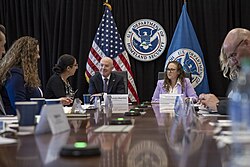
[[File:United States Department of Homeland Security on 2024-06-24 – 8.jpg|thumb|Picture of the current leadership of the United States Department of Homeland Security (the federal agency responsible for implementing immigration policies, including vetting procedures). ]]
[[File:United States Department of Homeland Security on 2024-06-24 – 8.jpg|thumb|Picture of the current leadership of the United States Department of Homeland Security (the federal agency responsible for implementing immigration policies, including vetting procedures). ]]
The concept of extreme [[vetting]] refers to intense immigration screening practices introduced by Donald [[Donald Trump|Trump]] during his [[Donald Trump 2016 presidential campaign|2016 presidential campaign.]] Implemented during his first administration, the term was initially used to describe a heightened scrutiny of visa applicants, refugees, and immigrants.<ref>{{Cite journal |last=Arafa|first=Mohamed A.|date=2018|title=A Question to the President of the United States, Donald Trump: Is It a Travel Ban, or a Muslim Ban, or a Travel Muslim Ban?|url=https://doi.org/10.2139/ssrn.3245550|journal=SSRN Electronic Journal|doi=10.2139/ssrn.3245550|issn=1556-5068}}</ref> Under the stated goal of “preventing terrorism,” extreme vetting procedures most evidently targeted those from Muslim-majority countries. While the phrase itself was new, scholars note that the policy arose from previous efforts to link immigration control with national security, notably after the [[September 11 attacks]]. Post-9/11 reforms, created of the [[United States Department of Homeland Security|Department of Homeland Security (DHS)]], expanded [[Biometric identification by country|biometric]] screening, increased interagency data sharing, and created the institutional and legal framework that later made extreme vetting possible.<ref>{{Citation |last1=Meissner |first1=Doris |title=Fragmentation in Unity: Immigration and Border Policy within DHS |date=2020-08-11 |work=Beyond 9/11 |pages=169–190 |url=https://doi.org/10.7551/mitpress/13831.003.0010 |access-date=2025-11-20 |publisher=The MIT Press |isbn=978-0-262-36134-7 |last2=Pope |first2=Amy |last3=Selee |first3=Andrew |doi=10.7551/mitpress/13831.003.0010 }}</ref>
The concept of extreme [[vetting]] refers to intense immigration screening practices introduced by Donald [[Donald Trump|Trump]] during his [[Donald Trump 2016 presidential campaign|2016 presidential campaign.]] Implemented during his first administration, the term was initially used to describe a heightened scrutiny of visa applicants, refugees, and immigrants.<ref>{{Cite |url=https://.org//|= |=..}}</ref> Under the stated goal of “preventing terrorism,” extreme vetting procedures most evidently targeted those from Muslim-majority countries. While the phrase itself was new, scholars note that the policy arose from previous efforts to link immigration control with national security, notably after the [[September 11 attacks]]. Post-9/11 reforms, created of the [[United States Department of Homeland Security|Department of Homeland Security (DHS)]], expanded [[Biometric identification by country|biometric]] screening, increased interagency data sharing, and created the institutional and legal framework that later made extreme vetting possible.<ref>{{Citation |last1=Meissner |first1=Doris |title=Fragmentation in Unity: Immigration and Border Policy within DHS |date=2020-08-11 |work=Beyond 9/11 |pages=169–190 |url=https://doi.org/10.7551/mitpress/13831.003.0010 |access-date=2025-11-20 |publisher=The MIT Press |isbn=978-0-262-36134-7 |last2=Pope |first2=Amy |last3=Selee |first3=Andrew |doi=10.7551/mitpress/13831.003.0010 }}</ref>
== Background ==
== Background ==
{{Draft categories|
{{Draft categories|
[[:Category:Wikipedia Student Program]]
[[Category:Wikipedia Student Program]]
[[:Category:Immigration to the United States]]
[[Category:Immigration to the United States]]
[[:Category:Presidencies of Donald Trump]]
[[Category:Presidencies of Donald Trump]]
}}
}}
{{Drafts moved from mainspace|date=December 2025}}
{{Drafts moved from mainspace|date=December 2025}}
{{Drafts moved from mainspace|date=December 2025}}

The concept of extreme vetting refers to intense immigration screening practices introduced by Donald Trump during his 2016 presidential campaign. Implemented during his first administration, the term was initially used to describe a heightened scrutiny of visa applicants, refugees, and immigrants.[1] Under the stated goal of “preventing terrorism,” extreme vetting procedures most evidently targeted those from Muslim-majority countries. While the phrase itself was new, scholars note that the policy arose from previous efforts to link immigration control with national security, notably after the September 11 attacks. Post-9/11 reforms, created of the Department of Homeland Security (DHS), expanded biometric screening, increased interagency data sharing, and created the institutional and legal framework that later made extreme vetting possible.[2]
Historians claim that the development of extreme vetting fits within a much broader pattern of racialized exclusion in American immigration law. As seen from the Chinese Exclusion Act to Cold War-era ideological screening, immigration scholars Paul Spickard, Cristina Beltran, and Laura Hooton state that U.S. policy has long defined “alienage” and national identity through categories of race, foreignness, and political loyalty.[3] Extreme vetting is understood not just as an isolated innovation, but as a contemporary extension of earlier security-based approaches that positioned certain groups as potential threats to the United States.
Campaign Origins and Policy Formation
[edit]
Extreme vetting as seen today emerged during the 2016 presidential race, when Trump called for “a total and complete shutdown of Muslims entering the United States” before reframing the proposal as “extreme vetting.”[4] Documentation of the administration shows a framing of the policy as a ‘national-security measure’ while critics argued that it functionally operated as a “Muslim ban.”[5] Trump’s early executive actions in 2017, including the first and second travel bans, additionally set the stage for expanded interview requirements, enhanced background checks, and increased social-media and identity screening.[6] This development became more apparent within the broader political and social dynamics of the 2010s, which included anxiety over terrorism, polarized debates about immigration, and global displacement crises.[7] Extreme vetting became both a framework for reshaping U.S. immigration enforcement as well as an expression of the country’s turn toward a more security-oriented focus on migration.
Policy Development and Implementation
[edit]
Policy development on extreme vetting during the Trump administrations has been followed through Executive Orders, Presidential Proclamations, administrative changes within the Department of Homeland Security (DHS) and the State Department (DOS), increased U.S. interagency coordination, and the refinement of the Controlled Application Review and Resolution Program (CARRP).[8]
.jpg)
Executive Orders and Presidential Proclamations
[edit]
Issued on January 27, 2017 this executive order immediately suspended entry for nationals from Iran, Iraq, Libya, Somalia, Sudan, Syria, and Yemen, halted refugee admissions, and reduced the refugee cap to no more than 50,000 admitted annually.[9]
Issued in March of 2017, this executive order revised the list of banned countries to remove Iraq and continue restrictions on Iran, Libya, Somalia, Sudan, Syria, and Yemen.[10]
Presidential Proclamation 9645
Released in September 2017, this document introduced the final Trump “Travel Ban” framework. It solidified country-specific restrictions to include Iran, Libya, Somalia, Syria, Yemen, North Korea, and certain categories of Venezuelan officials.[11]
Interagency Coordination and Department Adjustments
[edit]
Throughout the Trump administration, interagency coordination and communication between DHS, DOS, the Department of Justice (DOJ) and the Federal Bureau of Investigation (FBI) became increasingly integrated in regard to vetting. These agencies began creating and sharing databases, and developed interagency teams for identity verification protocols.
During this time, the State Department began collecting social media information on visa applicants. The department also began issuing expanded travel history questionnaires and requested extensive family intimation. Visa applicants report experiencing multiple rounds of administrative processing.[12]
The Controlled Application Review and Resolution Program (CARRP)
[edit]
First released under President Bush in 2008, the Controlled Application Review and Resolution Program functions through the Citizenship and Immigration Services Department of the United States (USCIS). In its early days, it sought to target applications labeled who were considered “national security concerns.” Without much attention from the general public, the program often remained largely unknown to applicants unless revealed in the event of litigation. In 2017, President Trump began to expand this preexisting CARRP program. This expansion contributed to future vetting systems of the Trump Administration.[13]
Applications may be flagged into the CARRP system due to name or partial-name matches with individuals in federal watchlist systems, travel histories connected to regions designated as security concerns, or familial, community, and organizational associations that appear in intelligence datasets. Additional triggers include inconsistencies or gaps in responses to questionnaires. Applicants with employment or academic affiliations considered sensitive or whose identity checks return data mismatches may also be flagged. Because flagging criteria is broad and sometimes related to an individual’s conduct, applications can be flagged even if they meet all statutory eligibility requirements.[14]
CARRP placements also include several categories that USCIS labels as national security concerns. These classifications include direct or indirect associations with individuals under federal surveillance, employment or student status at institutions considered potential intelligence risks, and inconsistencies in identity documents. Officers may also read into recent shifts in religious practice as reason to assume a potential national security concern.[15]
If an application is flagged or considered a potential security concern, it is removed from standard processing. Officers are unable to approve these cases until all flagged issues are fully resolved.[16] Resolution often requires interagency coordination, extending the time required to reach a resolution. Applicants often experience prolonged delays, repeated Requests for Evidence, extended periods of administrative processing, or stalled approvals following completed interviews. Applicant have further reported discovering that their application had been voided without their knowing. This was taken to court in WAGAFE v. Trump, as plaintiffs highlighted that they were never informed that they were placed into CARRP.
Filed in January of 2017 within the United States District Court for the Western District of Washington as docket 2:17-cv-00-94, Abdiqafar Wagafe and Mehdi Ostadhassan sought to sue President Trump for alleged use of a “secretive” vetting program to stall their immigration applications. At the time, Abdiqafar Wagafe, a Somali national and lawful permanent resident within the US, and Mehdi Ostadhassan, an Iranian national, both alleged to meet the statutory eligibility requirements for immigration benefits in the United States. Wagafe was seeking naturalization, and Ostadhassan sought an adjustment of status.
Wagafe and Ostadhassan co-signed as plaintiffs after facing similar challenges from USCIS’s CARRP program. They argued that CARRP was used as a mechanism of extreme vetting to stall and deny immigration applications to individuals from their native regions. They further asserted claims regarding the violation of the Immigration and Nationality Act of 1965 (INA), as well as violations of the Administrative Procedure Act (APA). Considering the protections of legal migrants under the constitution of the United States, Wagafe and Ostadhassan made additional claims including the failure of due process. As a result, they claim that they were deprived of the chance to challenge or substantively respond to their CARRP placement.
Claims and Alleged Violations
[edit]
Wagafe and Ostadhassan claim that despite individually meeting the statutory INA naturalization eligibility requirements, their applications were subjected to CARRP’s extreme vetting. They further state that this caused long delays for an effective non-decision status. Wagafe claims that after applying for citizenship in November of 2013, his application was delayed with no explanation. They also argued that CARRP imposes a substantive yet vague amount of additional criteria beyond what the INA has established for naturalization. They stated that an example includes labeling an applicant as a “national security concern” under vague or isolated metrics such as previous travel experience and the attainment of college degrees. They noted that such metrics violate the Uniform Rule of Naturalization Clause,[17] found in Article I, Section 8, Clause 4 of the U.S. Constitution.[18]
In addition to suing President Trump, the suit also seeks class action on behalf of the naturalization and adjustment of status applicants. Within both classes, this action seeks to advocate for applicants who have experienced a pending application for six months or longer. Plaintiffs expressly positioned the case against secret vetting policies such as alleged in CARRP along with proceeding extreme vetting programs of the Trump administrations.
Current Case Status
[edit]
As of December 2025, the case remains active with continuing litigation. Past updates have included a 2020 court issued discovery order,[19] and a 2017 class certification adjustment.[20]
The popular media portrayals of migrants during the Trump era were shaped by a political climate in which presidential rhetoric played a defining role.[21]Trump’s language, often amplified and frequently circulated across cable news, social media, and campaign events, shaped not only public attitudes toward migrants but also the political justification for restrictive immigration measures. Much of Trump’s rhetoric drew from isolated incidents to illustrate a generalized narrative national security threats.[22]

Study in Narrative Upscaling
[edit]
In his book, “The Truth About Immigration,” Zeke Hernandez highlights one such of these narratives on account of a young woman who was killed in the United States by an undocumented immigrant.[23][24] The day after the woman’s body was found, Trump circulated her story with the message, “A person came in from Mexico illegally and killed her. We need the wall, we need our immigration laws changed, we need our border laws changed.”[25] Trump freequently noted this tragedy within his migration rhetoric, invoking it as emblematic of a supposedly widespread threat posed by migrants. Centering national narratives about migration upon individual tragedies became central to Trump’s he framing of migration as inherently dangerous.[26] This pattern was further seen in his 2016 Victory Speech as he stated, “When Mexico sends its people, they’re not sending their best… they’re bringing drugs. They’re bringing crime. They’re rapists.”[27]
Linking Media Frames to Immigration Enforcement
[edit]
Statements like these were replayed across news cycles, shared on social media, and embedded into political advertising, reinforcing a media environment that depicted migrants primarily through frames of criminality and threat. Federal agencies responsible for immigration enforcement, primarily U.S. Immigration and Customs Enforcement (ICE) and U.S. Customs and Border Protection (CBP), justify deportation initiatives as necessary to protect the safety and security of American communities.[28] Within the Trump administrations, this framing was used to support intensified enforcement efforts and the revival of previously piloted programs designed to identify and remove undocumented immigrants.
One of the most expansive programs “Secure Communities“ (first piloted during the George W. Bush administration and later reactivated under President Trump) relied heavily on information-sharing between local law enforcement and federal immigration databases. The program used biometric data and local arrest records to check immigration status and facilitate removal proceedings. Trump officials frequently claimed that the program was responsible for the deportation of more than 43,000 “convicted criminal aliens” after its reinstatement.[28] However, independent analyses have shown that these figures overstated the program’s effectiveness and often conflated minor infractions with serious crimes, and have further challenged Trump’s assertions that increased cooperation with ICE has enhanced community safety. Studies comparing regions with “sanctuary” policies (those that decline to share certain data with federal immigration authorities), with regions that fully cooperated, found no meaningful differences in crime rates or in the number of arrests for reported crimes.[29] Research covering all fifty states between 2006 and 2015 found that undocumented immigrants were 33% less likely to be incarcerated than native-born citizens, while legal immigrants were 66% less likely to be imprisoned.[30] These trends have remained steady and stable in recent years.
Data Use and Public Interpretation
[edit]
Despite extensive evidence, Trump repeatedly circulated inflated or misleading statistics to support stricter enforcement. In 2019, he promoted a claim that “10,150 Americans were killed by illegal immigrants in 2018,” a figure that originated from a misrepresentation of a 2011 Government Accountability Office report and did not reflect actual crime data.[31] Such statements continued to reinforced the media environment in which singular incidents were highlighted as representative of migrant communities, contributing to public perceptions of widespread immigrant criminality, manifested in 42% of Americans associating immigrants with crime.[32]Scholars have underscored the power that portrayals shaped by presidential rhetoric have to shape stereotypes of immigrants, pointing to the public support of policies within extreme vetting. They have pointed to media coverage during the Trump administration to not merely reflected immigration policy debates, but aided in actively constructing them, showing the impact on public opinion and policy discourse even when the underlying claims lack statistical grounding.[33]
Criticism and Public Debate in the Trump Era
[edit]
Extreme vetting has remained a topic of public discussion both during and after the First Trump Administration, and has resurfaced during his current term, with differing opinions on its necessity and effectiveness.[34]

Justifications for Extreme Vetting
[edit]
Supporters of extreme vetting have pointed to a number of considerations that benefit from its implementation. Examples include the pre-2017 screening contained gaps that left the U.S. vulnerable to security risks, incomplete international data-sharing, inconsistent identity verification, and challenges vetting applicants from regions with limited infrastructure. To address these gaps, many advocate for the interagency coordination, biometric checks, and social-media reviews that accompany extreme vetting.[35] Some national-security analysts also observe that other countries, including European states responding to terrorism, had similarly enhanced travel-history analysis and intelligence sharing.[36] Political constituencies also framed extreme vetting as a means to strengthen federal authority over immigration and border security.[37]
Critiques and Civil Liberties Concerns
[edit]
.jpg)
While proponents of extreme vetting have highlighted potential security benefits, others have expressed concerns regarding its fairness, effectiveness, and broader ethical implications. Opponents to extreme vetting have noted that the policy appears to disproportionately affect Muslims and applicants from certain regions.[38] Skeptics of extreme vetting argue that CARRP intentionally perpetuates extended delays upon unclear statutory grounding as a means to delay migration to the United States without formally denying entry. They further assert that adding more steps to the screening process provided only small improvements in security that do not merit resources from government agencies.[39]
Continuing Influence
[edit]
Public opinion has shown Republicans generally supporting extreme vetting the policies, whereas Democrats and Independents are more perceive them as discriminatory. In response, advocacy groups, faith communities, and immigrant-rights organizations have engaged in protests and pursued legal challenges to raise awareness and seek redress.[39] Experts have suggested several possible alternatives, such as enhancing existing screening procedures, improving interagency communication and transparency, implementing targeted fraud detection, establishing and abiding by explicit statutory requirements, and increasing transparency overall.[40] Some have also suggested collaborative international vetting as a way to support security while reducing delays, noting that enhanced screening could help the U.S. stay aligned with international practices in migration management.[34]
The conversation around intensive vetting screening continues to ripple across discussions of refugee admissions, border management, and the broader landscape of immigration policy. Scholars observe these measures reflect not only a response to recent events, but a continuation of long‑standing debates over how the United States reconciles national security with constitutional protections, humanitarian commitments, and its historical identity as a nation shaped by immigration.
- ^ www.cato.org https://www.cato.org/policy-analysis/extreme-vetting-immigrants-estimating-terrorism-vetting-failures. Retrieved 2025-12-04.
- ^ Meissner, Doris; Pope, Amy; Selee, Andrew (2020-08-11), “Fragmentation in Unity: Immigration and Border Policy within DHS”, Beyond 9/11, The MIT Press, pp. 169–190, doi:10.7551/mitpress/13831.003.0010, ISBN 978-0-262-36134-7, retrieved 2025-11-20
- ^ Spickard, Paul; Beltrán, Francisco; Hooton, Laura (2022-08-23), “Immigration, Race, Ethnicity, Colonialism”, Almost All Aliens, New York: Routledge, pp. 1–26, doi:10.4324/9781315780290-1, ISBN 978-1-315-78029-0, retrieved 2025-11-20
- ^ Markon, Kristian Eric (2017-10-10). “Reliability as Lindley Information”. doi.org. doi:10.31234/osf.io/vgpfb. Retrieved 2025-11-20.
- ^ Wadhia, Shoba Sivaprasad (2025). “Deference in Immigration after Loper Bright”. doi.org. doi:10.2139/ssrn.5571738. Retrieved 2025-11-20.
- ^ Holder, Eric (2015-06-01). “Speech Presented at Brennan Center for Justice, New York University Law School”. Federal Sentencing Reporter. 27 (5): 293–296. doi:10.1525/fsr.2015.27.5.293. ISSN 1053-9867.
- ^ Nagel, Caroline (2025). “Immigration policy in the second Trump administration: Restriction, removal, and the limits of MAGA nativism”. The Geographical Journal. 191 (4) e70015. doi:10.1111/geoj.70015. ISSN 1475-4959.
- ^ Nagel, Caroline (1 May 2025). “Immigration policy in the second Trump administration: Restriction, removal, and the limits of MAGA nativism”. The Geographical Journal. 191 (4) e70015. doi:10.1111/geoj.70015. ISSN 0016-7398.
- ^ Putri Bilqis Oktaviani; Ahmad Khoirul Umam (2024-12-12). “Dampak Kebijakan Executive Order 13769 di Era Pemerintahan Donald Trump terhadap Imigran Muslim di Amerika Serikat Tahun 2017-2021”. Journal of Diplomacy & Foreign Policy. 1 (1). doi:10.51353/jdfp.v1i1.1048. ISSN 3090-0468.
- ^ Gregory, Mahler (2021). “Introduction: The Effect Of Donald Trump On Foreign Perceptions Of The United States”. Foreign Perceptions of the United States Under Donald Trump: 1–12. doi:10.5040/9781666988833.0004. ISBN 978-1-6669-8883-3.
- ^ Janoski, Jakob O (2024). Depicting The Donald: How Framing of Donald Trump in Media Changed Throughout the Course of His 2015-2016 United States Presidential Campaign (Thesis). West Virginia University Libraries. doi:10.33915/etd.12308.
- ^ DeLey, Margo (1983). “French Immigration Policy Since May 1981”. International Migration Review. 17 (2): 196–211. doi:10.2307/2545975. ISSN 0197-9183. JSTOR 2545975.
- ^ Holder, Eric (2015-06-01). “Speech Presented at Brennan Center for Justice, New York University Law School”. Federal Sentencing Reporter. 27 (5): 293–296. doi:10.1525/fsr.2015.27.5.293. ISSN 1053-9867.
- ^ “Extreme Vetting of Immigrants”. Human Rights Documents Online. doi:10.1163/2210-7975_hrd-9985-20180019. Retrieved 2025-11-29.
- ^ Wadhia, Shoba Sivaprasad (2025). “Deference in Immigration after Loper Bright”. doi.org. doi:10.2139/ssrn.5571738. Retrieved 2025-11-29.
- ^ Beers, Daniel J. (2020-07-24). “The End of Resettlement? U.S. Refugee Policy in the Age of Trump”. Social Sciences. 9 (8): 129. doi:10.3390/socsci9080129. ISSN 2076-0760.
- ^ https://constitution.congress.gov/browse/essay/artI-S8-C4-1-1/ALDE_00013160/
- ^ https://constitution.congress.gov/browse/article-1/section-8/clause-4/
- ^ https://www.americanbar.org/groups/public_education/resources/law_related_education_network/how_courts_work/discovery/
- ^ Wagafe, Abdiqafar, and Mehdi Ostadhassan. Complaint, Wagafe et al. v. Trump et al., Case No. 2:17-cv-00094 (W.D. Wash., filed January 23, 2017). https://nwirp.org/uploads/2018/04/Wagafe-et-al.-v.-Trump-et-al.-Complaint.pdf
- ^ Krupenkin, Masha; Hill, Shawndra; Rothschild, David (25 January 2024). “Anti-Immigrant Rhetoric and ICE Reporting Interest: Evidence from a Large-Scale Study of Web Search Data”. British Journal of Political Science. 54 (3): 748–770. doi:10.1017/S0007123423000558. ISSN 0007-1234.
- ^ Barton Hronešová, Jessie; Kreiss, Daniel (25 March 2024). “Strategically Hijacking Victimhood: A Political Communication Strategy in the Discourse of Viktor Orbán and Donald Trump”. Perspectives on Politics. 22 (3): 717–735. doi:10.1017/S1537592724000239. ISSN 1537-5927.
- ^ Zeke, Hernandez (2024). The Truth About Immigration: Why Successful Societies Welcome Newcomers. St. Martens Press. p. 161.
- ^ “Murder of Mollie Tibbetts”, Wikipedia, 2025-07-22, retrieved 2025-11-27
- ^ Gazette, The. “Trump on Mollie Tibbetts: We need the wall”. Retrieved 2025-11-20.
- ^ Dennison, James (28 October 2021). “Narratives: a review of concepts, determinants, effects, and uses in migration research”. Comparative Migration Studies. 9 (1) 50. Bibcode:2021CmpMS…9…50D. doi:10.1186/s40878-021-00259-9. ISSN 2214-594X.
- ^ Staff, TIME. “Here’s Donald Trump’s Presidential Announcement Speech”. TIME. Archived from the original on 2025-10-08. Retrieved 2025-11-20.
- ^ a b “Archived: Secure Communities | ICE”. www.ice.gov. 2020-08-26. Retrieved 2025-11-27.
- ^ Treyger, Elina; Chalfin, Aaron; Loeffler, Charles (2014). “Immigration Enforcement, Policing, and Crime”. Criminology & Public Policy. 13 (2): 285–322. doi:10.1111/1745-9133.12085. ISSN 1745-9133.
- ^ Gunadi, Christian (2019-09-20). “On the association between undocumented immigration and crime in the United States”. Oxford Economic Papers. 73 (1): 200–224. doi:10.1093/oep/gpz057. ISSN 0030-7653. Archived from the original on 2025-06-05.
- ^ Palma, Arturo Garcia, Bethania (2018-06-22). “Have Undocumented Immigrants Killed 63,000 American Citizens Since 9/11?”. Snopes. Retrieved 2025-11-27.
{{cite web}}: CS1 maint: multiple names: authors list (link) - ^ “Gallup”. Gallup.com. 2007-07-10. Retrieved 2025-11-27.
- ^ D, Flores, René (2018-06-01). “Can Elites Shape Public Attitudes Toward Immigrants?: Evidence from the 2016 US Presidential Election”. Social Forces. 96 (4): 1649–1690. doi:10.1093/sf/soy001. ISSN 0037-7732. Archived from the original on 2024-09-09.
{{cite journal}}: CS1 maint: multiple names: authors list (link) - ^ a b Proclamations (2025-06-04). “Restricting The Entry of Foreign Nationals to Protect the United States from Foreign Terrorists and Other National Security and Public Safety Threats”. The White House. Retrieved 2025-11-27.
- ^ “The Facts on America’s Immigrant and Visitor Vetting System | Brennan Center for Justice”. www.brennancenter.org. Retrieved 2025-11-27.
- ^ “Ethics and the Rule of Law | Brennan Center for Justice”. www.brennancenter.org. 2019-10-03. Retrieved 2025-11-27.
- ^ House, The White (2025-01-21). “Protecting The American People Against Invasion”. The White House. Retrieved 2025-11-27.
- ^ “Human Rights Watch Opposes Extreme Vetting Initiative | Human Rights Watch”. 2017-11-14. Retrieved 2025-11-27.
- ^ a b “New ACLU Report Examines Secretive Policy Used to Delay and Deny Immigrants’ Green Card and Citizenship Applications”. American Civil Liberties Union. Retrieved 2025-11-27.
- ^ “The Facts on America’s Immigrant and Visitor Vetting System | Brennan Center for Justice”. www.brennancenter.org. Retrieved 2025-11-27.



