


The Medieval village of Geridu is an abandoned settlement in northern Sardinia, Italy, between Sorso and Sennori. It is the only medieval site on the island where large-scale excavation[1] have been conducted.
Geridu’s population started to decrease during the late 14th century, and according to historical sources, the village was abandoned in the early 15th century, sometime before 1427.[2]
The site continues to be promoted by cultural organizations in Sardinia as a place of archaeological and historical interest.[3]
_-_until_2016.svg)
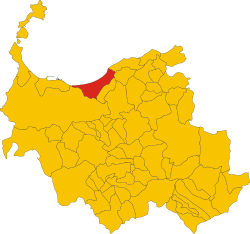
The medieval Village of Geridu is located within the municipal territory of Sorso, in the north of Sardinia. The site is 2 kilometers from the village of Sorso and 10 kilometers from the Sardinian city of Sassari. The Village is situated near the St Andrew’s “cave” and alongside Provincial Road 25, which connects the city of Sorso with nearby Sennori. [4][5]
The village is located on a hill in the Nurra plain, from which it is possible to see the Tyrrhenian Sea of the Gulf of Asinara. The area of the plain is rural; in fact, no significant modern constructions are present. The soil is particularly fertile, supporting various crops, among which vineyards and olive groves are the most prominent.
.jpg)
History and excavation
[edit]
Historical research indicates that Geridu developed as a rural settlement in northern Sardinia during the Middle Ages. Its location between Sorso and Sennori made it part of the wider network of villages in the Sassari area.
The first record of the village appears in Condaghe di San Pietro di Silki, and dates back to the year 1112.

During the 14th century, the village was one of the most populous settlements in the Romangia area, reaching its peak population in 1320, when it numbered 1250 inhabitants.
Excavations in the late 1990s and early 2000s by archaeologist Marco Milanese uncovered domestic structures, pottery, and burial sites, helping to reconstruct daily life in the village.[6] The excavations have revealed fifteen dwellings arragend around the church of Sant’Andrea, as well as cemetery and a manor house that was later demolished. De Castro, describing the village, mentioned the presence of a temple dedicated to Apollo, an amphitheatre, a sacred grove, several towers, and a defensive wall. After the village was abandoned, the area was used as as a quarry for building materials by the inhabitants of the surrounding areas.
A new phase of excavations conducted by the University of Sassari in May 2025 revealed previously undiscovered layers of habitation beneath Geridu’s medieval structures. These layers included older structures from the 11th and 12th centuries as well as dwellings that had been destroyed by fire around 1350. Parts of a Romanesque church and a villa giudicale were discovered during the 2025 campaign, indicating that Geridu had both religious and administrative importance during the giudicale era.[7][8]
In the course of the 2025 excavations, researchers identified traces of a fire that had likely damaged several dwellings around the year 1350. Beneath the burnt layers, they uncovered architectural remains dating back to the 11th and 12th centuries, pointing to a long-standing occupation of the site. Among the structures revealed during the campaign were the foundations of a Romanesque church and a villa giudicale. The villa is believed to have served an administrative role during the period of the giudicato of Torres. These findings provide a more detailed picture of Geridu’s historical function, suggesting that the village may have held greater political relevance than previously understood.[9]
[10]
[11]
As a result of the research and archaeological studies, conducted by the University of Sassari, traces of the daily life of the rural population that lived in this region during the 14th century have been uncovered. The investigations have revealed where and how this community lived. The village developed on a hill, its inhabitants enjoyed abundant water and sustained themselves through agriculture and livestock farming; the land was cultivated with vineyards, orchards, and gardens, and was also used for grazing animals.
The archaeological structure of that period consisted of a small village built around a central open space, the focal point of social and economic, around which more than 15 modest dwellings, a prestigious palace —disappeared during the Middle Ages—and community structures such as the cemetery and the Church of Saint Andrew were constructed. [1]
History of the Village of Geridu During the Catalan-Aragonese Rule (1323-1363)
[edit]
During the Catalan-Aragonese Rule, the history of Geridu is closely tied to its relationship with the city of Sassari. After the alliance of May 7, 1323, between James II of Aragon and the city of Sassari, confirmed during the siege of Villa di Chiesa on July 4 of the same year, Geridu was considered part of the Sassari territory. The agreements stipulated that neither Sassari nor its villages could be enfeoffed or separated from the Crown. Despite this, on February 12, 1324, the village was granted as a fief to Guillem Oulomar, contrary to the agreement. The concession was revoked on April 19, 1324, by Infante Alfonso of Aragon following protests from numerous Sassarese residents, and Oulomar was reallocated to another village, that of Mara.
Between 1324 and 1326, Sassari was the site of anti-Aragonese rebellions, supported by the Doria and Malaspina families. During this period, on October 1, 1325, Geridu was again enfeoffed to Thomas ca-Costa, in exchange for a loan of 8,000 Genoese soldi (about 400 lire per year), these findings have been used to estimate the village’s ordinary income at the beginning of Aragonese rule. The fief was granted according to the mos Italiae, with civil and lower criminal jurisdiction, and the obligation to provide four armed horses for three months of the year. Ça-Costa could sell or pledge the fief, but the king retained his right of pre-emption and the payment of the laudemio.
The granting met with opposition from Sassari, and Alfonso had to reiterate the validity of the concession several times between 1326 and 1331. The Sassari revolt of 1329, followed by the city’s depopulation and repopulation with people loyal to the Crown, did not change Sassari’s claims to Geridu. Thomas ça-Costa decided to delegate the management of the village to vicars, including Bernat Puculull and Ramon Guerau (active between 1332 and 1334), while local institutions of judicial tradition, such as the maiore de villa and the iuratos, continued to function. Upon his death, the fiefdom passed to his son Ramon; both failed to fulfill their military obligations, which resulted in the village getting confiscated and placed under the administration of the royal curia.
In the years that followed, Geridu changed owners several times. In 1334, Governor Ramon de Cardona purchased it, appointed a vicar, and collected the revenues. However, in 1337, due to debts, he ceded it to Guillem de Bellvis, who shortly thereafter sold it to Lope de Genestar, administrator of the revenues of the Kingdom of Sardinia. The value of the village was estimated at 52,000 soldi di alfonsini minuti (about 2,600 lire), demonstrating its economic importance. Upon Genestar’s death in 1339, the revenues caused several heated inheritance disputes between his wife Granyana, her brother Jacobo, the Montpaó family, various creditors (including the judge of Arborea, Pietro and Ramon ça-Vall), and King Peter IV. The situation remained unstable until 1342, when the fiefdom was assigned to Miquel Perez Çapata, with reduced military obligations.
During the rule of Perez Çapata, the village suffered social and economic tensions: theft, murder, and usury, practiced by the notary Margarito Rapallino, threatened to impoverish the community. The feudal lord had difficulty collecting taxes due to the hostility of the Sassaresi, the relocation of residents to the city, and the interference of royal officials. Geridu’s revenues were often contested or embezzled by the governors and administrators of the Kingdom, creating constant conflict.
From the mid-14th century, Geridu was hit by numerous crises, including the plague of 1348 and the war between the Catalan-Aragonese and Doria families (1347-1350), events that caused direct devastation: the village was besieged and burned. In 1353, during the war between the Crown of Aragon and Mariano IV of Arborea, Geridu rebelled along with the villages of Sorso and Taniga, but later returned to the royal curia. The participation of Geridu’s mayors in the Courts of Cagliari in 1355 demonstrates the village’s integration into the royal structures, and the population’s fear of new conflicts and their desire to take refuge in fortified centers such as Sassari or Osilo.
A document from 1358 describes Geridu in dire poverty, plundered, and burned: the inhabitants were allowed to defer their debts for five years, while the village’s proceeds were allocated to the maintenance of the castle of Sassari. Between 1358 and 1361, there was a modest recovery (an estimated annual income of 300 lire). In 1362 a plague reduced the population by half, decreasing the income to 66 lire in 1363. [12]
| before 1323 – 1325 | Municipality of Sassari |
| 1324 | nominal Aragonese enfeoffment to Guillem Oulomar |
| 1325 -1334 | Fief of Thomas Ça-Costa |
| 1327 or 1328 | vicarius (?) Bernat Puculull |
| 1332 | maior de villa Barisone de Naviçan |
| 1333 | procurator Guillem de Solà |
| 1332 -1334 | vicarius Ramon Guerau |
| 1334 | Fief of Ramon Ça-Costa |
| 1334 – 1336 | Royal aragonese Curia |
| 1334, December 29 – 1335, October 31 | vicarius Vicent Perez |
| 1336 – 1337 | Ramon de Cadorna |
| 1337 | Fief of Guillem de Bellvis |
| 1337 – 1338 | Lope de Genestar |
| 1338 | Royal Aragonese Curia |
| 1339 – 1354 | Fief of Miquel Perez Çapata |
| 1342 | vicarius Eniego Eximenis d’Ahe |
| after 1342 | vicarius Johan Perez de Vallcochan |
| 1349 | maior de villa Blasio Seche |
| 1345(?) – 1354 | vicarius Pere Eximenis de Lumbierra |
| 1355 | Royal Aragonese Curia
– Castle of Sassari |
| 1366 – 1388 | Judicate of Arborea |
| 1371 | nominal aragonese enfeoffment to March Castaner |
| 1391 – … | Fief of Galceran de Santacoloma |
| 1427 – 1434 | Royal Aragonese Curia – Sassari |
| 1434 – 1436 | Pietro Spano |
| 1436 | Pedro de Ferrera |
| 1436 – 1444 | Gonario Gambella |
Bold numbers represent the various eras of governance over Geridu, including rule by the Municipality of Sassari, the Catalan-Aragonese feudal lords, the Royal Aragonese Court, and the Arborean judiciary. The remaining numbers correspond to vicars, procurators, maiores, and village chiefs.
[12]
Village Abandonment
[edit]
Archaeological, documentary, and stratigraphic evidence show that the medieval village of Geridu was slowly abandoned between the second half of the 14th century and the early 15th century, during the Alborense occupation of Romangia (1366-1388). The depopulation did not happen all at once; it was the result of a long process driven by events such as economic crises, plagues, wars, and episodes of violence and destruction, with the ruined buildings sometimes reused in a partial and sporadic way.
Causes and Dynamics of Depopulation
[edit]
Scholars show that there is not a single cause for the abandonment; it was caused by the combination of several different factors:
- Heavy fiscal and economic pressure: documentary sources, such as tax records and archives, show that rural communities had to face a heavy tax burden. In an already fragile context, loans were often granted on usurious terms, fact that significantly increased debt and worsened the population’s living conditions.
- Local conflicts and wars: the village of Geridu was invovled in the war between the Municipality of Sassari, the Doria family, and the Giudicato of Arborea, resulting in several anti-Aragonese rebellions and military devastation in the region. Numerous traces of violent destruction have been found within the site, some examples can be: reddened layers of combustion inside rooms, ash, and the discovery of weapons, suggesting episodes of clashes or fires.
- Plagues and epidemics: Anthropological and paleopathological analyses have uncovered signs thar can be attributed to epidemic diseases, which may correspond to the great waves of the Black Death that struck the island in the 14th century. Sources report that, following these epidemics, the population of Geridu declined drastically, reduced by half.
- Episodes of Destruction and Spoliation: archaeological studies show that several structures bear evidence of violent destruction. Some buildings show collapses, followed by sporadic use of the remaining spaces, for example, with fireplaces built over the rubble or with the reuse of building materials. Building 12 demonstrates these dynamics, with fire-red soil, layers of ash, and the presence of various weapons. In Building 9, the roof collapse appears gradual, accompanied by the reuse of fallen materials. These elements indicate abandonment that was not always sudden, but sometimes violent and followed by spoliation.
- Economic Crisis and Reduction in Coinage in Use: numismatic evidence suggests that coins became less common after the first decades of Aragonese settlement. Coins from the second half of the 14th century are rarely found in archaeological contexts, pointing to a gradual economic slowdown and a reduction in trade.
The Process of Abandonment
The decline of the village was a gradual process. At first, there was a sharp drop in population caused by plagues and forced emigration due to wars, followed by episodes of violence and destruction. Over time, the buildings were slowly stripped of materials and only sporadically used after collapsing.
Stratigraphic evidence and material finds, such as ceramics and coins, suggest that some reuse and occasional occupation continued into the first half of the 15th century, even though the village no longer existed as a stable community. Indeed, during the Arboretum occupation of Romangia (1366-1388), depopulation became definitively irreversible, and between the late 14th and early 15th centuries, Geridu was completely abandoned. Only a few rural churches remained, such as San Biagio and, Sant’Andrea, which was still active in the 16th century but was demolished in the mid-19th century to make way for the parish church of San Pantaleo in Sorso.
Contemporary preservation
[edit]
In 2025, archaelogists from the University of Sassari discovered Sicilian and Tunisian ceramics from 1000-1100. This suggest the community was economically active. The inhabitants of Geridu were able to purchase the same goods used by the mercantile aristocracy of Pisa and Genoa in this period.[13]
Imported ceramics and coins from Sicily and Tunisia found during the 2025 excavations indicate that Geridu was actively engaged in mediterranean trade networks during the 11th and 12th centuries. According to archaeologist Marco Milanese, the presence of high-quality goods at Geridu suggest that its inhabitants enjoyed a level of prosperity comparable to urban mercantile communities such as as Pisa and Genoa.[14][15]
Origins of the name Geridu
[edit]
Site and archaeology
[edit]
The site was excavated in the late 1990s and early 2000s by archaeologist Marco Milanese. These excavations uncovered 25 individual graves in pits dated between the late 13th and the first half of the 14th century. These included the skeleton of an adult female with signs of congenital brachymetatarsia, believed to be the only such case in paleopathology.[16]
Over time excavations have uncovered traces of pots, pans, jugs and a wooden chest, a typical piece of furniture in medieval homes.
The buildings, with a rectangular plan, were built with limestone masonry, using clay as a binder, and a roofs covered with tiles resting on strong wooden beams. The houses had beaten- earth floors, and in the centre stood a wooden pole supporting the main beam of the roof.
The site also yielded agricultural implements, ceramics, and traces of water management systems, indicating that Geridu was a sustained rural community rather than a seasonal outpost.
Geridu is an abandoned medieval settlement with important cultural and historical point of interest in northern Sardinia. The site can be accessed from Sorso via Provincial Road 25, which connects the town with Sennori. Visitors can explore the rural landscape surrounding the archaeological area, located on a small hill overlooking the Gulf of Asinara.
Local cultural initiatives have aimed to integrate Geridu into the region’s tourism routes. Guided tours are occasionally organized by local associations and the municipality of Sorso, focusing on the site’s medieval past, its architectural remains, and the archaeological discoveries made during excavations. [3]
Findings from the site are preserved and exhibited at the Biddas Museum, an cultural space that is about to open again together with a new phase of excavations, hosted in the Baronial Palace of Sorso. This cultural space is dedicated to the history of abandoned medieval villages in Sardinia and has received the 2013 Francovich Award for its ability to combine innovation and tradition through modern communication.[17]
The museum showcases a selection of artifacts unearthed at Geridu, including ceramics and other medieval objects, offering visitors additional context on the daily life of the settlement’s inhabitants.[6]
Soft walking trails and agricultural landscapes make the area accessible to visitors interested in combining historical and nature tourism. The site is particularly valued by those exploring rural Sardinia and cultural heritage itineraries in the Sassari region.
The area of Geridu is uninhabited but remains under the protection of the Italian Ministry of Culture, which lists it among abandoned medieval heritage sites.[18]
The Biddas Museum is conserving and interpreting the Geridu site. It houses a dedicated hall for Geridu, showcasing main research findings, archaeological reconstructions, and exhibits that interpret the phenomenon of depopulation in Sardinia.[13]
Public engagement is promoted via special events such as *“simulated excavations”* and guided visits linking the museum to the archaeological site of Geridu.[19]
- ^ a b “Villaggio Medievale Abbandonato di Geridu – Idese”. cultura.gov.it.
- ^ Panetta, Alessandro (2024). ArcheoLogica Data, 4.1 (Scholarly book). All’Insegna del Giglio. pp. 93–115. ISBN 9788892852815.
- ^ a b “Il villaggio medievale di Geridu”. Ichnusa.org (in Italian). Associazione Ichnusa. 2022-11-15. Retrieved 2025-10-03.
- ^ “Villaggio Medievale di Geridu – DGABAP – Beni culturali abbandonati”. Ministero della Cultura (in Italian). Direzione generale Archeologia, belle arti e paesaggio (DGABAP). 2023-07-12. Retrieved 2025-10-09.
- ^ https://www.isoladisardegna.com/isola/la-nurra-.html
- ^ a b Milanese, Marco (2004). Milanese, Marco (ed.). Il villaggio medievale di Geridu: Studi e ricerche 1996–2001 (Scholarly book) (in Italian). Università di Sassari.
- ^ The Treasure of Geridu: New Discoveries in the Medieval Village of Sorso, L’Unione Sarda, 2025-05-29
- ^ Da Geridu riaffiorano nuove vestigia, Comune di Sorso, 2025-06-01
- ^ Sassari Oggi
- ^ Sardegnagol
- ^ Sassari Today
- ^ a b Milanese, Marco; Soddu, Alessandro (2006). Vita e morte dei villaggi rurali tra Medioevo ed età moderna : dallo scavo della Villa de Geriti ad una pianificazione della tutela e della conoscenza dei villaggi abbandonati della Sardegna (in Italian and French). All’Insegna del Giglio. pp. 123–130.
- ^ a b Pala, Mariangela (2025-05-29). “The Treasure of Geridu: New Discoveries in the Medieval Village of Sorso”. L’Unione Sarda English. Retrieved 2025-10-05.
- ^ Dagli scavi di Geridu nuove scoperte sul Medioevo sardo, RaiNews, 2025-05-30
- ^ The Treasure of Geridu: New Discoveries in the Medieval Village of Sorso, L’Unione Sarda, 2025-05-29
- ^ Giuffra, Valentina; Bianucci, Raffaella; Marco, Milanese; Eugenia, Tognotti; Andrea, Montella; Davide, Caramella; Gino, Fornaciari; Pasquale, Bandiera (2014). “A Case of Brachymetatarsia From Medieval Sardinia (Italy)”. The Anatomical Record. 297 (4): 650–652. Retrieved 7 October 2025.
- ^ “Il villaggio di Geridu, la Sardegna del Medioevo”. www.costasmeralda.it (in Italian). Retrieved 2025-10-15.
- ^ Ministero della Cultura (2023-07-12). “Villaggio Medievale di Geridu – DGABAP – Beni culturali abbandonati”. Ministero della Cultura (in Italian). Direzione generale Archeologia, belle arti e paesaggio (DGABAP). Retrieved 2025-10-03.
- ^ “Alla scoperta del Medioevo con il villaggio abbandonato di Geridu e il Museo Biddas”. MiC. 2022-09-07. Retrieved 2025-10-08.



