


From Wikipedia, the free encyclopedia
Content deleted Content added
|
|
|||
| Line 11: | Line 11: | ||
|
The ”’Meta Time Card”’ is a precision timing peripheral developed as part of [[Meta Platforms]]’ infrastructure hardware for network time synchronization in data centers and distributed computing environments. The card is designed as a PCI Express (PCIe) device that functions as a key component in precision timekeeping systems and can be integrated with commodity servers for improved timing accuracy.<ref>{{cite web |url=https://engineering.fb.com/2021/08/11/open-source/time-appliance/ |title=Open-sourcing a more precise time appliance |website=Engineering at Meta |date=11 August 2021 |access-date=10 January 2026}}</ref> |
The ”’Meta Time Card”’ is a precision timing peripheral developed as part of [[Meta Platforms]]’ infrastructure hardware for network time synchronization in data centers and distributed computing environments. The card is designed as a PCI Express (PCIe) device that functions as a key component in precision timekeeping systems and can be integrated with commodity servers for improved timing accuracy.<ref>{{cite web |url=https://engineering.fb.com/2021/08/11/open-source/time-appliance/ |title=Open-sourcing a more precise time appliance |website=Engineering at Meta |date=11 August 2021 |access-date=10 January 2026}}</ref> |
||
|
==Description== |
==Description== |
||
Revision as of 15:34, 10 January 2026
Computer hardware component for network time synchronization
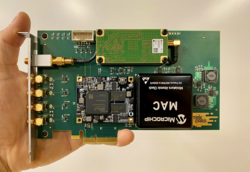
 Example of a time synchronization card using GNSS and atomic clock technology |
|
| Manufacturer | Meta Platforms |
|---|---|
| Introduced | 2021 |
| Type | Time synchronization card |
The Meta Time Card is a precision timing peripheral developed as part of Meta Platforms’ infrastructure hardware for network time synchronization in data centers and distributed computing environments. The card is designed as a PCI Express (PCIe) device that functions as a key component in precision timekeeping systems and can be integrated with commodity servers for improved timing accuracy.[1]
Description
The Time Card was introduced by Meta as part of an initiative to build a scalable and accurate timing solution that could be deployed within its global data center infrastructure. It was developed in conjunction with the Open Compute Project (OCP) Time Appliance Project, an effort to open-source the hardware and software required for precision timing appliances.[2] The card integrates a miniaturized atomic clock and Global Navigation Satellite System (GNSS) receiver, enabling servers to perform high-accuracy time synchronization independent of network-dependent time sources.[3]
Development and collaboration
Meta’s work on timing infrastructure began with internal enhancements to its data centers’ time distribution systems, transitioning from traditional Network Time Protocol (NTP) architectures to higher-precision solutions for applications that require microsecond-level accuracy.[4] As part of this broader effort, Meta collaborated with hardware vendors such as Orolia to develop cards based on Meta’s initial Time Card design. Orolia’s Atomic Reference Time (ART) cards, for example, incorporate rubidium oscillator technology aligned with the open-source timing specifications published by the OCP project.[5]
Uses
The Meta Time Card and its derivatives are used to synchronize time across servers in data center environments with precision that supports both Network Time Protocol (NTP) and Precision Time Protocol (PTP) implementations. Meta has adopted these cards to reduce synchronization error and achieve tighter timing accuracy across its infrastructure, often targeting timing stability within nanoseconds or microseconds.[6]
Industry context
At industry events such as the Open Compute Project Regional Summit in Prague in 2023, time cards incorporating atomic clocks and other high-precision timing technologies have been showcased alongside related products. These devices represent a broader trend toward hardware-based time synchronization solutions as an alternative to traditional software-based timing approaches, particularly for large-scale distributed computing and networked storage systems.[7]




