


=== Simultaneous Independent Parallel Instrument Approaches ===
=== Simultaneous Independent Parallel Instrument Approaches ===
Simultaneous Independent Parallel Instrument Approaches (SIPIA) permit simultaneous approaches to parallel runways with centerlines separated by at least 4,300 feet. Unlike dependent parallel approaches, independent parallel approaches do not use staggered radar separation procedures. For runways between 4,300 and 9,000 feet (9,200 feet for airport elevation 5,000 feet) apart, a no transgression zone final monitor controller and a tower controller are assigned for each runway.<ref name=”AIM” />{{rp|5-4-15}}<ref name=”boldmethod”>{{cite web |last1=Martin |first1=Swayne |title=How To Fly a PRM Approach |url=https://www.boldmethod.com/learn-to-fly/navigation/how-to-fly-a-prm-approach/ |website=Boldmethod |access-date=24 November 2025}}</ref>
Simultaneous Independent Parallel Instrument Approaches (SIPIA) permit simultaneous approaches to parallel runways with centerlines separated by at least 4,300 feet. Unlike dependent parallel approaches, independent parallel approaches do not use staggered radar separation procedures. For runways between 4,300 and 9,000 feet (9,200 feet for airport elevation 5,000 feet) apart, a no transgression zone final monitor controller assigned.<ref name=”AIM” />{{rp|5-4-15}}
<ref name=”boldmethod”>{{cite web |last1=Martin |first1=Swayne |title=How To Fly a PRM Approach |url=https://www.boldmethod.com/learn-to-fly/navigation/how-to-fly-a-prm-approach/ |website=Boldmethod |access-date=24 November 2025}}</ref>
=== Simultaneous Offset Instrument Approaches ===
Simultaneous Offset Instrument Approaches (SOIA)
== Precision Radar Monitor ==
== Precision Radar Monitor ==
In United States aviation, simultaneous approaches refer to instrument approach operations conducted simultaneously on two or three parallel runways. Simultaneous approaches are authorized for ILS, RNAV, and GLS approaches and are divided into three classes based on the runway centerline distances, ATC procedures, and ATC capabilities: Simultaneous Dependent Approaches, Simultaneous Independent Approaches, and Simultaneous Close Parallel PRM Approaches.[1]: 5-4-13
Simultaneous dependent approaches
[edit]

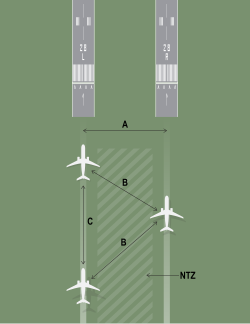
- A: Runway centerline distance between parallel runways (runway spacing)
- B: Diagonal separation (may be more than minimum depending on the required in-trail separation)
- C: In-trail separation
- NTZ: No transgression zone
Simultaneous dependent approaches are for parallel runway centerlines separated by usually at least 2,500 feet and up to 9,000 feet. For airports with less than 2,500 feet runway spacing, ATC will provide no less than the minimum authorized diagonal separation with the leader always arriving on the same runway. To mitigate wake turbulence, ATC will provide aircraft wake category pairing for the approaching traffic.[1]: 5-4-14
According to FAA Order JO 7110.65, ATC will provide a 1,000 feet vertical or a minimum of 3 miles radar separation between aircraft during “turn on”, the stage of the approach right before the parallel approach begins. After that, ATC provides the following minimum diagonal radar separation based on runway spacing:[2]
- 1 nautical mile, for 2,500 feet ≤ runway spacing ≤ 3,600 feet;
- 1.5 nautical miles, for 3,600 feet < runway spacing ≤ 8,300 feet;
- 2 nautical miles, for 8,300 feet < runway spacing ≤ 9,000 feet.
Simultaneous Independent Parallel Instrument Approaches
[edit]
Simultaneous Independent Parallel Instrument Approaches (SIPIA) permit simultaneous approaches to parallel runways with centerlines separated by at least 4,300 feet. Unlike dependent parallel approaches, independent parallel approaches do not use staggered radar separation procedures. For runways between 4,300 and 9,000 feet (9,200 feet for airport elevation 5,000 feet) apart, a no transgression zone final monitor controller is assigned.[1]: 5-4-15
Simultaneous Close Parallel PRM Approaches
[edit]
and a tower controller are assigned for each runway.[3]
Simultaneous Offset Instrument Approaches
[edit]
Simultaneous Offset Instrument Approaches (SOIA)
Precision Radar Monitor
[edit]
Precision Radar Monitor (PRM) is an advanced electronic scan radar or multilateration monitoring system intended to increase the use of multiple, closely-spaced parallel runways in instrument conditions by use of high resolution displays with alert algorithms and higher aircraft position update rate.[4]
No transgression zone
[edit]
The NTZ is a 2,000-foot-wide zone, located equidistant between parallel runways or SOIA final approach courses, in which flight is normally not allowed.[5]
Prior to 1962, simultaneous approaches were already being used for two parallel runways at Chicago O’Hare International Airport after analysis on lateral deviation of aircraft on ILS approach. In 1974, based on experience with William B. Hartsfield Atlanta International Airport, which had runways 4,000 feet apart, the FAA reduced the runway spacing requirement down to 4,300 feet. In the late 1980s, with the development and testing of PRM radars, the FAA permitted simultaneous approach to runways 3,400 feet apart. Another FAA project, called Multiple Parallel Approach Program, advanced the investigation and development of simultaneous approaches to three parallel runways.[7]
Operation considerations
[edit]
Pilot responsibility
[edit]
Pilots will be informed by ATC or automatic terminal information service that simultaneous approach is in use. Pilots need to closely monitor and strictly execute instructions from ATC to reduce ATC intervention or penetrating the no transgression zone.[1]: 5-4-13
Traffic collision avoidance system
[edit]
Traffic collision avoidance system (TCAS) will trigger a resolution advisory (RA) when two aircraft are in close proximity to each other. When two aircraft are converging at a very slow rate, such as during an approach to parallel runways, an additional protection known as “tau-cap” will be in effect. These protection mechanisms work in most airports with parallel approaches except for a few parallel approaches, which falsely trigger TCAS-RA when tau-cap mechanism is in effect.[8] 10° interception for aircraft on track-to-fix is recommended to minimize alerts from TCAS and flight management systems and decrease overshoots.
- ^ a b c d “Section 4. Arrival Procedures”. Aeronautical Information Manual. Federal Aviation Administration. Retrieved 23 November 2025.

- ^ “Radar Arrivals”. FAA Order JO 7110.65. Federal Aviation Administration. Retrieved 24 November 2025.
- ^ Martin, Swayne. “How To Fly a PRM Approach”. Boldmethod. Retrieved 24 November 2025.
- ^ “Appendix E: Simultaneous Approach Operations”. Order 8260.3D. United States Standard for Terminal Instrument Procedures (TERPS) (PDF). Federal Aviation Administration. February 16, 2018. Archived (PDF) from the original on November 21, 2025. Retrieved November 21, 2025.
- ^ “N”. Pilot/Controller Glossary. Federal Aviation Administration. Retrieved 23 November 2025.
- ^ “Chapter 16: Simultaneous Approach Operations”. Order 8260.3D. United States Standard for Terminal Instrument Procedures (TERPS) (PDF). Federal Aviation Administration. February 16, 2018. Archived (PDF) from the original on November 21, 2025. Retrieved November 21, 2025.
- ^ Massimini, S. Vincent (July 2006). “Simultaneous Independent and Dependent Parallel Instrument Approaches: Assumptions, Analysis, and Rationale” (PDF). Mitre Corporation. p. 5-1. Retrieved 24 November 2025.
- ^ “AIC 01 2025 TCAS RESOLUTION ADVISORIES DURING CLOSELY SPACED PARALLEL APPROACHES”. Qatar Civil Aviation Authority. 20 February 2025. Retrieved 23 November 2025.




