


American artist, theater director, and media theorist


Ebon Fisher is an internationally recognized media artist whose pioneering works explored the cultivation of living systems.[1][2] He taught at MIT’s Media Lab at its inception and later became a leading figure in the Brooklyn Immersionists arts movement that revived a struggling industrial neighborhood in Williamsburg, Brooklyn in the 1990s. The artist’s immersive strategies of creation, and his cultivation of living networks, have challenged both the 20th century paradigm of human self expression, and the distancing aesthetics of postmodernism. Fisher’s manifesto from 1988, You Sub Mod, introduced “submodernism,” a philosophy of deep environmental participation.[3]
From art to living systems
[edit]
Creative living systems
[edit]
The French art historian, Frank Popper has stated in the book, Contemporary Artists, that Fisher’s goal was to make neither art nor science, but to cultivate “the living properties of information.”[4] Citing a body of work spanning street graffiti, immersive rock performance, information sharing theater and viral network ethics, Popper elaborates:
“[Fisher’s creations] can be seen as an effort at moving our collective gaze away from both art and science and towards the nurturing of ‘life’ in the broadest, non-objective, and non-human sense. It is an attempt to seed a form of ‘subjective ecology.’ This leads, among other things, to a de-centered authorship where one creates with the community, with the medium, and with nature.”[4]
Fisher’s experimental theater company, Nerve Circle cultivated living media systems, or what Fisher called “media organisms,”[4] that helped to revitalize a distressed industrial area of Williamsburg, Brooklyn in the 1990s. Nerve Circle, and other experimental groups like Epoché, the Green Room, Keep Refrigerated, Lalalandia, The Lizard’s Tail Cabaret, Minor Injury Gallery and the Outpost helped to catalyze a renaissance in Williamsburg that spread through much of Brooklyn.[5] In 2024, The New York Times included Organism, a 15 hour “web jam”[6] Fisher instigated for 2,000 people,[7] among the immersive events that established Brooklyn as “Where It’s At”[8] in New York’s cultural life. Earlier, in Domus Magazine, Suzan Wines described that all night gathering as a “symbolic climax” to Williamsburg’s creative emergence:
- “Conceived by Ebon Fisher, Organism became a kind of symbolic climax to the renegade activity that had been stirring within the community since the late eighties. It exploited the notion of architecture as living event, breathing and transforming for fifteen hours in an abandoned mustard factory.”[9]
In his introduction to a museum exhibition at the University of Illinois, Out of Town: The Williamsburg Paradigm (1993), the art historian, Jonathan Fineberg spoke of Fisher’s commitment to a full cultural relationship with his Brooklyn neighborhood:
“After twenty-five years of a language-based focus to the art world – hand in hand with the demise of confidence in the ability of ‘vanguard’ artists to affect culture by showing radical work in SoHo galleries (much less ones in Kreuzberg or the Marais) – many artists today are returning to immediate experience, to the body, and to a neighborhood cultural interaction. As Ebon Fisher, a key figure on the Williamsburg scene recently told me, ‘we’re not making art out here, we’re creating culture.'”[10]
Living systems at the MIT Media Lab
[edit]
While still a graduate student at the Massachusetts Institute of Technology, Ebon Fisher was appointed by Professor Muriel Cooper to teach a dynamic media course, Creative Seeing to undergraduates at the MIT Media Lab at its inception in 1985.[11] Running for two years, Fisher’s course helped to establish the Media Lab as a think tank that explored new ways to conceptualize art, media, information and living systems. Moving beyond Marshall McLuhan’s definition of media as a species-centric extension of the human being, Fisher presented the arts and media as an equal relationship between humans and their environment. He invited students to join him on the streets of Cambridge and use telephone poles as a medium of expression for prints of their evolving digital communications; he took them to the top of the tallest building on campus to observe television against the backdrop of the surrounding urban ecosystem; and he invited them to experience total sensory deprivation in MIT’s anechoic chamber.[12][13] Drawing from these experiences, Fisher began to formulate an immersive rock theater company, Nerve Circle in 1986 that focused on biological systems and themes.[14] On the strength of Fisher’s biomorphic creations, the director of Boston’s Institute of Contemporary Art (ICA), David Roth paid Fisher a studio visit and advised him to move to New York where his experimental nature would be more fully embraced..[15][16] After performances at Boston rock clubs, Harvard’s Carpenter Center for the Arts, and the ICA, three Boston police officers shut down a highly charged performance of Nerve Circle’s “Evolution of the Grid” at a party in Fisher’s studio. The intrusion convinced Fisher to follow David Roth’s advice.[12]
Revitalizing Brooklyn
[edit]


In 1988, two years after receiving a Master of Science from MIT’s Center for Advanced Visual Studies, Fisher brought his biological systems thinking to Williamsburg, Brooklyn where he became a leading figure in an ecological arts movement that would eventually be called the Brooklyn Immersionists.[15] Nerve Circle played a critical role in building a creative, environmentally engaged community among the warehouses, streets and rooftops of Williamsburg’s waterfront area. Fisher was among the early members of Williamsburg’s international “artists colony,”[17] as Die Zeit described the Immersionist scene by the Brooklyn waterfront.[18][19] As a featured artist at Test-Site Gallery, Fisher encouraged the enterprise to open its doors to the community by building a media store into the entrance and hosting public events like The Salon of the Mating Spiders, which included over 600 local artists and non-artists alike.[20] Coming of age in a postmodern era that questioned human objectivity and industrial progress, the Immersionists transitioned to a post-postmodern cultural paradigm that emphasized environmental immersion, organic vitality, and a departure from 20th century individualism that led to what Fisher called “subjective ecology.”[21][15]
In the 1990s, Fisher and his interdisciplinary colleagues played a key role in transforming Brooklyn’s depressed industrial waterfront and bringing down the rate of attrition for disadvantaged populations.[22] The Brooklyn Immersionists helped to catalyze a renaissance in Williamsburg that spread through much of Brooklyn and beyond.[23] According to a 2004 report in the Journal of the American Planning Association, the emergence of such a dynamic culture in the early 1990s helped Williamsburg to revive its neighborhood-based economy and to stem the rate of attrition for its disadvantaged population.[24] In the new millennium, the Bloomberg administration rezoned the district for high rises and provided tax abatements for large corporate developers.[25] Instead of embracing the Immersionists’ emergent local economy, these corporate welfare policies led to a rise in the cost of living.[26] Rates of attrition for the disadvantaged began to rise again under the City’s new corporate welfare policies.[27] Among those forced to leave were the artists, activists and writers which had initiated the renaissance.[18]
Advancing art, urban ecology and technology
[edit]


Interviewed on Fuji Television[28] and Yale Radio,[29] and covered in Newsweek,[30] Die Zeit,[31] Wired,[32] Flash Art,[33] and the New York Times,[8] Ebon Fisher has been at the vanguard of several emerging cultural paradigms: urban ecology, digital culture and Brooklyn’s renaissance at the turn of the 21st century. Converging all three areas of interest, Fisher’s experimental arrangements of bodies, information and living context were designed to induce a shared presence that the artist likened to a “media organism.”[7] In the 2000 edition of his book, Art Since 1940: Strategies of Being, Fineberg elaborates on Fisher’s interdisciplinary range:
“The artist Ebon Fisher inhabited the close-knit artists’ neighborhood that existed in Williamsburg, Brooklyn at the start of the nineties. His work involved the interface of media, technology, and industry with the human environment of a small community… ‘The web,’ he said, ‘has created the new Vienna.’ …Fisher also began making digital art that had no fixed materiality; instead it had the flavor of contemporary Cyberpunk fiction, as in William Gibson’s 1984 novel Neuromancer… Fisher wrote utopian “social programs” on the computer [and] through community-based cultural enterprises and consumer technology, he aspired to reclaim the production of culture from the mass marketers.”[34]
The rituals were sometimes accompanied by other innovations such as Fisher’s “bionic codes,” a system of network ethics which Popper describes as “artificial lifeforms cultivated in the plasma of popular culture.”[7] Popper underscores the organic vitality driving Nerve Circle’s immersive creations in Cambridge and Boston in the 1980s, and later in Williamsburg beginning in the late 1980s:
- “These rituals focused on the immediacy of body-experience and on community-based culture, as Fisher organized massive participatory art events in gyms, nightclubs and neighborhoods. They were also efforts at exploring new ways to build vital convergences of humans and media technology.”[7]
Wired Magazine covered Fisher’s works five times, beginning with a 1995 article titled “Mr. Meme,”[35] and the artist’s diagrams of living media systems have appeared in numerous 20th century survey exhibitions, including the Cooper Hewitt, the Musée d’Art Contemporain de Montréal, and the Guggenheim Museum. Three years after including Fisher’s voice activated community board, (718) Subwire in its “New Bohemia” issue on Williamsburg, Brooklyn, New York Magazine included Fisher in another cover story, “The New York Cyber 60,”[36] describing the artist and his network ethics codes as “More Jenny Holzerish than Jenny Holzer.”[36] The Encyclopædia Britannica featured Fisher’s website as one of The Web’s Best Sites in 1994.[37] Fisher’s Bionic Codes were presented from 1996–2006 in the Guggenheim’s online CyberAtlas, which curator Laura Trippi described in the Guggenheim Magazine as “the first concerted effort to chart the cultural terrain known as cyberspace.”[38] In 1997 Elliott Sharp included Fisher’s music in his anthology, State of the Union, along with two other prominent Williamsburg musicians, Greg Asch and Karthik Swaminathan.[39] Along with other pioneering artists and theorists like Mark Pauline, Jaron Lanier and Douglas Rushkoff, Fisher has been lauded as one of the “Visionaries of the New Millennium”[40] by David Pescovitz in Java Magazine. In the foreword to a retrospective of Fisher’s work in 2006, media theorist Douglas Rushkoff underscored Fisher’s biological approach to culture:
“It’s not enough to come up with a great idea, or even the solution to one of the world’s great problems… For what if the person you truly need to hear your message doesn’t speak your language, refuses to see through your cultural bias, or hasn’t even been born yet? How can one communicate across these chasms? The work in your hands is just such an artifact. Ebon Fisher’s expressions are at once an immediately hypnotic viral challenge, and an advanced set of social protocols for evolving into a more inclusive and collaborative cultural organism.”[41]
Neurons and Networks
[edit]
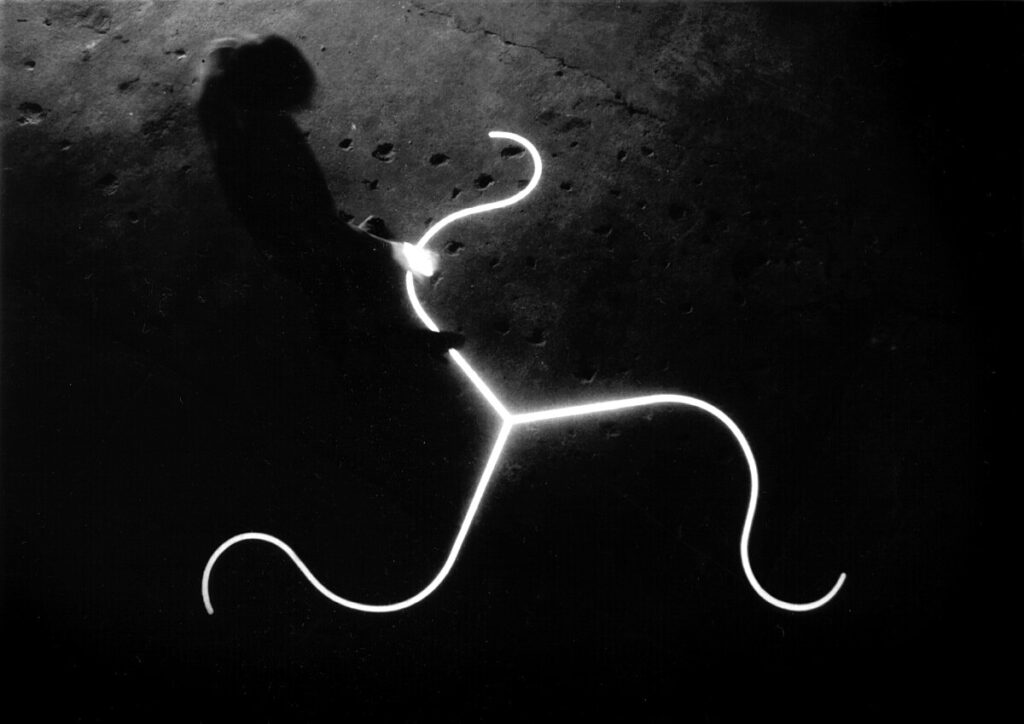
Ebon Fisher’s cultural creations have followed a trajectory from neuron graffiti to cultural experiments at MIT’s Media Lab, to an evolving media world. A common element in all of Fisher’s work has been the nurturing and illumination of living networks.[42] Fisher began to develop his nerve-like visual language as an art student at Carnegie-Mellon University. In 1981 he spray-painted a series of neurons under a bridge and along the train tracks in Pittsburgh’s Panther Hollow, eventually being introduced to another Pennsylvania graffiti artist, Keith Haring by one of his professors, the painter Jim Denny.[7] Rather than follow Haring to the world of New York galleries, Fisher began to take courses in computer programming which extended human nervous system and thinking into a mesh of machines. Using the programming language, Pascal, Fisher wrote the program, Book.dat, that could in theory generate an infinite number of text and images. The project opened the door to studies at MIT’s Center for Advanced Visual Studies and Fisher was invited to teach at MIT’s Media Lab at its inception. Informed by his exposure to cybernetics and feedback systems at the MIT Media Lab in the mid-1980s, Fisher continued to approach his work as a collaboration with the world to cultivate meshes of nervelike systems.[7]
- Neuron graffiti: Pittsburgh, PA (1980–82).
- Nerve Circle (phase 1): Interactive rock theatre born during studies and teaching at MIT (1984–88).
- Nerve Circle (phase 2): Community-based information-sharing rituals in Williamsburg, Brooklyn (1988–98).[43]
- Network ethics: Bionic ethics system, the Bionic Codes, which evolved into Zoacodes (1992-present).
- The Nervepool: An evolving transmedia world that began in Brooklyn as The AlulA Dimension[2] and evolved into the Nervepool and later Zoapool (1992-present).[44]
Embodied network architecture
[edit]
In the mid-1990s, Ebon Fisher built an immersive architectural system into his loft called The AlulA Dimension. It acted as a three dimensional expression of a node in Fisher’s nervelike system of ethics, the Bionic Codes, which had grown out of his media sharing systems in Williamsburg.[23] In 1998, Suzan Wines discussed the weblike nature of the climbable structure which Fisher used as a site for fully embodied media events:
“As a ‘living media organism’ the AlulA Dimension has a completely symbiotic relationship with its environment and inhabitants. Inspired by similarities between the flexible structures of ecological systems and the internet, Ebon Fisher began breeding the AlulA Dimension as an “organic matrix” for social interaction.”[45]
Over the years since, Fisher developed AlulA and the Bionic Codes into more biomorphic structures which were rendered in both physical and digital media: the Nervepool and the Zoacodes.[23][46] Both codes and architecture are now evolving again into a film and a weblike transmedia world called Zoapool which Fisher is cultivating in the Pinelands National Reserve of New Jersey.[7]
Philosophy and teaching
[edit]
Scholarly endeavors
[edit]
Much of Fisher’s work and writing redefines both art and technology as forms of environmental nurturing and cultivation,[23] encouraging a paradigm shift that has gained the interest of numerous institutions of higher learning. In addition to teaching at MIT, the Massachusetts College of Art, the New School and the University of Iowa, Fisher has been invited to speak at New York University, Sarah Lawrence College, Bennington College, the University of Washington, the Rennselaer Polytechnic Institute, and Columbia University. He has written on media and the arts for Art Byte, the Utne Reader, Digital Creativity Journal, the Walker Arts Center, the New York Council for the Arts and MIT’s Leonardo Journal. His bionic terms have appeared in Wired Magazine and numerous dictionaries and glossaries,[47][48] and Fisher was invited to give a TEDx talk at the Academy of Art in Vilnius, Lithuania, and a Banquet Keynote at the IT Revolutions Conference in Venice, Italy.
In 1998 Fisher was invited by the University of Iowa to create a new media arts program which he directed for three years under the name Digital Worlds. In 2001 Hunter College invited Fisher to become an associate professor, but just as the media artist began to move his young family to a new studio in Long Island City, the attack on the World Trade Center undermined New York City’s finances and the fledgling media arts program that Fisher joined was suspended that same year. Fisher then moved with his family to the Pinelands National Reserve in New Jersey where he began to develop an independent media studio by the Rancocas River. There he began to immerse himself and other media artists in the local wildlife, extracting video footage from those multi-species relationships for a fictional series called Zoapool or “living pool.”[15]


Ever since he spray-painted a series of neurons in the streets of Pittsburgh as an art student, Ebon Fisher sought to move his creative operations out of the ivory tower and immerse it in a public arena. A manifesto on environmental immersion that Fisher wrote in 1988 and posted in the streets of Williamsburg was discussed in 2023 by music historian, Cisco Bradley. In his book, The Williamsburg Avant-garde: Music and Sound on the Brooklyn Waterfront, Bradley notes that Fisher’s manifesto, You Sub Mod helped to shape the discourse of Williamsburg’s creative community:
- “Some theorists have characterized the period as one of immersionism, a kind of total artwork… As Ebon Fisher stated in 1988, in reference to the first use of the term, ‘You are the SUB MODERN. You live in a million tribes and burrows beneath the illusion we call the real world. While the Party passes over your heads you see its abject nakedness. You never believed in modernism and you aren’t fooled by its vain reflection, postmodernism… Without proclamation you have integrated yourself into the endless unfolding of spectacles. You found that to immerse yourself was the thing, sensing that objectivity was only another dream.’”[15]
Bradley also quotes Fisher on the contrast between the postmodern approach to culture and that of the Immersionists: “Postmodern deconstruction was over. Immersionism was about biological congealing and the vitality born from such convergence.”[15]
According to Bradley the aesthetic philosophy Fisher helped to launch was pivotal in transitioning away from the cynicism of postmodern theories of art and culture:
- “In many ways, Immersionism was the next stage of evolution of the New York art scene, which had evolved from the rationalist works of figures like conceptual artist Joseph Kosuth (b. 1945) or minimalist Donald Judd (1928-94) to the postmodern rebellion of the 1980s… As some of the early theorists of Immersionism stated, ‘[Immersionism] helped to shift cultural protocols away from cold, postmodern cynicism, towards something a whole lot warmer: immersive, mutual world construction.’ ”[15]
Fisher’s Quaker upbringing in Philadelphia, and his experiences at the Meeting School, a Quaker educational experiment on a farm in New Hampshire, were significant influences on his ecological approach to culture.[18]
Inspired by both the living community networks in Williamsburg, Brooklyn, and an increasingly collaborative internet culture, Ebon Fisher posted the first draft of his Wigglism Manifesto on the internet in 1996. He formally invited the public to contribute to its evolution, establishing Wigglism as one of the first intentionally open source systems of philosophy.[49] From its inception Wigglism has promoted the notion that the truth, or that which seems true, is interactively constructed with the world as a whole, not just with other humans or in the limited text space known as discourse. As dialogues surrounding the evolving manifesto have suggested, the most significant property of an interactively determined truth is not its veracity but the vitality in the collaboration in which it emerges. Wigglism also points to a post-art, post-science, post-human world in which both objective reality and subjective aesthetics give way to a living, subjective ecosystem. This supports an emerging green culture underscored by an ethic of nurturing vital systems.
The Wigglism Manifesto
Loop into strange coilings, this coiling. Well up in the fibrillations of this hysterical continuum, this bionic boiling. Rise up and nurture the wiggling – of sinew and circuit, riot and union, mud and imagination. Nurture with the loaded logic of the living, with ceaseless reflection and a moving center.
Ovulate your tender eggs, your shivering codes, into the blood of interconnection. Soak tendrils of thought and gesture in an ethical jelly of feedback. Infuse phantoms and facts with equal measures of visceral significance. Creep along the rivulets and curls of writhing truth, this feral fetus squinting in a boundless womb of cultivations.
Breed turbulent creatures in a mongrel jungle of plasma, machines and minds. Embrace these creatures, these hives, these worlds. Keep that which is lively, and that which sustains life, in succulent focus. May the lonely pools of science, art and heaven congeal into a sea of quivering being.
At this twist in the orgy of Mystery we are drunk with the sweat of the stars, with that which seems alive, with lunges, lickings and startled presences. We fuse with the creatures of our devotion, becoming everything we encounter, becoming devotion itself. We transmute mind and matter into a zoology of spirit.
Dare to suckle this wild vapor. Convulse and clutch in waves of milky wonder. Siphon every atom, and theory of atom, into the folds of our collective screen, our flesh. Melt into the monstrous, grooving spasm of the infinite wiggling.
Nurture the wiggling, for that which wiggles is amazing.
— Ebon Fisher, with input from the public, 1996-2007
In 2005, a retrospective of Ebon Fisher’s works was presented at the University of Northern Iowa curated by Darrell Taylor. That 5,000 sq. ft. exhibition led to an invitation to become the 2005 Marjorie Rankin Scholar-in-Residence at Drexel University. In 2006 Fisher collaborated with NPR commentator, Andrei Codrescu, on the creation of a new Zoacode, “Signal Strangely,” which reflected Codrescu’s stormlike travel patterns as he sought support for the survivors of Hurricane Katrina. In 2006, Fisher became a full time affiliate associate professor at the Stevens Institute of Technology in Hoboken, NJ, where he and a colleague, Prof. Quynh Dinh, received a National Science Foundation grant for a “Transmedia Search Engine.”[50][51] He was interviewed extensively in the documentary, Brooklyn DIY by Marcin Ramocki which premiered at the Museum of Modern Art in 2009. In that same year, Fisher was invited to present a banquet keynote talk at the IT Revolutions conference in Venice, Italy, sponsored by the IEEE.
After weathering the occupation of Williamsburg by corporate developers, an exodus from New York induced by the 2001 attack on the World Trade Center, exploitive conditions at the Stevens Institute of Technology that led to the removal of the institute’s president,[52] the Great Recession and the Coronavirus Pandemic, Ebon Fisher has returned to cultivating The Nervepool and its nerve-like ethics, the Zoacodes. The transmedia world has moved 80 miles south of New York to the Pinelands National Reserve and is now taking the form of a new incarnation called Zoapool.
- Jonathan Fineberg, Art Since 1940: Strategies of Being, Abrams/Prentice Hall, 1995/2000
- Claudia Steinberg, “Vis-a-vis Manhattan,” Die Zeit, 1997
- Frank Popper, From Technological to Virtual Art, MIT Press, 2007
- Frank Popper, “Ebon Fisher,” Contemporary Artists, ed. by Tom and Sarah Pendergast, St. James Press, 2002
- Ebon Fisher, Music, “Circulate All Sensation,” in CD Anthology, State of the Union, compiled by Elliott Sharp, 1996
- Sylvie Myerson & Vidyut Jain, “Interview with Ebon Fisher,” Sandbox Magazine, 1996
- David Alm, “Soft Machines: Ebon Fisher Coils into Gentle Linkage,” RES Magazine, vol. 4 no. 4, 2001
- Ebon Fisher, “Wigglism: A Philosophoid Entity Turns 10,” Leonardo Journal Vol. 40, Number I, 2007
- Flash Art, Interview with Annie Herron, director of Test-Site Gallery, Brooklyn, Feb. 1993
- Charles Runette, “The New York Cyber 60,” New York Magazine, Nov. 13, 1995
- ^ “Brooklyn Unbound” by Mark Rose, New York Press, March 6-12, 1991, p. 10
- ^ a b “Ebon Fisher’s AlulA Dimension” by Jennifer Dalton, Performing Arts Journal (PAJ), Johns Hopkins University Press, January 1998, p.62
- ^ The Williamsburg Avant-Garde: Experimental Music and Sound on the Brooklyn Waterfront by Cisco Bradley, Duke University Press, 2023, p. 27
- ^ a b c Popper, Frank (2002). Contemporary Artists (Volume 1 ed.). New York, San Francisco, Boston, London, Munich: St. James Press. pp. 515–516. ISBN 1-55862-488-0.
- ^ The Williamsburg Avant-Garde: Experimental Music and Sound on the Brooklyn Waterfront by Cisco Bradley, Duke University Press, 2023, p. 27
- ^ “Where Do We Go After the Rave?” by Melissa Rossi, Newsweek, July 26, 1993, p. 58
- ^ a b c d e f g Frank Popper, “From Technological to Virtual Art,” MIT Press, 2007, p. 119
- ^ a b Kurutz, Steven (January 29, 2024). “Williamsburg. What Happened?”. The New York Times. Retrieved April 12, 2024.
- ^ Suzan Wines, “Go with the Flow: Eight New York Based Artists and Architects in the Digital Era,” Domus, February 1998, p. 84
- ^ Introduction by Jonathan Fineberg to the catalogue for the exhibition, Out of Town: The Williamsburg Paradigm, curated by Fineberg for the Krannert Art Museum (University of Illinois, 1992).
- ^ Carey, Brainard (July 20, 2016). “Interview with Ebon Fisher”. Interviews from Yale University Radio, WYBCX.
- ^ a b “Transformations in the Nervepool: The Rituals & Zoacodes of Ebon Fisher,” catalog for a retrospective at University of Northern Iowa Gallery of Art curated by Darrell Taylor, 2006
- ^ Carey, Brainard (July 20, 2016). “Interview with Ebon Fisher”. Interviews from Yale University Radio, WYBCX.
- ^ “Ebon Fisher’s AlulA Dimension” by Jennifer Dalton, Performing Arts Journal (PAJ), Johns Hopkins University Press, January 1998, p.62
- ^ a b c d e f g Bradley, Cisco (2023). The Williamsburg Avant-Garde: Experimental Music and Sound on the Brooklyn Waterfront. Duke University Press. p. 23.
- ^ Jennifer Dalton, “Ebon Fisher’s AlulA Dimension,” Performing Arts Journal, Johns Hopkins University Press, January 1998, p. 62
- ^ Steinberg, Claudia (September 19, 1997). ““Vis a Vis Manhattan”“. Die Zeit. p. 77.
- ^ a b c Carey, Brainard (July 20, 2016). “Interview with Ebon Fisher”. Interviews from Yale University Radio, WYBCX.
- ^ Bradley, Cisco (2023). The Williamsburg Avant-Garde: Experimental Music and Sound on the Brooklyn Waterfront. Duke University Press
- ^ Interview by Francesco Bonami with Annie Herron, Flash Art, January/February 1993.
- ^ Ebon Fisher, “The Future of Wiggling Things,” Digital Creativity, Vol. 9 No. 1, 1998, p. 25
- ^ “Gentrification and Displacement: New York City in the 1990s” by Lance Freeman and Frank Braconi, Journal of the American Planning Association, Vol. 70, 2004, Issue 1, Pages 39–52. Published online November 26, 2007.
- ^ a b c d Dalton, Jennifer (January 1998). “Ebon Fisher’s AlulA Dimension”. Performing Arts Journal: 62.
- ^ Freeman, Lance; Braconi, Frank (November 26, 2007). “Gentrification and Displacement: New York City in the 1990s”. Journal of the American Planning Association. 70 (1): 39–52. doi:10.1080/01944360408976337. S2CID 154008236.
- ^ Buettner, Russ; Rivera, Ray (October 28, 2009). “A Stalled Vision: Big Development as City’s Future”. The New York Times. ISSN 0362-4331. Retrieved November 23, 2023.
- ^ Hackworth, Jason; Smith, Neil (November 1, 2001). “The Changing State of Gentrification”. Tijdschrift voor economische en sociale geografie. 92 (4): 464–477. doi:10.1111/1467-9663.00172. Retrieved December 5, 2023.
- ^ “An Economic Snapshot of Brooklyn,” Office of the New York State Comptroller, June 2018. https://www.osc.state.ny.us/files/reports/osdc/pdf/report-3-2019.pdf
- ^ Tetsua Suda interviews Immersionists at Galapagos Art Space on “OK:NY” for Fuji Television, Williamsburg, Brooklyn, 1997
- ^ Carey, Brainard (July 20, 2016). “Interview with Ebon Fisher”. Interviews from Yale University Radio, WYBCX.
- ^ “Where Do We Go After the Rave?” by Melissa Rossi, Newsweek, July 26, 1993, p. 58
- ^ Steinberg, Claudia, “Vis a Vis Manhattan,” Die Zeit, September 19, 1997, p. 77
- ^ “Mr. Meme” by Matt Haber, Wired Magazine, December 1995, p. 44.
- ^ Interview by Francesco Bonami with Annie Herron, Flash Art, January/February 1993.
- ^ Fineberg, Jonathan (2000). Art Since 1940: Strategies of Being (2nd ed.). Upper Saddle River, NJ: Prentice Hall. p. 502. ISBN 0-13-183321-9.
- ^ Matt Haber, “Mr. Meme,” Wired Magazine, December, 1995, p. 44
- ^ a b “The New York Cyber 60,” cover story on the New York new media community, New York Magazine. November 13, 1995. p. 48.
- ^ “The Web’s Best Sites,” Arts & Entertainment, Brittanica.com, 1994
- ^ CyberAtlas, an interactive web project curated by Jon Ippolito and Laura Trippi, Guggenheim Museum, 1996–2006; and “Intelligent Life” by Laura Trippi, Guggenheim Magazine, Spring 1997, p. 53
- ^ Music by Greg Asch, Ebon Fisher and Karthik Swaminathan (Kit Krash) in State of the Union, an anthology produced by Elliott Sharp, 1997.
- ^ David Pescovitz, “Visionaries of the New Millennium,” Java Magazine, January, 1997
- ^ Foreward by Douglas Rushkoff to “Transformations in the Nervepool: The Rituals & Zoacodes of Ebon Fisher,” catalog for a retrospective at University of Northern Iowa Gallery of Art curated by Darrell Taylor, 2006
- ^ Carey, Brainard (July 20, 2016). “Interview with Ebon Fisher”. Interviews from Yale University Radio, WYBCX.
- ^ Peter Boerboom, “Absorb into Memory: Ebon Fisher’s Media Organisms,” Mute Magazine, London, Winter 1997
- ^ Melody Parker, “Nervepool,” The Courier, Waterloo & Cedar Falls, Iowa, January 15, 2006
- ^ Wines, Suzan (February 1998). “Go With the Flow: Eight New York Artists and Architects in the Digital Era”. Domus Magazine.
- ^ M. Parker, “Nervepool,” The Courier, Waterloo & Cedar Falls, Iowa, January 15, 2006
- ^ “Web Jam,” and “Bionic Code,” Netlingo.com, 1997-2007
- ^ Jim Crotty, “Web Jam,” How to Talk American: A Guide to Our Native Tongues, Mariner Books, 1997
- ^ Ebon Fisher, “Wigglism,” Leonardo Journal, Vol. 40, Number I, 2007
- ^ Dinh, H. Quynh; Fisher, Ebon (2008). “Towards a Transmedia Search Engine: A User Study on Perceiving Analogies in Multimedia Data”.
- ^ “Computer Science, Art & Technology Team on NSF Grant”. U.S. National Science Foundation. October 2, 2007.
- ^ Dillon, Sam (December 21, 2009). “New Jersey College Is Beset by Accusations”. New York Times. p. 1. Retrieved December 5, 2023.



