


Church in the United States
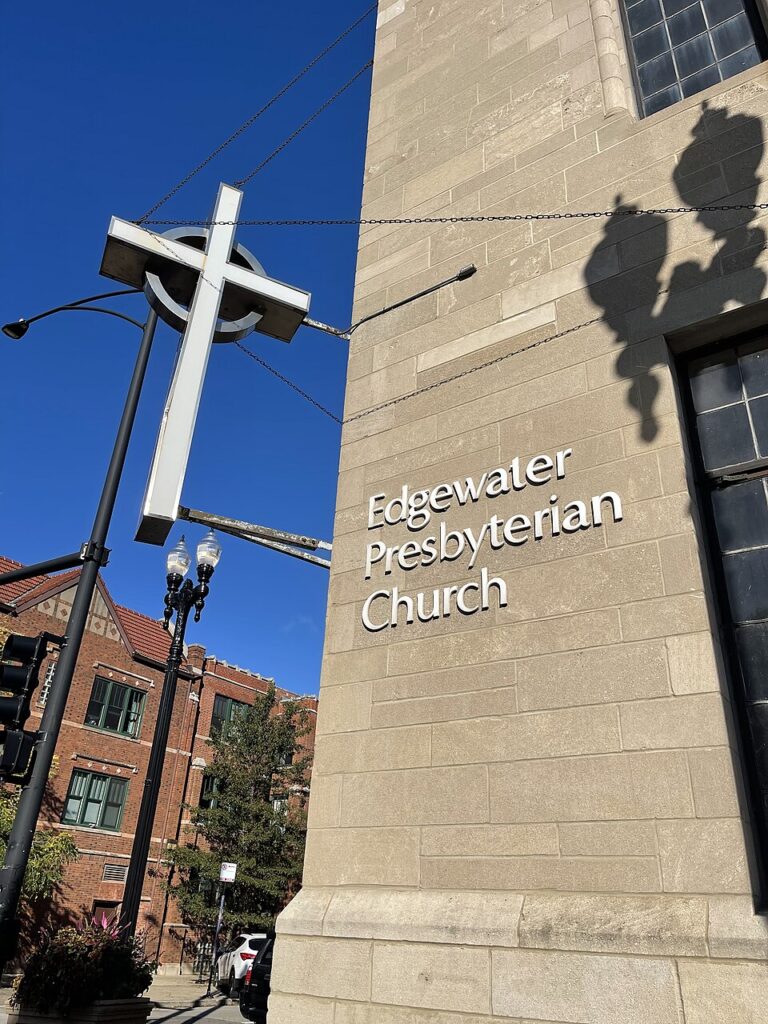
Edgewater Presbyterian Church, sometimes referred to as the Edgewater Kirk, is a mainline Protestant church rooted in Reformed theology and is a member of the Presbyterian Church (USA), the largest Presbyterian denomination in the U.S.
Located in the Edgewater neighborhood community area of Chicago, Illinois, the church is one of several historic buildings of the Bryn Mawr Historic District and is designed in the French Romanesque style with concrete clad in Indiana Limestone.
It was founded by 43 charter members with Church of Scotland roots on June 9, 1896. Many of the first congregants were of Scottish and Welsh ancestry or immigrants from Great Britain[1].
The congregation is a member of the Presbytery of Chicago[2] which is represented in and by the Synod of Lincoln Trails[3], one of 16 regional governing bodies of the Presbyterian Church (USA). Edgewater Presbyterian Church is represented in the highest governing body of the denomination, the General Assembly, by elected commissioners from the presbytery. The General Assembly meets every two years.
Two other faith communities worship in, but are independent of, Edgewater Presbyterian Church. They are Northside Friends Meeting[4], a Quaker congregation, and Grace Baptist Church[5], a congregation of the American Baptist Churches.
The current pastor of Edgewater Presbyterian Church is the Rev. Kristin E. Hutson, M.Div., J.D. She concurrently serves with Presbyterian Disaster Assistance (PDA) National Response Team[6]. She was previously Chaplain and Director of Religious Life at Coe College[7], a Presbyterian Church (USA) institution in Cedar Rapids, Iowa.
Theology
As a member of the Presbyterian Church (USA), Edgewater Presbyterian Church believes in the Bible as the written word of God. The Constitution of the faith is found in the Book of Order and Book of Confessions. Among the Confessions are the Nicene Creed, Apostle’s Creed, Scots Confession, Heidelberg Catechism, Second Helvetic Confession, Westminster Confession of Faith, Shorter Catechism, Larger Catechism, Theological Declaration of Barmen, Confession of 1967, Confession of Belhar, and Brief Statement of Faith.
Liturgy
Edgewater Presbyterian Church uses the Book of Common Worship 2018 edition, among other liturgical resources, to guide its liturgical practices[8]. It also uses Glory to God: The Presbyterian Hymnal as its primary source for hymns. It is the official hymnal of the Presbyterian Church (USA)[9].
Architecture
Edgewater Presbyterian Church was designed by the architectural firm Perkins, Hamilton & Fellows which had an office in downtown Chicago.[10]
The building features fireproof concrete, which was state-of-the-art at the time, clad in Indiana Limestone.
Architectural ornamentation above the church’s front and side doors were designed by sculptor Emil Zettler. He was a regular contractor for the architect. Zettler designed the sculpted reliefs for their 815 E. Tower Court office and studio and the Gymnastic Wing of Evanston Township High School in suburban Evanston, Illinois. He was also instrumental in the relief designs for Temple Sholom.
Early churches and community houses
Previous to its current location, the congregation met in several smaller church properties. Its first church was on leased property at Granville Ave. at Greenwood Ave., across from the present-day Stephen K. Hayt Elementary School. With over 700 members, it outgrew the space. It then built a new church at 5550 N. Kenmore Ave., with the help of philanthropist Nancy Fowler McCormick. Further growth meant the need for a larger space culminating in the purchase of two lots across the street at 1020 W. Bryn Mawr Ave.[11]
Granville Avenue Presbyterian Church
Edgewater Presbyterian Church evangelized the larger area under the leadership of its second pastor, the Rev. Dr. Louis Perkins Cain, D.D. One of the goals of the mission was temperance.
A 1945 bulletin of that mission’s successor church recorded[12], according to Edgewater Historical Society:
“It was back in 1903, when Dr. Louis P. Cain and some of his Edgewater Presbyterian Young People purchased a small folding organ with which they put on street evangelistic services and tried to counteract the influence of the increasing liquor traffic. Granville was just a cabbage patch in those days. Northwestern University, a strictly Methodist School then controlled and dominated all property for four miles around down to Devon Avenue, and by the force of its charter kept all that land ‘dry.’ The south side of the street was John Barley Corn’s front line, which Dr. Cain and his troopers decided to attact with a war of nerves. So on Sunday afternoons they would hold street meetings to evangelize the neighborhood, starting at Rosehill Cemetery working north on Clark Street until by 1904 they had sufficient followers to rent a store building near the southeast corner of Devon and Clark for a Sunday School.”
Outgrowing its storefront, the mission was installed in an old Edgewater Presbyterian Church building. It was a simple A-frame structure that was physically moved for them to Granville Ave.
The bulletin continued:
“For the next five years [after the dedication of the building] students from the seminary were employed in what was known then as the Presbyterian mission of North Edgewater. Finally the church gained strength and on Thursday evening, March 31, 1910 it was organized into the Granville Avenue Presbyterian Church. Dr. Louis B.[sic] Cain spoke on that occasion.”
Granville Avenue Presbyterian Church was dissolved by the Presbytery of Chicago.
Development
When the existing Edgewater Presbyterian Church outgrew its church and community house at 5550 N. Kenmore Ave., they purchased a lot across the street with the intention of building a new church and adjacent New Community House.[13]
The New Community House was completed in 1926 with four-stories and 52,000 square feet of space. It housed a theater auditorium, gymnasium with bleachers, and the top floor served as the manse where pastor and service staff would live.
The 1929 stock market crash threatened the New Community House with foreclosure. Members of the congregation mortgaged their own homes to save the building. They also scrapped plans for the construction of a new church with steeple next door.
Without the separate church, the congregation pivoted and transformed the theater space into a permanent Sanctuary for liturgies. The raised stage was reconstructed as a chancel with pulpit at the center. Risers were built behind the pastoral chairs for the choir and massive pipe organ manual. The velvet-lined, folding theater seating remained.
Space-sharers
Since then, the building has housed several theater companies, schools, a Head Start program, and various social service organizations. Artists, musicians, and writers have also made residencies in the New Community House.
A 99-seat black box theater space on the second floor is home to City Lit Theater, a theater company that specializes in stage productions of literary works, since 1979[14]. Its founding received the attention of Tennessee Williams who sent his personal congratulations[15].
Leadership
Edgewater Presbyterian Church appoints the pastor of their congregation through a process of the Presbyterian Church (USA)[16].
As per the polity of the Presbyterian Church (USA), the pastor concurrently serves as moderator. He or she is a co-equal leader of the congregation alongside the Session. The Session of Edgewater Presbyterian Church is elected from among the congregation and each person attains the office of ruling elder. In keeping with Presbyterian tradition, the office of ruling elder is an ordained ministry[17].
Elected from the Session is a ruling elder who serves the office of Clerk of Session. Like the pastor, he or she serves as a visible leader of the community, speaking on behalf of the congregation in the larger public. The Clerk also serves as the primary recordkeeper of the congregation: administering the official membership rolls; records of births, baptisms, marriages, funerals, ordinations, membership; minutes of the Session and committees; approvals of building use; approval of the administration of the Sacraments; official correspondence and communication.
Congregations in the Presbyterian Church (USA) are normally served by a Board of Trustees and Board of Deacons. Edgewater Presbyterian Church abolished those boards and the Session retains their authorities.
- Rev. R.R. Stevens (1896-1898)
- Rev. Dr. Louis Perkins Cain, D.D. (1899-1918)
- Rev. Dr. Asa J. Ferry, D.D. (1921-1934)
- Rev. Dr. William Woodfin, D.D. (1934-1938)
- Rev. Dr. Adolph Bohn, D.D. (1938-1966)
- Rev. Richard Dunn (1967-1968)
- Rev. Dr. Robert C. Linthicum, D.Min. (1969-1975)
- Rev. Leland B. Issleib (1977-1991)
- Rev. Gordon Neil Butcher (1994-2001)
- Rev. Dr. Barbara H. Cathey, D. Min. (2004-2020)
- Rev. Amy Pagliarella (2018-2020) co-pastor
- Rev. Kristin E. Hutson (2022-present) incumbent
During vacancies in the pastoral role, the Presbytery of Chicago Commission on Ministry has identified interim pastors to serve, at the pleasure of the Session. During that time, the Session convenes a Pastoral Nominating Committee in search of a successor, following Presbyterian Church (USA) procedures.
Gallery
-

A hand-carved cross above the Sanctuary is centered between illuminated stained-glass.
-

Worshippers gather in the Sanctuary during Liturgy of the Word.
-

Cameroonian Christian Women Fellowship dance their tithes to the Communion table during the annual Harvest Liturgy.
-

Emil Zettler sculpted the piece adorning the front doors on Bryn Mawr Ave. depicting biblical prophets.
-

Emil Zettler sculpted the piece adorning the side doors on Kenmore Ave. depicting family and community themes.
-

Welcome sign on Kenmore Ave. for Northside Friends Meeting, a Quaker congregation.


External links
Sources
41°59′02″N 87°39′23″W / 41.9839°N 87.6563°W / 41.9839; -87.6563



