
Ernest Sanglan was a French sculptor active in the late 19th and early 20th centuries, associated with the Art Nouveau movement—a style known for its organic forms, flowing lines, and inspiration drawn from nature and mythology.<ref>{{Cite web |title=Vintage Ernest Sanglan’s French Art Nouveau Bronze Vase Featuring a Young Satyr; Grapes Motif |url=https://www.chairish.com/product/16825445/vintage-ernest-sanglans-french-art-nouveau-bronze-vase-featuring-a-young-satyr-grapes-motif |access-date=2025-11-04 |website=Chairish |language=en}}</ref> Sanglan made notable contributions to the decorative arts scene in France, and his work is still appreciated by collectors and art historians for its intricate craftsmanship and imaginative themes.
Ernest Sanglan was a French sculptor active in the late 19th and early 20th centuries, associated with the Art Nouveau movement—a style known for its organic forms, flowing lines, and inspiration drawn from nature and mythology.<ref>{{Cite web |title=Vintage Ernest Sanglan’s French Art Nouveau Bronze Vase Featuring a Young Satyr; Grapes Motif |url=https://www.chairish.com/product/16825445/vintage-ernest-sanglans-french-art-nouveau-bronze-vase-featuring-a-young-satyr-grapes-motif |access-date=2025-11-04 |website=Chairish |language=en}}</ref> Sanglan made notable contributions to the decorative arts scene in France, and his work is still appreciated by collectors and art historians for its intricate craftsmanship and imaginative themes.
Little is known about Sanglan’s personal life, but his artistic legacy survives through the variety of bronze pieces he created, many of which reflect a deep fascination with mythological subjects and natural elements. His works often served both aesthetic and functional purposes, such as ornate inkwells, vases, and tableware. These objects typically feature rich, symbolic imagery—ranging from satyrs and Venus to insects and foliage – executed in patinated bronze with a high level of detail.
Little is known about Sanglan’s personal life, but his artistic legacy survives through the variety of bronze pieces he created, many of which reflect a deep fascination with mythological subjects and natural elements. His works often served both aesthetic and functional purposes, such as ornate inkwells, vases, and tableware. These objects typically feature rich, symbolic imagery—ranging from satyrs and Venus to insects and foliage – executed in patinated bronze with a high level of detail.
[[File:Sleeping Satyr.png|thumb|Sleeping Satyr]]
[[File:Sleeping Satyr.png|thumb|Sleeping Satyr]]
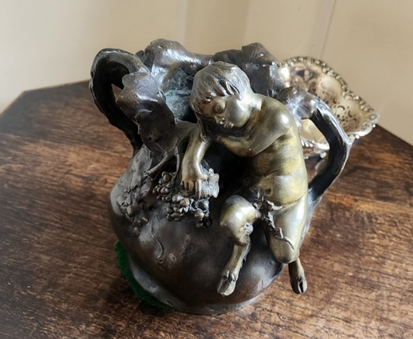
One of Sanglan’s most compelling pieces is his bronze “Sleeping Satyr”, a small but evocative sculpture that exemplifies both the sensuality and the dreamlike quality typical of Art Nouveau. The satyr, a mythological woodland creature symbolizing indulgence and the natural world, is depicted in a state of serene slumber. His relaxed pose, combined with the texture and warm tones of the bronze, conveys both physical realism and an ethereal quality. The piece captures a moment of stillness, as if the satyr has momentarily stepped out of myth and into a human state of vulnerability. It’s a work that invites contemplation, blending classical mythology with a deeply human emotional tone.<ref>{{Cite web |title=Ernest Sanglan Patinated Bronze Sculptured Vase of Satyr at Harvest |website=1stdibs.com |url=https://www.1stdibs.com/furniture/decorative-objects/vases-vessels/vases/ernest-sanglan-patinated-bronze-sculptured-vase-satyr-at-harvest/id-f_1832602/}}</ref>
One of most compelling pieces is his bronze “Sleeping Satyr”, a small but evocative sculpture that exemplifies both the sensuality and the dreamlike quality typical of Art Nouveau. The satyr, a mythological woodland creature symbolizing indulgence and the natural world, is depicted in a state of serene slumber. His relaxed pose, combined with the texture and warm tones of the bronze, conveys both physical realism and an ethereal quality. The piece captures a moment of stillness, as if the satyr has momentarily stepped out of myth and into a human state of vulnerability. a work that invites contemplation, blending classical mythology with a deeply human emotional tone.<ref>{{Cite web |title=Ernest Sanglan Patinated Bronze Sculptured Vase of Satyr at Harvest |website=1stdibs.com |url=https://www.1stdibs.com/furniture/decorative-objects/vases-vessels/vases/ernest-sanglan-patinated-bronze-sculptured-vase-satyr-at-harvest/id-f_1832602/}}</ref>
==References==
==References==
{{reflist}}
{{reflist}}
{{authority control}}
{{authority control}}
{{DEFAULTSORT:Sanglan, Ernest}}
{{DEFAULTSORT:Sanglan, Ernest}}
[[Category:French male sculptors]]
[[Category:French male sculptors]]
[[Category:Year of death missing]]
[[Category:Year of death missing]]
Ernest Sanglan was a French sculptor active in the late 19th and early 20th centuries, associated with the Art Nouveau movement—a style known for its organic forms, flowing lines, and inspiration drawn from nature and mythology.[1] Sanglan made notable contributions to the decorative arts scene in France, and his work is still appreciated by collectors and art historians for its intricate craftsmanship and imaginative themes.
Little is known about Sanglan’s personal life, but his artistic legacy survives through the variety of bronze pieces he created, many of which reflect a deep fascination with mythological subjects and natural elements. His works often served both aesthetic and functional purposes, such as ornate inkwells, vases, and tableware. These objects typically feature rich, symbolic imagery—ranging from satyrs and Venus to insects and foliage – executed in patinated bronze with a high level of detail.

One of Sanglan’s most compelling pieces is his bronze “Sleeping Satyr”, a small but evocative sculpture that exemplifies both the sensuality and the dreamlike quality typical of Art Nouveau. The satyr, a mythological woodland creature symbolizing indulgence and the natural world, is depicted in a state of serene slumber. His relaxed pose, combined with the texture and warm tones of the bronze, conveys both physical realism and an ethereal quality. The piece captures a moment of stillness, as if the satyr has momentarily stepped out of myth and into a human state of vulnerability. It’s a work that invites contemplation, blending classical mythology with a deeply human emotional tone.[2]

