


add to Category:20th-century American people
| ← Previous revision | Revision as of 10:33, 15 October 2025 | ||
| Line 1: | Line 1: | ||
|
{{Short description|American entertainment businessman and cotton planter (1882–1967)}}
|
{{Short description|American entertainment businessman and cotton planter (1882–1967)}}
|
||
|
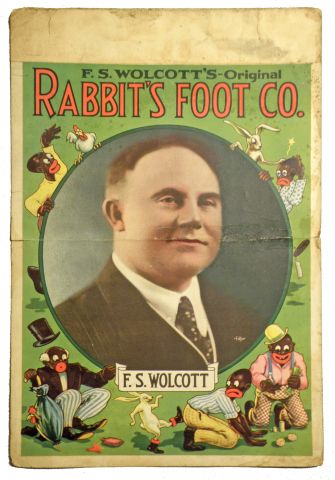
[[File:F S Wolcott.jpg|thumb|Window card for F. S. Wolcott’s Original Rabbit’s Foot Co.]]
|
[[File:F S Wolcott.jpg|thumb|Window card for F. S. Wolcott’s Original Rabbit’s Foot Co.]]
|
||
|
”’Fred Swift Wolcott”’ (May 2, 1882 – July 27, 1967) was an American entertainment businessman and cotton planter who was the owner and manager of the [[The Rabbit’s Foot Company|Original Rabbit’s Foot Company]] from 1912 to 1950. He bought the business after the death of its founder [[Pat Chappelle]], and operated the company from [[Port Gibson, Mississippi]], close to his 1,000-acre plantation.
|
”’Fred Swift Wolcott”’ (May 2, 1882 – July 27, 1967) was an American entertainment businessman and cotton planter who was the owner and manager of the [[The Rabbit’s Foot Company|Original Rabbit’s Foot Company]] from 1912 to 1950. He bought the business after the death of its founder [[Pat Chappelle]], and operated the company from [[Port Gibson, Mississippi]], close to his 1,000-acre plantation.
|
||
|
The Rabbit Foot Minstrels or “Foots”, as they were colloquially known, made up the leading traveling [[vaudeville]] show featuring [[African-American]] performers through the first half of the twentieth century. Many leading [[blues]], [[comedy]] and [[jazz]] entertainers got their start while touring with the company. Under his ownership, it became known as “F. S. Wolcott’s Original Rabbit’s Foot Company”.
|
The Rabbit Foot Minstrels or “Foots”, as they were colloquially known, made up the leading traveling [[vaudeville]] show featuring [[African-American]] performers through the first half of the twentieth century. Many leading [[blues]], [[comedy]] and [[jazz]] entertainers got their start while touring with the company. Under his ownership, it became known as “F. S. Wolcott’s Original Rabbit’s Foot Company”.
|
||
| Line 8: | Line 8: | ||
|
Wolcott was born in [[Onondaga Township, Michigan]], and grew up on a farm. He married and moved to the American South, establishing a small touring company, F. S. Wolcott Carnivals, in [[Columbia, South Carolina]]. It produced a touring show, “F. S. Wolcott’s Fun Factory”, in the Carolinas.<ref>[https://books.google.com/books?id=DVsKAgAAQBAJ&q=%22f+s+wolcott%22+&pg=PA1167 Henry T. Sampson, ”Blacks in Blackface: A Sourcebook on Early Black Musical Shows”], Scarecrow Press, 2013, p. 1167<!– ISBN needed –></ref>
|
Wolcott was born in [[Onondaga Township, Michigan]], and grew up on a farm. He married and moved to the American South, establishing a small touring company, F. S. Wolcott Carnivals, in [[Columbia, South Carolina]]. It produced a touring show, “F. S. Wolcott’s Fun Factory”, in the Carolinas.<ref>[https://books.google.com/books?id=DVsKAgAAQBAJ&q=%22f+s+wolcott%22+&pg=PA1167 Henry T. Sampson, ”Blacks in Blackface: A Sourcebook on Early Black Musical Shows”], Scarecrow Press, 2013, p. 1167<!– ISBN needed –></ref>
|
||
|
In 1912, he bought the Rabbit’s Foot Company from Rosa Chappelle, widow of founder [[Pat Chappelle]]. Chappelle was an African-American theatre owner in [[Tampa, Florida]], who had founded the business in 1900. Chappelle’s vaudeville company was noted as “authentic” (that is, it used all African-American, or black, rather than [[blackface]] performers). It was highly popular, and toured widely in the southern states each year.
|
In 1912, he bought the Rabbit’s Foot Company from Rosa Chappelle, widow of founder [[Pat Chappelle]]. Chappelle was an African-American theatre owner in [[Tampa, Florida]], who had founded the business in 1900. Chappelle’s vaudeville company was noted as “authentic” (that is, it used all African-American, or black, rather than [[blackface]] performers). It was highly popular, and toured widely in the southern states each year.
|
||
|
Wolcott maintained the company, initially as both owner and manager; he also attracted new talent, including [[blues]] singer [[Ida Cox]] who joined the company in 1913. Wolcott moved the company’s base in 1918 to his 1,000-acre Glen Sade Plantation outside [[Port Gibson, Mississippi]]. Company offices were located in the center of the trading town.
|
Wolcott maintained the company, initially as both owner and manager; he also attracted new talent, including [[blues]] singer [[Ida Cox]] who joined the company in 1913. Wolcott moved the company’s base in 1918 to his 1,000-acre Glen Sade Plantation outside [[Port Gibson, Mississippi]]. Company offices were located in the center of the trading town.
|
||
|
Wolcott began to refer to the show as a “minstrel show” – a term Chappelle had eschewed. As a major planter and businessman, he became a member of “Port Gibson’s privileged white aristocracy”.<ref name=abbott>[https://books.google.com/books?id=u4rc-BKNCyoC&dq=wolcott+%22port+gibson%22&pg=PA281 Lynn Abbott, Doug Seroff, ”Ragged But Right: Black Traveling Shows, Coon Songs, and the Dark Pathway to Blues and Jazz”], Univ. Press of Mississippi, 2009, pp. 270-289<!– ISBN needed –></ref> Company member trombonist [[Leon “Pee Wee” Whittaker]], described Wolcott as “a good man” who looked after his performers.<ref name=abbott/>
|
Wolcott began to refer to the show as a “minstrel show” – a term Chappelle had eschewed. As a major planter and businessman, he became a member of “Port Gibson’s privileged white aristocracy”.<ref name=abbott>[https://books.google.com/books?id=u4rc-BKNCyoC&dq=wolcott+%22port+gibson%22&pg=PA281 Lynn Abbott, Doug Seroff, ”Ragged But Right: Black Traveling Shows, Coon Songs, and the Dark Pathway to Blues and Jazz”], Univ. Press of Mississippi, 2009, pp. 270-289<!– ISBN needed –></ref> Company member trombonist [[Leon “Pee Wee” Whittaker]], described Wolcott as “a good man” who looked after his performers.<ref name=abbott/>
|
||
| Line 43: | Line 43: | ||
|
[[Category:Planters from Mississippi]]
|
[[Category:Planters from Mississippi]]
|
||
|
<!– [[Category:Disease-related deaths in Mississippi]]- Not established by source in article –>
|
<!– [[Category:Disease-related deaths in Mississippi]]- Not established by source in article –>
|
||
|
[[Category:20th-century American people]]
|
|||



