
British steam locomotive
38°24′31″N 85°22′31″W / 38.408533°N 85.375352°W
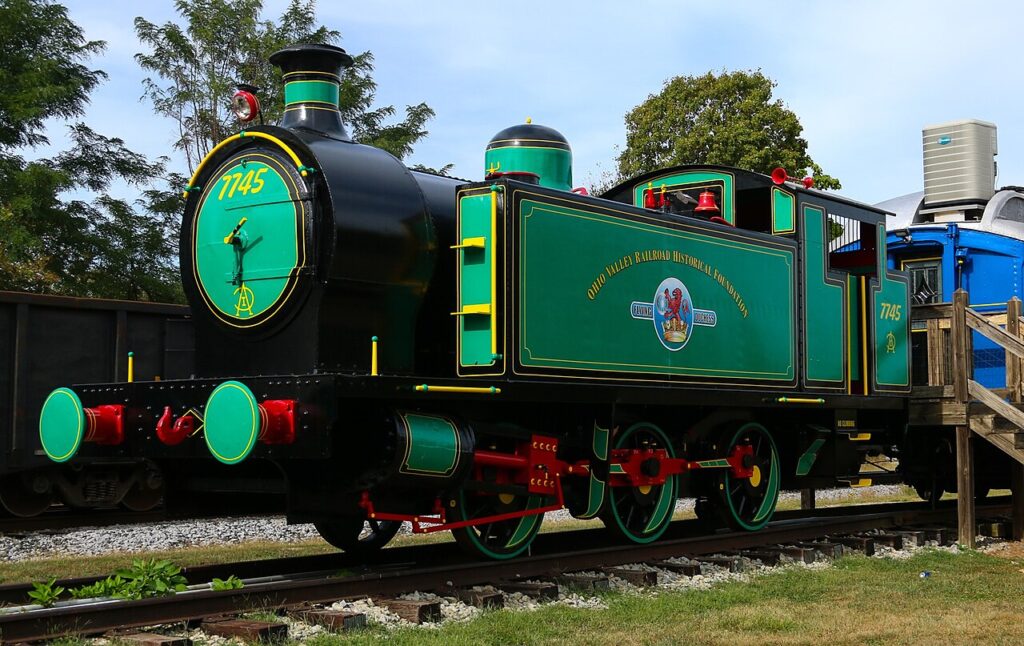
Flying Duchess[a] is a 0-6-0T steam locomotive, built from 1951 to 1952 by Robert Stephenson and Hawthorns (RSH) in North East England. The locomotive originally worked at the Meaford Power Station, numbered MEA No. 2, until 1970. In 1971, the locomotive was moved to the United States, and received the name Flying Duchess. Throughout the 1970s, the locomotive ran on heritage railroads, such as the Boyne City Railroad (BCRR) in Boyne City, Michigan, and the Tennessee Valley Railroad Museum (TVRM) in Chattanooga, Tennessee. It is currently on display at the La Grange Railroad Museum in La Grange, Kentucky.
United Kingdom (1952–1970)
[edit]

The locomotive was built from 1951 to 1952 by Robert Stephenson and Hawthorns (RSH) in North East England, originally numbered 7745.[1][2] In 1952, the locomotive began service at Meaford B – located within the Meaford Power Station in Staffordshire, England – as MEA No. 2.[2] The locomotive would work with MEA No. 1 (originally numbered 7683), a similar 0-6-0T locomotive built in 1951 by RSH. The two locomotives were used for heavy shunting services on the 9 miles (14 km) of sidings at the power station. The two locomotives would be in steam from 6:00 a.m. to 10:00 p.m. for seven days a week. The two locomotives would alternate shunting duties every six weeks until 1966, when the firebox of MEA No. 1 was deemed unsafe.[3] In 1969, three 0-4-0DH locomotives built from 1957 to 1958 by Andrew Barclay Sons & Co. had been transferred from High Marnham Power Station, located in Newark, England, to Meaford Power Station.[4] In 1970, MEA No. 2 was withdrawn from service at the power station, and was replaced by the new diesel locomotives.[2]
Heritage services (1971–1981)
[edit]

In 1971, the locomotive was bought by Hollis Baker and Charles Williams, and moved to the Boyne City Railroad (BCRR) in Boyne City, Michigan.[5][6] The locomotive was given a new coat of bright green paint and named Flying Duchess.[2][6] Three British Rail Mark 1 passenger coaches were also bought,[6][7][8] which were dark red with gold lining.[5] To comply with local railroad regulations, the locomotive was fitted with buckeye couplers and a high-intensity headlamp.[9] “We just thought that an all-English train would be an interesting attraction,” Baker said in an interview with the Associated Press.[5]
The BCRR would change from a shortline railroad to a heritage railroad. Freight services on the BCRR ceased in 1970, and Hollis Baker – the owner of the railroad at the time – repurposed the railroad for running exclusively tourist services, with the intention to revive the railroad.[6] The Flying Duchess and its coaches would be used for the railroad’s daily summer services, in addition to another passenger service consisting of a GE 44-ton switcher, two to three open observation cars, one roofed observation car, and a caboose.[7][10] The railroad had two stations: Boyne City and Boyne Falls. One round trip was 12 miles (19 km), and took about 1 hour and 40 minutes.[8] Passengers could ride both trains during the same trip; for example, a passenger could ride with the Flying Duchess in one direction, and ride with the GE switcher in the opposite direction.[7] In the summer of 1972, the two trains carried 24,500 passengers.[10]
Following the 1970s oil crises, Baker would begin auctioning everything from the railroad on May 15, 1976.[11][6] All 2,000 items from the museum – and approximately 600 feet (180 m) of Lake Charlevoix frontage – would cost US$400,000 (equivalent to US$2,200,000 in 2024) in total. The Flying Duchess, paired with its three Mark 1 coaches, would start at US$50,000 (equivalent to US$300,000 in 2024).[6] The railroad’s roundhouse was sold to a man from Ionia, Michigan for US$110,000 (equivalent to US$600,000 in 2024). The railroad line itself and its rolling stock were sold to a group for US$150,000 (equivalent to US$800,000 in 2024),[12] and the railroad would continue its operations as Boyne Valley Railroad.[13]
In 1978, a survey by the Federal Railroad Administration deemed the railroad lines unsafe, and would have to be rebuilt in order to resume services. The railroad was unable to afford rebuilding the new lines, and ceased its operations the same year.[14][13] The locomotive was sold to the Tennessee Valley Railroad Museum (TVRM) in Chattanooga, Tennessee,[2] where it operated passenger services in October 1978 and September 1979.[15] In the first quarter of 1980, the locomotive was in steam and appeared on the television program PM Magazine.[16]
Static display (since 1981)
[edit]
The locomotive was missing documentation on its boiler, and would need a boiler ticket from the state of Tennessee to continue running. In 1981, the locomotive stopped operating passenger services on the TVRM, and was put on static display. Southern Railway 4501 took over passenger services at the TVRM.[9] The locomotive was not cosmetically maintained while it was on static display, and fell into disrepair.[9][2] In 2000, the locomotive was sold and moved to Indiana.[2][1] The locomotive was sold again and moved to Louisville, Kentucky,[2][9] where it sat in the yard of a logistics center for over a decade.[2]
.jpg)
In 2011, the Louisville Harrods Creek & Westport Railway Foundation, which owned the locomotive at the time, would loan the locomotive for 20 years to the Ohio Valley Railroad Historical Foundation.[17] On August 23, 2011, the locomotive was moved to the La Grange Railroad Museum in La Grange, Kentucky, and placed onto the tracks outside the museum’s depot the following day.[17][2][18] The locomotive’s side tanks were obtained separately from the Louisville yard and placed on the locomotive; several of the original components from the locomotive could not be obtained by the Ohio Valley Railroad Historical Foundation.[9] A fundraising campaign was started to restore the locomotive cosmetically.[17] The locomotive was painted in a matte black after its arrival to slow down rust. In July 2014, the locomotive was repainted in a gloss black in preparation for a restoration. In 2018, the locomotive received a cosmetic restoration; the locomotive was repainted green, and was fitted with several new components in place of missing components.[2][9] As of 2026,[update] the locomotive is on static display about 30 feet (9.1 m) from a CSX railroad line,[2] in front of a dining car and caboose previously owned by the Louisville and Nashville Railroad.[1]
- ^ also known as No. 7745 and MEA No. 2
- ^ a b c McKinney, Helen (May 2021). “La Grange, Ky., Railroad Museum is still chugging along”. RoundAbout. Retrieved January 10, 2026.
- ^ a b c d e f g h i j k l “History of Our Steam Engine 7745”. La Grange Railroad Museum. Retrieved January 10, 2026.
- ^ “Standard Gauge in North Staffordshire”. The Industrial Railway Record. Vol. 17. February 1968. pp. 169–175. Retrieved January 10, 2026.
- ^ Warner, T. “Meaford No. 1”. Embsay and Bolton Abbey Steam Railway. Retrieved January 19, 2026.
- ^ a b c “North Michigan ‘British’ Train To Make Runs”. Associated Press. Boyne City, Michigan: Reading Eagle. January 24, 1971. p. 21. Retrieved January 10, 2026.
- ^ a b c d e f Chargot, Patricia (May 2, 1976). “For sale – lock, stock and linch pin: The Boyne City Line, Michigan’s Shortest, Prettiest railroad”. Detroit Free Press. Detroit, Michigan. Retrieved January 10, 2026.
- ^ a b c “Railroading Anyone?”. The Antrim County News. August 31, 1972. Retrieved January 12, 2026.
- ^ a b Miles, David (September 22, 2022). “Looking Back: Burglars, babies and railroad buffs found among historical headlines”. Charlevoix Historical Society. Petoskey News-Review. Archived from the original on January 22, 2026. Retrieved January 10, 2026.
- ^ a b c d e f La Grange Railroad Museum (December 5, 2020). The Flying Duchess (Video). La Grange, Kentucky: Phipps Media. Retrieved January 22, 2026.
- ^ a b “BOYNE CITY – success sans U.S. steam”. Trains. Vol. 32–33. 1971. Retrieved January 10, 2026.
- ^ “Want to buy railroad?”. The Rocky Mountain News. Vol. 118, no. 6. Boyne City. April 28, 1976. Retrieved January 13, 2026.
- ^ “Boyne Line Only A Memory Now”. Associated Press. Boyne City, Michigan. June 21, 1976. Retrieved January 10, 2026.
- ^ a b M. Meints, Graydon (1992). Michigan Railroads & Railroad Companies. Michigan State University Press.
- ^ Richard, A. Wiles (December 2014). “The little railroad that could – The Boyne City-Gaylord & Alpena Railroad story” (PDF). Mackinac Journal: 6–7. Retrieved January 10, 2026.
- ^ “The First 55 Years” (PDF). Smoke & Cinders. Vol. 56, no. 1. Tennessee Valley Railroad Museum. First Quarter 2017. ISSN 1083-1606. Retrieved January 10, 2026.
- ^ “This Quarter in TVRM History” (PDF). Smoke & Cinders. Vol. 59, no. 1. Tennessee Valley Railroad Museum. 2021. p. 7. ISSN 1083-1606. Retrieved January 13, 2026.
- ^ a b c “‘Flying Duchess’ steam locomotive lands in La Grange”. RoundAbout. September 2011. Retrieved January 10, 2026.
- ^ “The Pie Card” (PDF). The Pie Card. Vol. 45, no. 9. Division Eight Newsletter – Mid-Central Region, National Model Railroad Association. September 2011. Retrieved January 10, 2026.

