


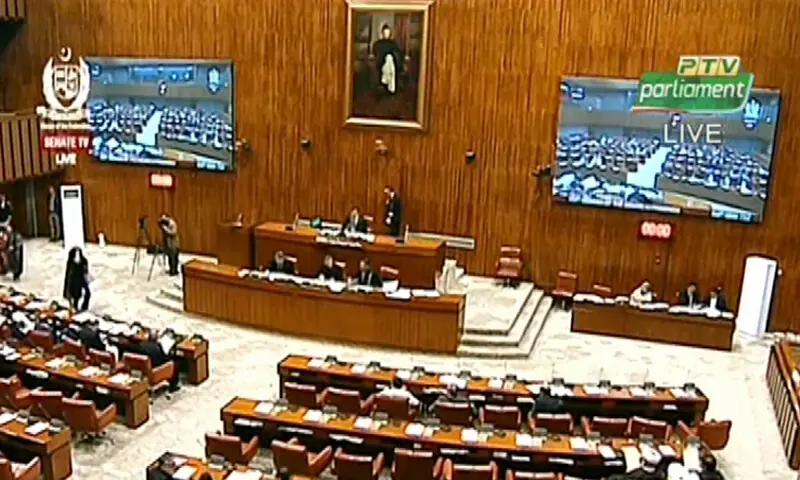
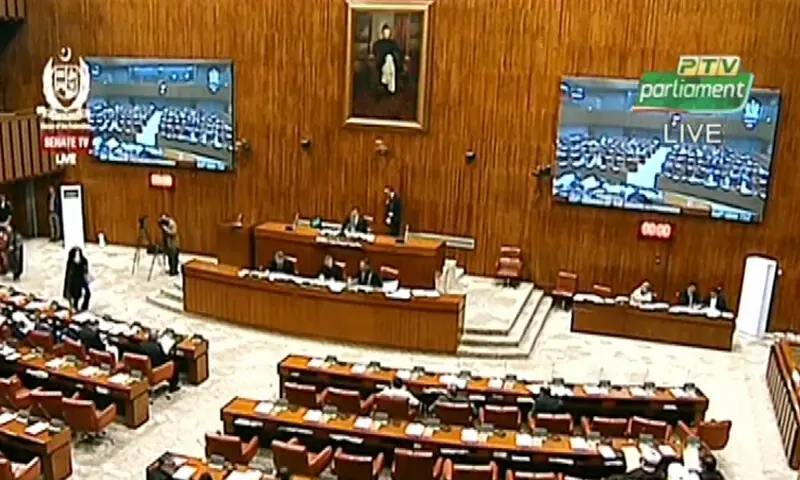
The Senate swiftly passed four bills related to the recently approved contentious 27th Constitutional Amendment on Friday, including one that seeks changes to the Army Act and resets the tenure of Chief of the Army Staff (COAS) Field Marshal Asim Munir after his appointment as the chief of the defence forces (CDF).
As explained by Law Minister Azam Nazeer Tarar in the National Assembly (NA) yesterday, this means that the five-year tenure of the chief of the defence forces would commence from the date of his notification of the appointment.
The four bills were passed by the Senate today — a day after their hurried passage in the National Assembly — without debate and with little resistance from the opposition.
Apart from the Pakistan Army Amendment Bill 2025, the bills also included the Pakistan Air Force Amendment Bill 2025, the Pakistan Navy Amendment Bill 2025, and the Supreme Court Practice and Procedure Amendment Bill 2025.
Deputy Prime Minister and Foreign Minister Ishaq Dar tabled the Pakistan Army Amendment Bill 2025 and the Pakistan Air Force Amendment Bill 2025 on behalf of Defence Minister Khawaja Asif until he joined the session.
Asif presented the Pakistan Navy Amendment Bill 2025 when he arrived in the house. After him, Parliamentary Affairs Minister Tariq Fazal Chaudhry tabled the Supreme Court Practice and Procedure Amendment Bill 2025 on behalf of Law Minister Tarar.
As Dar began presenting the bills, he explained that the bill sought changes to the relevant laws in line with the 27th Constitutional Amendment, which was enacted into law yesterday.
The passage of the Amendment, which has paved the way for the establishment of a Federal Constitutional Court (FCC) and changes to the military leadership structure, has been heavily criticised by the opposition.
Former and sitting judges, as well as lawyers, have also voiced opposition to the Amendment, particularly citing its implications for the Supreme Court.
But, little resistance by the opposition to the passage of the four bills in the Senate was witnessed today.
What are the changes?
The Pakistan Army (Amendment) Bill seeks to replace the expression “chief of the army staff” with “chief of the defence forces” as per the 27th Amendment. Similarly, it suggests replacing the “Chairman Joint Chiefs of Staff Committee” (CJCSC) with the “commander of the National Strategic Command”.
Another important amendment to Section 8A of the Pakistan Army Act 1952 says that “provided that for the first appointment of the chief of the army staff concurrently the chief of the defence forces under paragraph (a) of Clause 4 of the Article 243 of the Constitution of the Islamic Republic of Pakistan, the tenure under this section shall commence from the date of notification of the said office”.
Another amendment regarding the appointment of commander of the National Strategic Command says, “The prime minister may, on the recommendation of the chief of the army staff concurrently the chief of the defence forces, appoint the commander of the National Strategic Command, from amongst generals in the Pakistan Army, for a tenure of three years.”
The proposed amendment also authorises the prime minister to “reappoint the commander…for additional tenure of three years and/or extend the tenure(s)…up to three years” on the recommendations of the chief of the defence forces.
It further says that “the appointment, reappointment or extension of the commander of the National Strategic Command, or the exercise of discretion by the appointing authority in this regard, shall not be called into question before any court on any ground whatsoever”.
Another amendment reads that “the federal government may, on the recommendation of the chief of the army staff concurrently the chief of the defence forces and by order in writing, authorise the officer appointed as vice chief of the army staff or deputy chief of the army staff to exercise and perform such of the powers and functions vested in the chief of the army staff under any law, rules, regulations, orders or instructions for the time being in force as may be so specified”.
Meanwhile, amendments to the air force and navy laws include the elimination of the post of CJCSC from their documents.
The amendment to the Supreme Court law paves the way for the elimination of the Constitutional Bench, which was formed under the 26th Amendment.



