



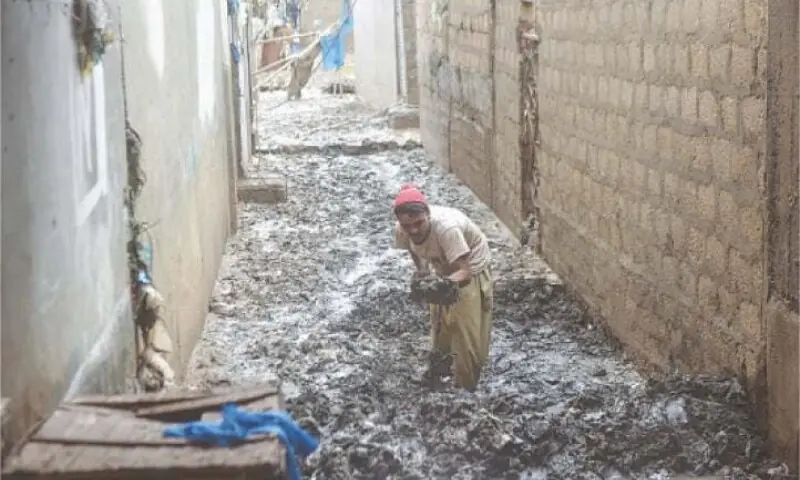
After the skies cleared and the muddy floodwaters began to recede, Nasir Sultan stood in what used to be the front room of his modest 80-square-yard home in Shafiq Colony — now a soggy mess of broken furniture, splintered wood, and ruined memories. His wife swept mud from the corners, while their three children — Areesha, 12, and her younger brothers Daniyal and Zayan — picked through the wreckage of their school bags, textbooks reduced to pulp, pencils floating in puddles.
Shafiq Colony, a densely populated locality tucked off the industrial zone in F. B. Area, sits precariously on the banks of the Lyari River. When the recent spell of rain pounded Karachi on Tuesday, the river swelled with a ferocity that many long-time residents say they have never witnessed in their lives. The floodwaters surged over the banks, pouring into homes like Nasir’s with devastating force.
The family had just returned from two nights of emergency shelter at a nearby government school, where they were rescued and housed by Al-Khidmat. Local UC representatives provided food and basic supplies, but nothing could prepare them for what they found upon returning.
“My work, my children’s future — everything is gone,” said Nasir, whose small trade of industrial supplies was wiped out in the flood. He had stored the goods in a back room of the house, hoping to make deliveries the next week. “We came back to nothing but silence and mud.”
All around them, Shafiq Colony is stirring again — people returning, sweeping, salvaging. But with the trauma still fresh and livelihoods destroyed, many, like Nasir and his family, are unsure how to begin again.
The last monsoon spell that drenched Karachi didn’t just bring chaos to Shafiq Colony and neighbouring Madina Colony in Gulberg Town — it left a trail of destruction across the city. At least five people lost their lives in rain-related incidents, including electrocutions and wall collapses, while hundreds more had to be rescued from submerged homes and stranded vehicles.
Low-lying areas across the metropolis turned into waterways overnight, and the city’s already fragile drainage system collapsed under the weight of continuous, unrelenting rain.
The situation worsened as hill torrents from the Kirthar mountain range — which runs along the western edge of Sindh — surged down into Karachi, feeding into the Lyari and Malir rivers. Both rivers, already swollen from urban runoff, rose to record levels.
What began as seasonal rains quickly turned into a citywide emergency, overwhelming neighbourhoods like Shafiq Colony and Madina Colony that sit directly in the path of the surging rivers. For residents like Nasir, the floods weren’t just a natural disaster — they were a total erasure of stability, security, and home.
In the aftermath, the scenes in Shafiq Colony resembled a disaster zone — lanes clogged with sludge, garbage strewn across rooftops, and a heavy stench of stagnation hanging in the air. To make the area livable again, the town administration deployed heavy machinery and sanitation teams to clear out the thick layers of mud and debris. Excavators and water pumps worked round the clock to drain stagnant pools, while municipal workers, ankle-deep in filth, laboured to unclog sewer lines and clear access roads.
“We had to act fast, or families couldn’t have returned for days, maybe weeks,” said Sabir Hussain, the vice chairman of the UC overseeing the cleanup. “The water had receded, but the filth and disease risk it left behind was worse.”
Only after the initial rounds of cleaning did authorities begin allowing displaced families like Nasir’s to return — many of them carrying little more than plastic bags filled with dry clothes and salvaged papers, stepping cautiously into homes that no longer felt like their own.
Karachi, a city already marked by a history of devastation during monsoon rains, has now been warned of a new and more dangerous reality. However, experts argue that the chaos the city endures during every monsoon season is less about climate change and more a reflection of chronic bad governance marked by corruption, inefficiency, and a persistent lack of political will.
Urban planner and researcher Muhammad Toheed said Karachi’s recurring urban flooding is the outcome of poor planning that ignored the city’s natural slope and terrain.
“There would be no question of flooding in Karachi if its geology and natural drainage were considered in its growth,” he said.
“Stormwater drains were heavily encroached upon and narrowed down. Their paths were ignored in development projects, leading to widespread flooding,” said Mr Toheed.
His concerns about Karachi’s flawed urban planning found a strong echo in Chief Minister Syed Murad Ali Shah’s remarks to journalists on Thursday afternoon. Amid the devastation and chaos brought on by the recent monsoon rains, CM Shah offered a rare silver lining: a comprehensive master plan for Karachi is now underway with support from the World Bank.
“The city’s unplanned expansion has created serious problems,” the chief minister acknowledged.
Referring to his recent visit to the banks of the Lyari River, the CM highlighted the plight of those living in vulnerable areas, saying: “We must find humane, long-term solutions to Karachi’s urban challenges.”
Published in Dawn, September 12th, 2025



