
From Wikipedia, the free encyclopedia
Content deleted Content added
| Line 7: | Line 7: | ||
|
==Interest in books== |
==Interest in books== |
||
|
His father, a noted bibliophile, was Master of the Royal Library. When he died in 1617, Francois inherited the office despite his youth. |
His father, a noted bibliophile, was Master of the Royal Library. When he died in 1617, Francois inherited the office despite his youth. |
||
|
He also maintained the family library |
He also maintained the family library the Greek minuscule manuscript known as [[Minuscule 601]] (Gregory-Åland). |
||
|
[[Nicolas Rigault]] took on the job of royal librarian with the arrest of de Thou. Under his name appeared |
[[Nicolas Rigault]] took on the job of royal librarian with the arrest of de Thou. Under his name appeared |
||
Revision as of 17:34, 30 September 2025
French magistrate

François-Auguste de Thou (24 August 1604 – 12 September 1642) was a French magistrate.
He was born in Paris, the eldest son of Jacques-Auguste de Thou and his second wife Gasparde de La Châtre.
Interest in books
His father, a noted bibliophile, was Master of the Royal Library. When he died in 1617, Francois inherited the office despite his youth.
He also maintained the family library including the Greek minuscule manuscript known as Minuscule 601 (Gregory-Åland).
Nicolas Rigault took on the job of royal librarian with the arrest of de Thou. Under his name appeared
Pièces concernant l’Histoire; Mémoires et instructions pour servir à justifier l’innocence de Messire François-Auguste de Thou.
Political career
He was a councillor to the parliament of Paris in 1626 and a conseiller d’État shortly afterwards. From 1632 to 1635, he was steward of Burgundy and steward of the armies with Cardinal Louis de Nogaret of Valletta.
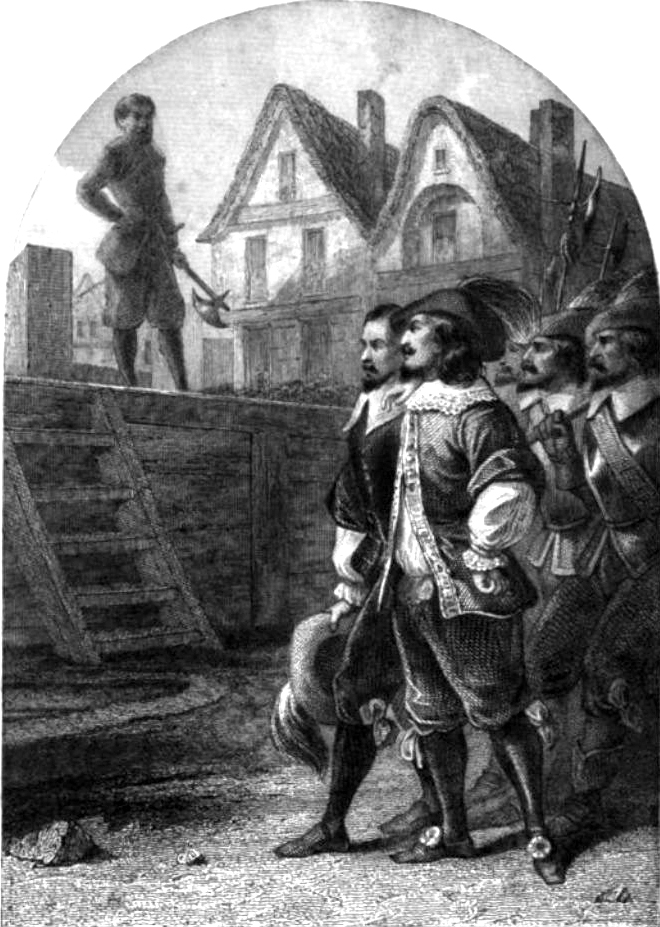
He was unwise enough to link himself to Cardinal Richelieu‘s enemies. His misguided mediation between Anne of Austria and Marie de Rohan was pardoned, but he fell in the conspiracy between Spain and Cinq-Mars, a favorite of king Louis XIII. For not revealing what he knew of the conspiracy, his silence was taken as proof of guilt and he was beheaded at Lyon on the same day as Cinq-Mars on Richelieu’s orders.[1]

He was portrayed in the 1826 Cinq-Mars by Alfred de Vigny. A famous 19th century historical painting The State Barge of Cardinal Richelieu on the Rhône by Paul Delaroche shows Cardinal Richelieu in a gorgeous barge, preceding the boat carrying De Thou and Cinq-Mars to their execution.
Notes
- ^ Encyclopédie Larousse du XXe siècle, Paris, 1932

