


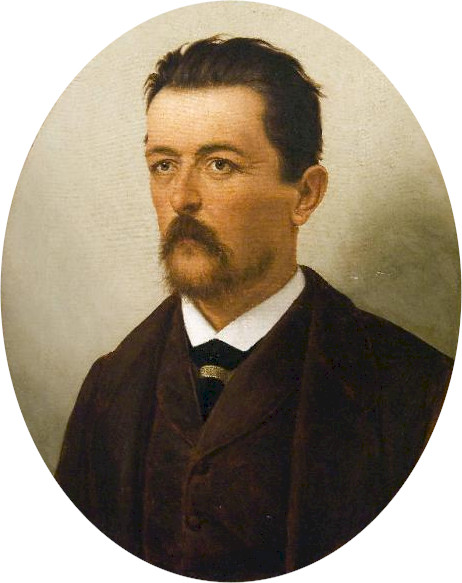
Gabriele Camozzi Vertova (Bergamo, 24 April 1823 – Dalmine, 17 April 1869) was an Italian patriot, military officer and politician, known for his involvement in the Italian unification and for his prominent role in the Risorgimento events in Lombardy and Sicily.[1][2][3][4]
Gabriele Camozzi was born in Bergamo to Andrea Camozzi and Countess Elisabetta Vertova, from a family of ancient local nobility.[3] He completed his early studies at the Barnabite college in Monza and continued at the lyceum in Bergamo, later earning a law degree from University of Pavia, which would have allowed him to pursue a legal career but was soon abandoned for the patriotic cause.[4]
In his youth, Camozzi connected with Lombard patriots and in 1848, at the age of twenty-five, became directly involved in anti-Austrian uprisings. He participated in the formation of the provisional government of Bergamo and led the city’s National Guard, organizing its units and improving its armament and structure.[1][2] He actively engaged in armed clashes against Austrian troops stationed in the city and surrounding provinces, demonstrating notable courage and organizational skill.[3]
Following the Armistice of Salasco in August 1848, Camozzi was forced to leave Bergamo with a battalion of volunteers and take refuge in Switzerland, where he met Giuseppe Mazzini and contributed to spreading republican ideas through the newspaper L’Italia del popolo.[1][3] There, he was assigned reconnaissance missions in northern Lombardy to assess the feasibility of local uprisings, and through his prudence, he dissuaded Mazzini from premature actions that could have ended disastrously.[4]
In March 1849, after King Charles Albert denounced the armistice, Camozzi returned to Lombardy to lead a volunteer column to relieve the besieged city of Brescia. He demonstrated considerable leadership, organizing and arming several hundred volunteers and coordinating with other patriotic forces, although adverse conditions and superior enemy forces forced a retreat back to Switzerland.[3]
After staying in Genoa to focus on commerce and family, Camozzi enlisted in 1859 as a second lieutenant in Garibaldi’s Cacciatori delle Alpi during the Second Italian War of Independence. He was quickly promoted to major and actively participated in military operations in Lombardy, supporting Garibaldi’s advance and occupying key cities like Lecco, Bergamo, and Como.[1][2][3][4] After the Armistice of Villafranca, he left active service to reorganize the National Guard in Bergamo, which he led efficiently.[3]
From 1860, he was elected deputy for the Trescore constituency and participated in the first Parliament of the Kingdom of Italy. While sitting with the Historical Left, he often maintained independent and moderate positions, showing attention to national unity and political stability.[1][4]
In 1866, during the Third Italian War of Independence, Camozzi, although a forty-year-old parliamentarian, requested to return to active service against Austria. He was instead assigned to command the National Guard in Palermo to suppress local uprisings, where he faced insurgent groups, showing courage and organizational skill. His intervention earned him honors including Commander of the Order of Saints Maurice and Lazarus, Officer of the Military Order of Savoy, and a silver medal.[1][2][3][4]
In his later years, he lived between Dalmine and Bergamo, continuing parliamentary work and caring for his family. He died of illness on the night of 16–17 April 1869, just days before his forty-sixth birthday.[1][2][3][4] His wife Alba helped establish the Museo Risorgimentale Dalminese, preserving his personal memorabilia. On 8 September 1912, a bust of Gabriele Camozzi by sculptor Giuseppe Siccardi (1883–1956) was inaugurated.[5]
Camozzi was a direct witness of the Lombard uprisings of 1848–1849 and the Italian unification movements.[6][7] Notable publications include:
- Notes and documents of the Lombard insurrection of 1849, collecting military and political documents.[7]
- Documents of the Holy War of Italy: Notes and Documents (1849), on the role of Italian patriots in the independence struggle.[7]
- The Camozzi Column and the Bergamo Insurrection of 1849, focusing on local events and family-led forces.[7]
- The Lombardo-Veneto and the new Kingdom of Italy: collection of documents (1864), documenting the political transition after unification.[7]
- Reasons of Gabriele Camozzi to the Italian government on the events of 1848 and 1849 in the war of independence (1863), a political reflection on state and conflict management.[7]
Camozzi also applied his legal training to fiscal and judicial matters in post-unification Italy, publishing:
- On the allocation of direct taxes (1868), analyzing fiscal challenges in unified Italy.[7]
- On the conclusions of the public prosecutor: observations regarding expenses incurred by the author in 1848 for the Bergamo noble guard and in 1849 for the war tax (1863).[7]
His works, many based on original documents and personal letters, are an important source for studying Lombard and Italian Risorgimento history.[6][7] They are preserved in various libraries and archives, including the Camozzi Danieli family archive and public collections dedicated to the Risorgimento.[6]
The city of Bergamo honored him with a main street, Via Gabriele Camozzi, near the ancestral family palace.[4]



