


[[Category:Sculptures in the Thorvaldsen Museum]]
[[Category:Sculptures in the Thorvaldsen Museum]]
[[Category:Sculptures of eagles]]
[[Category:Sculptures of eagles]]
[[Category:Food and drink sculptures]]
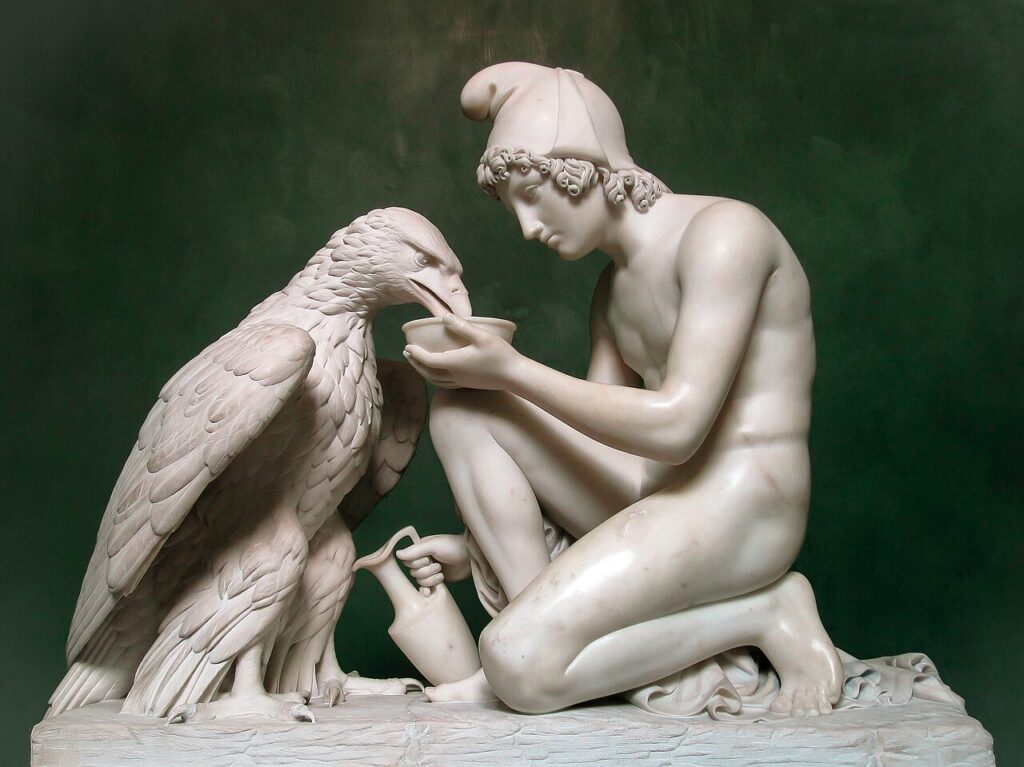
Ganymede and the Eagle or Ganymede with Jupiter’s Eagle (Ganymedes med Jupiters ørn) is a sculpture by the Danish artist Bertel Thorvaldsen. There are several specimens; the most famous is exhibited in the Thorvaldsen Museum in Copenhagen. Other marble specimens can be found in the Chrysler Museum of Art in Norfolk, Virginia, United States,[1] the Heim Gallery in London,[2] the Kennedy Galleries in New York,[3] at the Killruddery House in Bray in Ireland,[4] at the Minneapolis Institute of Art in the USA[5], in the Museum of Fine Arts in Leipzig, Germany[6] and at the Pinacoteca Tosio Martinengo in Brescia, Italy.[7] The Thorvaldsen Museum also owns two plaster specimens. His marble copy was made in Italy from 1815 onwards,[8] brought from Livorno to Copenhagen on the Danish corvette Galathea in 1833 and left to the museum after the artist’s death in 1844.
In Greek mythology, Ganymede was a Trojan prince who was the most beautiful of all mortals. Zeus, who corresponds to Jupiter in Roman mythology, fell in love with him and abducted him to Olympus with the help of an eagle, sometimes identified as Zeus himself. Ganymede then lived in eternal youth as a cup-bearer of the gods.
Thorvaldsen was a representative of neoclassicism and was considered by his contemporaries to be the most important sculptor next to Antonio Canova. He stayed in Rome from 1797 to 1838, where he was a central figure for Scandinavian and German artists,[9] who undertook the grand tour to study ancient Roman culture.
The art historian Fritz Baumgart [10] that the sculpture is characterized by “eerie beauty” and is unsurpassed in its perfection of form. Ganymede, with his smooth skin and trusting gaze, kneels in front of the eagle, whose plumage is carefully crafted. Thorvaldsen chose neither the motif of the violent abduction of the boy nor that of the handsome youth as cup-bearer for this sculpture. Instead, it is depicted how the power of the father of the gods and the ferocity of the predator are united in the eagle, which in turn are defeated by beauty and love. In art, the relationship between Zeus and Ganymede is usually portrayed as erotic.
Thorvaldsen portrayed Ganymede as a cup-bearer in two other sculptures: in the sculpture Ganymedes skænker i skålen (Ganymede filling the bowl, 1816)[11] and in the sculpture Ganymedes rækker skålen (Ganymede hands over the bowl, plaster version around 1805,[12] marble version 1820s[13]). Both are exhibited in the Thorvaldsen Museum.
Image gallery
-
![Marble sculpture, donated to the Museum of Fine Arts in Leipzig in 1864[9]](https://upload.wikimedia.org/wikipedia/commons/thumb/e/e4/Leipzig%2C_Museum_der_bildenden_K%C3%BCnste%2C_Bertel_Thorvaldsen%2C_Ganymed%2C_den_Adler_tr%C3%A4nkend.JPG/120px-Leipzig%2C_Museum_der_bildenden_K%C3%BCnste%2C_Bertel_Thorvaldsen%2C_Ganymed%2C_den_Adler_tr%C3%A4nkend.JPG) Marble sculpture, donated to the Museum of Fine Arts in Leipzig in 1864[9]
Marble sculpture, donated to the Museum of Fine Arts in Leipzig in 1864[9] -

The sculpture Ganymede filling the bowl from 1816. Thorvaldsen Museum.
-

The sculpture Ganymede hands over the bowl from the 1820s. Thorvaldsen Museum.


References
- ^ “Ganymede with Jupiter’s Eagle, AX83 – Thorvaldsens Museums Katalog”. kataloget.thorvaldsensmuseum.dk. Retrieved 2026-01-30.
- ^ “Ganymede with Jupiter’s Eagle, AX134 – Thorvaldsens Museums Katalog”. kataloget.thorvaldsensmuseum.dk. Retrieved 2026-01-30.
- ^ “Ganymede with Jupiter’s Eagle, AX257 – Thorvaldsens Museums Katalog”. kataloget.thorvaldsensmuseum.dk. Retrieved 2026-01-30.
- ^ “Ganymede with Jupiter’s Eagle, AX260 – Thorvaldsens Museums Katalog”. kataloget.thorvaldsensmuseum.dk. Retrieved 2026-01-30.
- ^ “Ganymede with Jupiter’s Eagle, AX327 – Thorvaldsens Museums Katalog”. kataloget.thorvaldsensmuseum.dk. Retrieved 2026-01-30.
- ^ “Ganymede with Jupiter’s Eagle, AX349 – Thorvaldsens Museums Katalog”. kataloget.thorvaldsensmuseum.dk. Retrieved 2026-01-30.
- ^ “Ganymede with Jupiter’s Eagle, AX396 – Thorvaldsens Museums Katalog”. kataloget.thorvaldsensmuseum.dk. Retrieved 2026-01-30.
- ^ Anthony Morris Clark (1966). Thorvaldsen Museum (ed.). “Thorvaldsen and His Ganymede and the Eagle”. arkivet.thorvaldsensmuseum.dk. Retrieved 2025-10-26.
- ^ a b Andreas Priever (1997). Thorvaldsen Museum (ed.). “Welch freudige Überraschung – zu Bertel Thorvaldsens Besuch in Leipzig”. arkivet.thorvaldsensmuseum.de (in German). Retrieved 2025-10-25.
- ^ Fritz Baumgart (1983). Konsthistoria: arkitektur, måleri, skulptur (in Swedish). p. 237. ISBN 91-37-07978-6.
- ^ “Ganymede filling the cup, A42 – Thorvaldsens Museums Katalog”. kataloget.thorvaldsensmuseum.dk. Retrieved 2026-01-30.
- ^ “Ganymede Offering the Cup, A41 – Thorvaldsens Museums Katalog”. kataloget.thorvaldsensmuseum.dk. Retrieved 2026-01-30.
- ^ “Ganymede Offering the Cup, A854 – Thorvaldsens Museums Katalog”. kataloget.thorvaldsensmuseum.dk. Retrieved 2026-01-30.



