


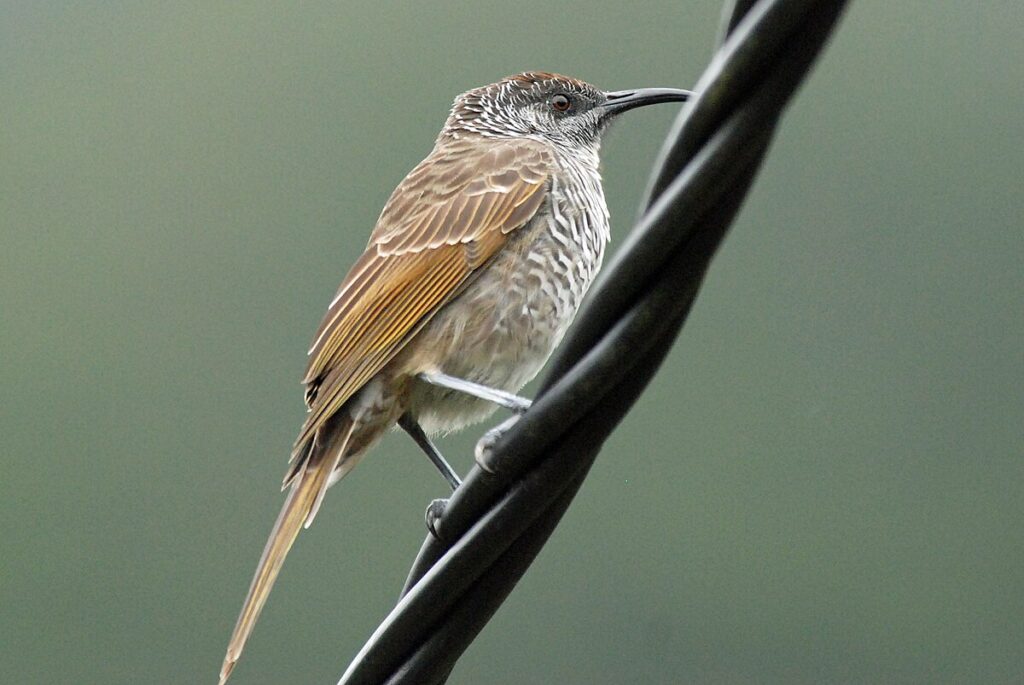
From Wikipedia, the free encyclopedia
Genus of birds
Gliciphila is a genus of honeyeaters endemic to Australia, New Caledonia and Vanuatu.
The genus Gliciphila was introduced in 1837 by the English zoologist William Swainson to accommodate a single species, Certhia fulvifrons Lewin, 1808. This is the type species. The name is a junior synonym of Certhia melanops Latham, 1801, the tawny-crowned honeyeater.[1][2][3] The genus name combines the Ancient Greek γλυκυς/glukus meaning “sweet” or “sweet tasting” with φιλος/philos meaning “lover”.[4]
Molecular genetic studies found that the tawny-crowned honeyeater in the genus Gliciphila was embedded in a clade containing the two species in the genus Glycifohia. To resolve the polyphyly the three species are now placed together in Gliciphila.[5][6][7]
The genus contains three species:[7]
- ^ Swainson, William (1837). On the Natural History and Classification of Birds. Vol. 2. London: Longman, Rees, Orme, Brown, Green & Longman and John Taylor. p. 326.
- ^ Paynter, Raymond A. Jr, ed. (1986). Check-list of Birds of the World. Vol. 12. Cambridge, Massachusetts: Museum of Comparative Zoology. p. 426.
- ^ Dickinson, E.C.; Remsen, J.V. Jr., eds. (2013). The Howard & Moore Complete Checklist of the Birds of the World. Vol. 1: Non-passerines (4th ed.). Eastbourne, UK: Aves Press. p. 159. ISBN 978-0-9568611-0-8.
- ^ Jobling, James A. “Gliciphila”. The Key to Scientific Names. Cornell Lab of Ornithology. Retrieved 12 November 2025.
- ^ Andersen, M.J.; Naikatini, A.; Moyle, R.G. (2014). “A molecular phylogeny of Pacific honeyeaters (Aves: Meliphagidae) reveals extensive paraphyly and an isolated Polynesian radiation”. Molecular Phylogenetics and Evolution. 71: 308–315. Bibcode:2014MolPE..71..308A. doi:10.1016/j.ympev.2013.11.014. PMID 24315868.
- ^ Marki, P.Z.; Jønsson, K.A.; Irestedt, M.; Nguyen, J.M.T.; Rahbek, C.; Fjeldså, J. (2017). “Supermatrix phylogeny and biogeography of the Australasian Meliphagides radiation (Aves: Passeriformes)”. Molecular Phylogenetics and Evolution. 107: 516–529. Bibcode:2017MolPE.107..516M. doi:10.1016/j.ympev.2016.12.021. hdl:10852/65203.
- ^ a b AviList Core Team (2025). “AviList: The Global Avian Checklist, v2025”. doi:10.2173/avilist.v2025. Retrieved 12 November 2025.




