
From Wikipedia, the free encyclopedia
Content deleted Content added
| Line 1: | Line 1: | ||
|
{{Short description|Imperial German Army general (1855–1917)}} |
{{Short description|Imperial German Army general (1855–1917)}} |
||
|
{{Use dmy dates|date=January 2024}} |
{{Use dmy dates|date=January 2024}} |
||
|
[[File:Guretzky- |
[[File:Guretzky-.|thumb| ]] |
||
|
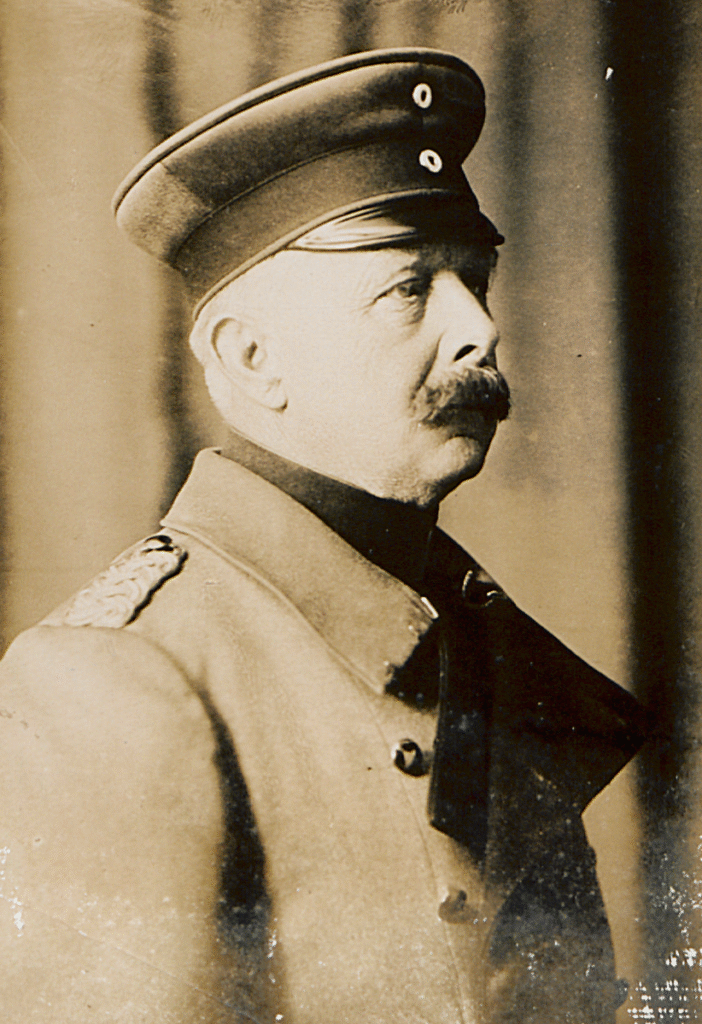
”’Hans Karl Moritz von Guretzky-Cornitz”’ (10 August 1855–27 July 1917) was a German army general of the [[First World War]]. He was commander of the [[9th Reserve Division (German Empire)|9th Reserve Division]] during the early part of the war. He is noted for an incident during the 1916 [[Battle of Verdun]] when he falsely reported capturing [[Fort Vaux]] and was awarded the [[Pour le Mérite]]. |
”’Hans Karl Moritz von Guretzky-Cornitz”’ (10 August 1855–27 July 1917) was a German army general of the [[First World War]]. He was commander of the [[9th Reserve Division (German Empire)|9th Reserve Division]] during the early part of the war. He is noted for an incident during the 1916 [[Battle of Verdun]] when he falsely reported capturing [[Fort Vaux]] and was awarded the [[Pour le Mérite]]. |
||
Revision as of 09:10, 3 November 2025
Imperial German Army general (1855–1917)

Hans Karl Moritz von Guretzky-Cornitz (10 August 1855–27 July 1917) was a German army general of the First World War. He was commander of the 9th Reserve Division during the early part of the war. He is noted for an incident during the 1916 Battle of Verdun when he falsely reported capturing Fort Vaux and was awarded the Pour le Mérite.
Biography
Guretzky-Cornitz was born in Fürstenwalde, Prussia, on 10 August 1855.[1][2] He was the first son and second child of the Prussian cavalry general Karl Sigmund von Guretzky-Cornitz, and his wife Thekla von Selmnitz. On 11 October 1889 he married Antoinette von Restorff in Radegast, Saxony-Anhalt, which was her family’s seat. By 1891 Guretzky-Cornitz was a captain and company commander in the 4th (Queen Augusta) Guards Grenadiers in the Prussian Army, which formed part of the Imperial German Army.[1] By 1904 Guretzky-Cornitz was a colonel and chief of staff of the IX Army Corps.[3]
During the early part of the First World War Guretzky-Cornitz commanded the 9th Reserve Division. The division took part in the Battle of Verdun in 1916 and seized the village of Vaux-devant-Damloup from French troops in early March. On 9 March Guretzky-Cornitz received reports that his troops had captured the key French fortification of Fort Vaux. It was believed that the French had abandoned the post as they did earlier at Fort Douaumont.[4] The report had come from a forward infantry officer. The brigade commander raised doubts but apparent confirmation came from an artillery observer who reported seeing a German flag on the fort glacis and other observers reported sighting German troops at the fort with piled arms. The brigade artillery commander noted that this was unlikely but was ordered to cease firing on the fort immediately.
Guretzky-Cornitz sent a self-aggrandising report to the 5th Army headquarters, from which it was sent onwards without verification.[4] The capture of Fort Vaux was notified to the world’s press as a major victory. German Emperor Wilhelm II authorised the award of the Pour le Mérite to Guretzky-Cornitz for the success.[4] Because of the importance of the victory 5th Army commander Crown Prince Wilhelm took the unusual step of driving immediately to Guretzky-Cornitz’s headquarters to award the medal on 9 March.[7]
A column of troops sent by Guretzky-Cornitz to occupy Fort Vaux found the defenders were still present. They were machine gunned as they marched over the glacis and suffered heavy casualties.[8][4] The repulse was featured in French propaganda.[4][8] A new German press release was made stating that following a French counter-attack they had taken a foothold in the fort once more. Despite the misleading report Guretzky-Cornitz was permitted to retain his decoration. He died on 27 July 1917.[10][2] The German Federal Military Archive at Freiburg im Breisgau holds a collection of his First World War papers.[11]
References
- ^ a b Dachenhausen, Alexander von (1891). Genealogisches Taschenbuch des Uradels (in German). Friedr. Irrgang. pp. 230–231.
- ^ a b Cook, Chris; Pugh, Geoff (1987). Sources in European Political History: The European left. Macmillan Press. p. 73. ISBN 978-0-333-23996-4.
- ^ Staff, United States War Department General (1905). … Bulletin of Military Notes. U.S. Government Printing Office. p. 126.
- ^ a b c d e Buckingham, William F. (15 January 2016). Verdun 1916: The Deadliest Battle of the First World War. Amberley Publishing Limited. p. 90. ISBN 978-1-4456-4117-1.
- ^ Brazier, Kevin (19 August 2013). The Complete Blue Max: A Chronological Record of the Holders of the Pour le Mérite, Prussia’s Highest Military Order, from 1740 to 1918. Casemate Publishers. p. 120. ISBN 978-1-78383-057-2.
- ^ a b Horne, Alistair (28 June 2007). The Price of Glory: Verdun 1916. Penguin Books Limited. p. 163. ISBN 978-0-14-193752-6.
- ^ Damerau, Helmut; Hauser, Wolfgang (December 1997). Deutsches Soldatenjahrbuch 1997.: 45. Deutscher Soldatenkalender (in German). Schild – Verlag. p. 18. ISBN 978-3-88014-113-1.
- ^ Cook, Chris (1987). Sources in European Political History: War and resistance. Macmillan. p. 73. ISBN 978-0-333-23996-4.
Bibliography

