
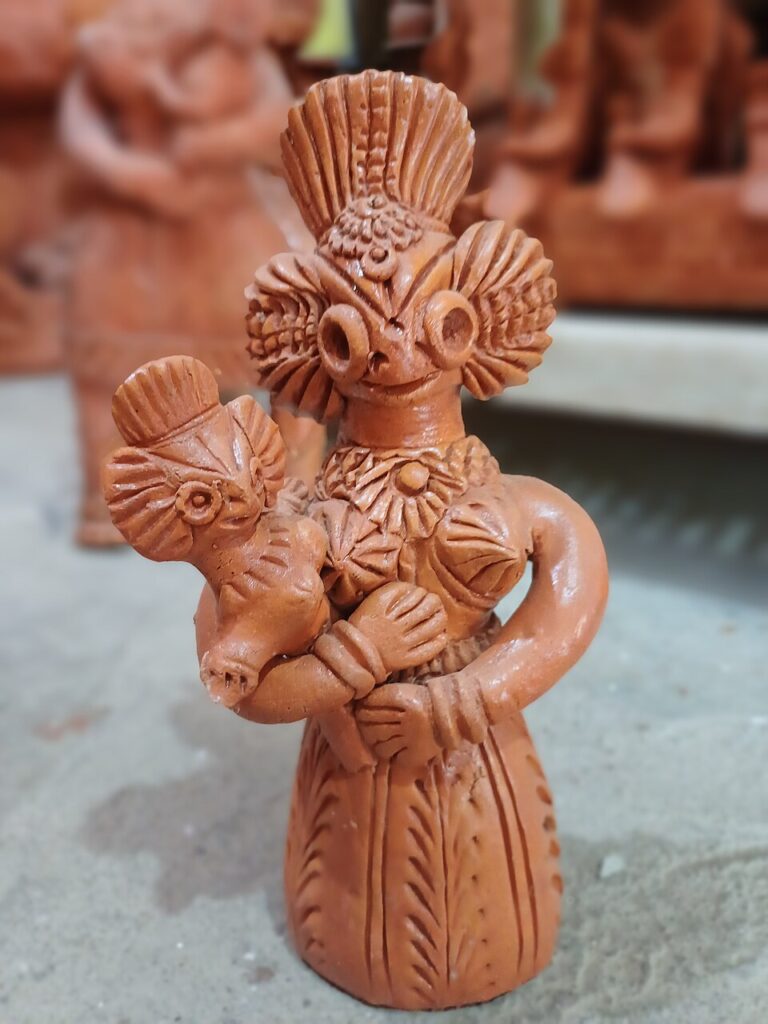
The term Putul means “toy” or “doll” in local language which came from Assamese word for doll “Putola”. The word Hatima is derived from the Assamese word “Hati” for “elephant,” referring to the doll’s unusually large, elephant-like ears and “Ma” for “mother”. This distinctive feature symbolizes motherhood and mother–child affection.<ref name=”Enroute”>{{cite web |title=Traditional Assamese Toys: Asharikandi Terracotta Toys |url=https://enrouteindianhistory.com/traditional-assamese-toys-asharikandi-terracotta-toys/ |website=Enroute Indian History |access-date=20 November 2025}}</ref>
The term Putul means “toy” or “doll” in local language which came from Assamese word for doll “Putola”. The word Hatima is derived from the Assamese word “Hati” for “elephant,” referring to the doll’s unusually large, elephant-like ears and “Ma” for “mother”. This distinctive feature symbolizes motherhood and mother–child affection.<ref name=”Enroute”>{{cite web |title=Traditional Assamese Toys: Asharikandi Terracotta Toys |url=https://enrouteindianhistory.com/traditional-assamese-toys-asharikandi-terracotta-toys/ |website=Enroute Indian History |access-date=20 November 2025}}</ref>
Artisans of the village fondly recall how the traditional ‘mother and child’ terracotta toy came to be known by its local name. The story goes back to the early 1970s, a vibrant period when the royal family of nearby [[Gauripur]] actively patronised terracotta craftsmanship. It was Nilima Baruah, sister of renowned filmmaker [[Pramathesh Barua]]—who coined the name Hatima Putul and introduced these dolls to audiences around the world.<ref name=”NE”>{{cite web |title=Asharikandi: Echoing Harappan terracotta tradition |url=https://www.nezine.com/info/Sm1ESm80MTlLZVFYZld1dFhaY0VTQT09/asharikandi:-echoing-harappan-terracotta-tradition.html |website=nezine.com |access-date=21 November 2025}}</ref>
Artisans of the village fondly recall how the traditional ‘mother and child’ terracotta toy came to be known by its local name. The story goes back to the early 1970s, a vibrant period when the royal family of nearby [[Gauripur]] actively patronised terracotta craftsmanship. It was Nilima Baruah, sister of renowned filmmaker [[Pramathesh Barua]]—who coined the name Hatima Putul and introduced these dolls to audiences around the world.<ref name=”NE”>{{cite web |title=Asharikandi: Echoing Harappan terracotta tradition |url=https://www.nezine.com/info/Sm1ESm80MTlLZVFYZld1dFhaY0VTQT09/asharikandi:-echoing-harappan-terracotta-tradition.html |website=nezine.com |access-date=21 November 2025}}</ref>
The name is believed to have emerged from the elephant-like ears of the mother figure in the doll. The Gauripur royal family had long nurtured an elephant-centred culture, capturing elephants from the wild, rearing them, and engaging in their trade. Many local people were involved in this occupation, and over time, the region’s [[Goalpariya Lokogeet]] and other folk songs also grew deeply rooted in this rich elephant heritage.<ref name=”NE”/>
The name is believed to have emerged from the elephant-like ears of the mother figure in the doll. The Gauripur royal family had long nurtured an elephant-centred culture, capturing elephants from the wild, rearing them, and engaging in their trade. Many local people were involved in this occupation, and over time, the region’s [[Goalpariya Lokogeet]] and other folk songs also grew deeply rooted in this rich elephant heritage.<ref name=”NE”/>
Traditional terracotta doll of India
Hatima Putul is a traditional terracotta doll originating from Asharikandi village in the Dhubri district of Assam, India. It is considered the hallmark of Asharikandi’s terracotta craft tradition and typically represents a mother holding her child. The doll is regarded as a cultural symbol of Assamese folk art.[1]
Etymology
The term Putul means “toy” or “doll” in local language which came from Assamese word for doll “Putola”. The word Hatima is derived from the Assamese word “Hati” for “elephant,” referring to the doll’s unusually large, elephant-like ears and “Ma” for “mother”. This distinctive feature symbolizes motherhood and mother–child affection.[2]
Artisans of the village fondly recall how the traditional ‘mother and child’ terracotta toy came to be known by its local name. The story goes back to the early 1970s, a vibrant period when the royal family of nearby Gauripur actively patronised terracotta craftsmanship. It was Nilima Baruah, sister of renowned filmmaker Pramathesh Barua—who coined the name Hatima Putul and introduced these dolls to audiences around the world.[3]
The name is believed to have emerged from the elephant-like ears of the mother figure in the doll. The Gauripur royal family had long nurtured an elephant-centred culture, capturing elephants from the wild, rearing them, and engaging in their trade. Many local people were involved in this occupation, and over time, the region’s Goalpariya Lokogeet and other folk songs also grew deeply rooted in this rich elephant heritage.[3]
Origin and Background
Asharikandi, located about 14 kilometres from Dhubri town, is one of the largest terracotta-producing villages in Assam. The craft tradition is primarily practiced by the Pala community, who migrated from the Pabna region of present-day Bangladesh during the 19th century. They were settled in the area and engaged in pottery-making.[4]
The name Asharikandi is believed to derive from two Assamese words — Aahar or Ashar (“month of monsoon”) and kandi (“tears”) — referring to the heavy rains of the region that historically hampered agricultural activity.[1][5][6]
Appearance and Characteristics

Hatima Putul is generally modelled as a mother figure holding her child. Prominent features include:
- Large, elephant-like ears
- A clear mother–child motif
- Occasional inclusion of lampstands
- Minimal ornamentation, with natural terracotta colouring as the primary aesthetic element
The doll conveys themes of motherhood, fertility, and affection.[2]
Production Process
The dolls are crafted using a special type of clay known as Hiramati, collected from the banks of local rivers.[1] The production involves several stages:
- Clay Preparation: The clay is soaked, cleaned of impurities, mixed with sand, and softened by foot-treading.
- Shaping: Artisans shape the doll by hand using traditional tools such as khota, pitna, and kodal.
- Drying and Firing: The shaped dolls are sun-dried and then fired in a clay furnace, a process known locally as bhati diya.
- Finishing: The fired dolls are coated with a thin mixture of khai, soda, and red mountain clay.
Terracotta craft in Asharikandi provides livelihood to hundreds of families.[7]
Cultural Significance
Hatima Putul is not merely a children’s toy but an important component of the folk culture and artistic heritage of Asharikandi. It represents the identity of the region’s clay artisans and plays a vital role in sustaining their economy.[4]
Recognition
In 1982, Asharikandi artisan Sarla Bala Devi received the President’s Award for her contributions to traditional terracotta art.[1] Since then, Hatima Putul has been featured in numerous handicraft exhibitions and museum collections across India. Organizations such as NECTAAR (North East Center for Technology Application and Reach) have undertaken initiatives and training programs to preserve and promote this craft tradition.[8] Considering the tourism potential of this craft village, the Government of Assam has declared the village as a model village and brought under its rural tourism projects. NECARDO (North East Craft And Rural Development Organisation), an NGO, has been working for the revival of the craft and socio-economic development of the craftspersons. NECARDO is also implementing a United Nations Development Project (UNDP) for the promotion of terracotta art and culture since 2006.[9]

