
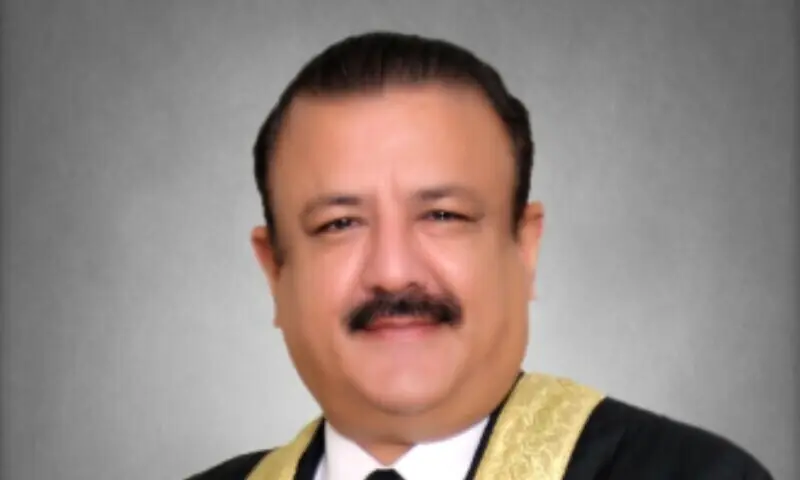
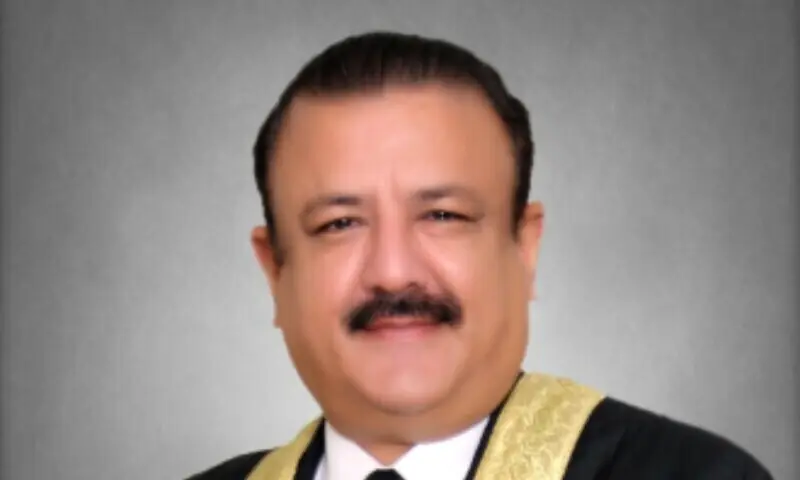
ISLAMABAD: The Islamabad High Court (IHC) has fixed for hearing a petition challenging the appointment of one of its own sitting judges, Justice Tariq Mahmood Jahangiri, over allegations of possessing an invalid law degree.
A two-member bench, led by Chief Justice Sardar Mohammad Sarfraz Dogar and comprising Justice Mohammad Azam Khan, will hear on September 16 the petition filed by Advocate Mian Dawood.
The petition, filed under Article 199 of the Constitution, seeks a writ of quo warranto (by what authority) against Justice Jahangiri, arguing that his foundational qualification for judicial office — an LLB degree from the University of Karachi — is “invalid”, thereby rendering his entire legal career and subsequent appointment illegitimate.
The petitioner has based his case on official correspondence from the University of Karachi, which is attached as evidence.
Justice Dogar’s predecessor had reserved judgement on maintainability of plea; fresh hearings will delve into substantive allegations
The petition was initially filed earlier this year. Former IHC CJ Aamer Farooq had reserved judgement on the preliminary issue of whether the petition was maintainable.
With the case now listed for a fresh hearing before a new bench, the court is poised to potentially delve into the substantive allegations.
The key allegations include use of dual enrollment numbers, as the record shows two different enrollment numbers for Justice Jahangiri’s LLB Part-I and Part-II examinations. The University of Karachi has previously stated that it is “impossible to allot two enrollment numbers to a student for one programme”.
The enrolment number AIL-5968/87, which appears on Justice Jahangiri’s LLB Part-I mark sheet, was officially allocated by the university to another individual, Imtiaz Ahmad, son of Muhammad Ellahi.
Furthermore, the principal of Government Islamia Law College, Karachi, stated in a letter that a student named “Tariq Mehmood s/o Qazi Muhammad Akram”, under enrolment number AIL-7124/87, was never admitted to the college for the LLB programme during the relevant period.
In addition, the Controller of Examinations at the University of Karachi concluded in an official letter that the degree and mark sheets in question are “invalid”.
The petition argues that the appointment of a judge without the requisite legal qualification is not just an administrative error, but a violation of the fundamental rights of all citizens.
Citing judgments like the Sajjad Ali Shah case, the petitioner contended that the presence of a judge with an allegedly invalid degree “shakes public confidence” and “tarnishes the image of the judiciary as a neutral arbiter”.
It may be recalled that Justice Jahangiri is one of the five judges who challenged the transfer of Justice Dogar, along with two other judges —Justice Khadim Hussain Soomro and Justice Mohammad Asif — to the Islamabad High Court.
He was also among the cohort that, last year, wrote a letter to the Supreme Judicial Council, alleging interference by intelligence agencies in the judicial matters.
Days before the controversy over his degree initially surfaced, Justice Jahangiri was expeditiously hearing election petitions against alleged rigging in all three constituencies of Islamabad.
Published in Dawn, September 12th, 2025

