
For Papua New Guinea, the conflict presents two stark choices: solidarity among fellow [[Melanesians|Melanesian tribes]] or maintaining good relations with Indonesia, its closest neighbor across the border.The first visit to Indonesia by [[Prime Minister of Papua New Guinea|Papua New Guinean Prime Minister]] [[Michael Somare]] and President [[Suharto]] in 1977 focused on security and economic cooperation, as well as a desire to establish a joint defense communique.<ref>{{cite web|url=https://eresources.nlb.gov.sg/newspapers/digitised/page/straitstimes19770115-1.1.2 |title=Somare: Peking ready for ties with -Jakarta|date= 15 January 1977|access-date=1 January 2026|website= New Straits Times}}</ref><ref>{{cite web|url=https://soehartolibrary.id/1977-01-13-indonesia-papua-nugini-keluarkan-komunike-bersama/|title=Indonesia-Papua Nugini Keluarkan Komunike Bersama|date= 13 January 1977|access-date=1 January 2026|website=soehartolibrary.id}}</ref> In 1979, President Suharto visited Papua New Guinea for the first time to finalize the points of a defense agreement.<ref>{{cite web|url=https://eresources.nlb.gov.sg/newspapers/digitised/page/straitstimes19790607-1.1.3|title=Accord to prevent rebel raids|date= 7 June 1979|access-date=1 January 2026|website= New Straits Times}}</ref> President Suharto successfully convinced Papua New Guineans to strengthen cooperation for mutual prosperity. The massive Indonesian military offensive in Papua, [[1976 Jayapura operation|Operation Jayapura]], weakened the [[Free Papua Movement|OPM movement]], causing many to flee to the Papua New Guinea border. The Papua New Guinean military culminated in the capture of OPM leaders [[Jacob Prai]] and [[John Ondawame]], who took refuge in PNG.<ref>{{cite web|url=https://eresources.nlb.gov.sg/newspapers/digitised/page/straitstimes19780928-1.1.5|title=Top rebel leader arrested|date= 28 September 1978|access-date=1 January 2026|website= New Straits Times}}</ref><ref>{{cite web|url=https://data.tempo.co/MajalahTeks/detail/ARM2018061277922/kita-agak-terganggu-dengan-kita-agak-terganggu-dengan|title=Wawancara dengan menlu mochtar|date= 30 December 1978|access-date=1 January 2026|website=Data.tempo.com}}</ref>
For Papua New Guinea, the conflict presents two stark choices: solidarity among fellow [[Melanesians|Melanesian tribes]] or maintaining good relations with Indonesia, its closest neighbor across the border.The first visit to Indonesia by [[Prime Minister of Papua New Guinea|Papua New Guinean Prime Minister]] [[Michael Somare]] and President [[Suharto]] in 1977 focused on security and economic cooperation, as well as a desire to establish a joint defense communique.<ref>{{cite web|url=https://eresources.nlb.gov.sg/newspapers/digitised/page/straitstimes19770115-1.1.2 |title=Somare: Peking ready for ties with -Jakarta|date= 15 January 1977|access-date=1 January 2026|website= New Straits Times}}</ref><ref>{{cite web|url=https://soehartolibrary.id/1977-01-13-indonesia-papua-nugini-keluarkan-komunike-bersama/|title=Indonesia-Papua Nugini Keluarkan Komunike Bersama|date= 13 January 1977|access-date=1 January 2026|website=soehartolibrary.id}}</ref> In 1979, President Suharto visited Papua New Guinea for the first time to finalize the points of a defense agreement.<ref>{{cite web|url=https://eresources.nlb.gov.sg/newspapers/digitised/page/straitstimes19790607-1.1.3|title=Accord to prevent rebel raids|date= 7 June 1979|access-date=1 January 2026|website= New Straits Times}}</ref> President Suharto successfully convinced Papua New Guineans to strengthen cooperation for mutual prosperity. The massive Indonesian military offensive in Papua, [[1976 Jayapura operation|Operation Jayapura]], weakened the [[Free Papua Movement|OPM movement]], causing many to flee to the Papua New Guinea border. The Papua New Guinean military culminated in the capture of OPM leaders [[Jacob Prai]] and [[John Ondawame]], who took refuge in PNG.<ref>{{cite web|url=https://eresources.nlb.gov.sg/newspapers/digitised/page/straitstimes19780928-1.1.5|title=Top rebel leader arrested|date= 28 September 1978|access-date=1 January 2026|website= New Straits Times}}</ref><ref>{{cite web|url=https://data.tempo.co/MajalahTeks/detail/ARM2018061277922/kita-agak-terganggu-dengan-kita-agak-terganggu-dengan|title=Wawancara dengan menlu mochtar|date= 30 December 1978|access-date=1 January 2026|website=Data.tempo.com}}</ref>
Entering the 1980s, the OPM movement weakened following Indonesia’s massive military operation in Jayapura and also due to internal strife within the OPM leadership.{{sfn|Osborne|1985|pp=63–65}} According to [[Kopkamtib]] (Indonesia’s special military intelligence agency), remnants of the OPM movement remained and were hiding around the border with PNG. The Indonesian military launched a new military operation, Operation Clean Sweap (”Operasi Sapu Bersih”), to hunt down OPM movements on the PNG border.<ref>{{cite web|url=https://suarapapua.com/2019/12/12/15-operasi-militer-indonesia-di-papua-antara-1963-2004/|title=15 Operasi Militer Indonesia di Papua antara 1963 – 2004|date= 12 December 2019|access-date=10 January 2026|website= suarapapua.com }}</ref>
Entering the 1980s, the OPM movement weakened following Indonesia’s massive military operation in Jayapura and also due to internal strife within the OPM leadership.{{sfn|Osborne|1985|pp=63–65}} According to [[Kopkamtib]] (Indonesia’s special military intelligence agency), remnants of the OPM movement remained and were hiding around the border with PNG. The Indonesian military launched a new military operation, Operation Clean Sweap (”Operasi Sapu Bersih”), to hunt down OPM movements on the PNG border.<ref>{{cite web|url=https://suarapapua.com/2019/12/12/15-operasi-militer-indonesia-di-papua-antara-1963-2004/|title=15 Operasi Militer Indonesia di Papua antara 1963 – 2004|date= 12 December 2019|access-date=10 January 2026|website= suarapapua.com }}</ref>
During a visit to [[Jakarta]], Papua New Guinea’s Foreign Minister, [[Rabbie Namaliu]], protested the Indonesian military’s border violations, which triggered a mass exodus of West Papuans to Papua New Guinea.<ref>{{cite web|url=https://eresources.nlb.gov.sg/newspapers/digitised/page/straitstimes19841019-1.1.7 |title=Namaliu: We’ve every right|date= 19 October 1984|access-date=10 January 2026|website= New Straits Times}}</ref> The two governments agreed to resolve the border crisis by updating the 1979 security agreement with a more comprehensive and comprehensive agreement covering refugees, borders, defense and security, and respect for the territorial integrity of both regions. The agreement is called the ”Treaty of Mutual Respect, Cooperation and Friendship” which was signed on October 27, 1986.<ref>{{cite web|url=https://eresources.nlb.gov.sg/newspapers/digitised/page/straitstimes19860529-1.1.6|title=PNG, Indonesia make headway in treaty talks|date= 29 May 1986|access-date=10 January 2026|website= New Straits Times}}</ref> In the agreement, both countries agreed to “avoid, reduce and limit disputes or conflicts between their countries and respect the territorial integrity of both countries and resolve any differences that may arise only by peaceful means”.<ref name=”:0″>{{Cite web|url=http://countrystudies.us/indonesia/100.htm|title=Indonesia – Papua New Guinea}}</ref> <ref>{{cite web|url=https://www.tandfonline.com/doi/abs/10.1080/14672715.1987.10409793 |title=Mutual respect, friendship and co-operation” The Indonesia-Papua New Guinea Border and its effects on relations between Papua New Guinea and Indonesia|date= 5 July 2019|access-date=10 January 2026|website= tandfonline.com }}</ref>
During a visit to [[Jakarta]], Papua New Guinea’s Foreign Minister, [[Rabbie Namaliu]], protested the Indonesian military’s border violations, which triggered a mass exodus of West Papuans to Papua New Guinea.<ref>{{cite web|url=https://eresources.nlb.gov.sg/newspapers/digitised/page/straitstimes19841019-1.1.7 |title=Namaliu: We’ve every right|date= 19 October 1984|access-date=10 January 2026|website= New Straits Times}}</ref> The two governments agreed to resolve the border crisis by updating the 1979 security agreement with a more comprehensive and comprehensive agreement covering refugees, borders, defense and security, and respect for the territorial integrity of both regions. The agreement is called the ”Treaty of Mutual Respect, Cooperation and Friendship” which was signed on October 27, 1986.<ref>{{cite web|url=https://eresources.nlb.gov.sg/newspapers/digitised/page/straitstimes19860529-1.1.6|title=PNG, Indonesia make headway in treaty talks|date= 29 May 1986|access-date=10 January 2026|website= New Straits Times}}</ref> In the agreement, both countries agreed to “avoid, reduce and limit disputes or conflicts between their countries and respect the territorial integrity of both countries and resolve any differences that may arise only by peaceful means”.<ref name=”:0″>{{Cite web|url=http://countrystudies.us/indonesia/100.htm|title=Indonesia – Papua New Guinea}}</ref> <ref>{{cite web|url=https://www.tandfonline.com/doi/abs/10.1080/14672715.1987.10409793 |title=Mutual respect, friendship and co-operation” The Indonesia-Papua New Guinea Border and its effects on relations between Papua New Guinea and Indonesia|date= 5 July 2019|access-date=10 January 2026|website= tandfonline.com }}</ref>
Bilateral relations
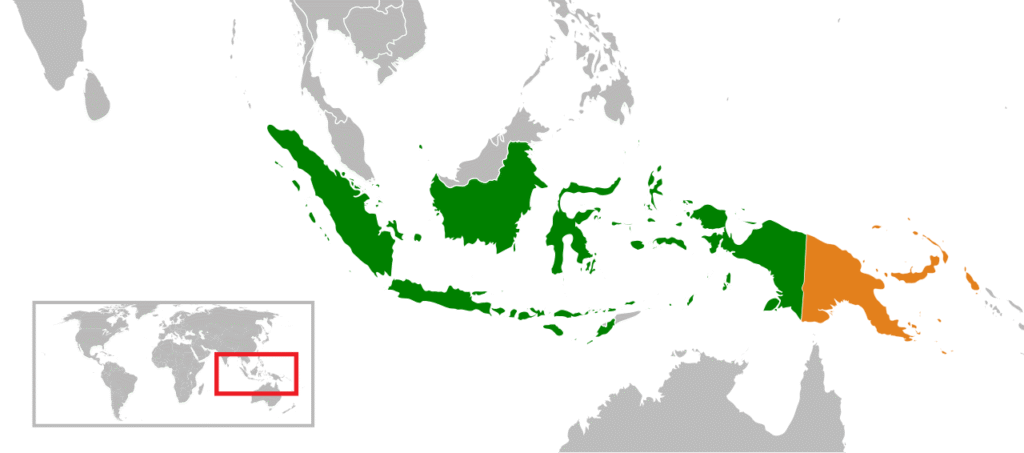
Indonesia–Papua New Guinea relations are foreign relations between Indonesia and Papua New Guinea.The relationship between the two countries has existed for a long time, even before Papua New Guinea’s independence, when it was still under Australian control. The Indonesian and Australian governments collaborated to establish a boundary line for Indonesia and British New Guinea in the early 1970s.[1]
For Indonesia, Papua New Guinea is an important country, one of three countries sharing a land border with Indonesia. The two countries share an 820-kilometre (510 mi) border that has raised tensions and ongoing diplomatic issues over many decades.[2]
Indonesia is represented in Papua New Guinea with an embassy in Port Moresby[3] and a consulate in Vanimo,[4] while Papua New Guinea is represented in Indonesia with an embassy in Jakarta[5] and a consulate-general in Jayapura.[6] Both nations are members of APEC, Non-Aligned Movement and the United Nations.
Indonesia was one of the first eight countries to recognize Papua New Guinea’s independence on 16 September 1975.[7][8]
The Indonesian government began the decolonization process in West Papua, a former Dutch colony, in 1963, and international recognition was granted in 1969 following the Act of Free Choice, a controversial referendum, with a voter turnout less than the local population.[9] The Free Papua Movement (Indonesian: Organisasi Papua Merdeka/OPM) was founded in response, aiming to achieve independence from Indonesia. The movement began an armed struggle primarily against the Indonesian Army. The Indonesian government’s crackdown on the rebellion in West Papua has led to extensive and ongoing border issues resulting in a prolonged refugee presence and constant movement between Papua and Papua New Guinea.[10]
For Papua New Guinea, the conflict presents two stark choices: solidarity among fellow Melanesian tribes or maintaining good relations with Indonesia, its closest neighbor across the border.The first visit to Indonesia by Papua New Guinean Prime Minister Michael Somare and President Suharto in 1977 focused on security and economic cooperation, as well as a desire to establish a joint defense communique.[11][12] In 1979, President Suharto visited Papua New Guinea for the first time to finalize the points of a defense agreement.[13] President Suharto successfully convinced Papua New Guineans to strengthen cooperation for mutual prosperity. The massive Indonesian military offensive in Papua, Operation Jayapura, weakened the OPM movement, causing many to flee to the Papua New Guinea border. The Papua New Guinean military culminated in the capture of OPM leaders Jacob Prai and John Ondawame, who took refuge in PNG.[14][15]
Entering the 1980s, the OPM movement weakened following Indonesia’s massive military operation in Jayapura and also due to internal strife within the OPM leadership. According to Kopkamtib (Indonesia’s special military intelligence agency), remnants of the OPM movement remained and were hiding around the border with PNG.[17] The Indonesian military launched a new military operation, Operation Clean Sweap (Operasi Sapu Bersih), to hunt down OPM movements on the PNG border.[18]
During a visit to Jakarta, Papua New Guinea’s Foreign Minister, Rabbie Namaliu, protested the Indonesian military’s border violations, which triggered a mass exodus of West Papuans to Papua New Guinea.[19] The two governments agreed to resolve the border crisis by updating the 1979 security agreement with a more comprehensive and comprehensive agreement covering refugees, borders, defense and security, and respect for the territorial integrity of both regions. The agreement is called the Treaty of Mutual Respect, Cooperation and Friendship which was signed on October 27, 1986.[20] In the agreement, both countries agreed to “avoid, reduce and limit disputes or conflicts between their countries and respect the territorial integrity of both countries and resolve any differences that may arise only by peaceful means”.[2] [21]
Bilateral Relations
[edit]
Due to conflict adjacent to the border between the two countries, refugees have crossed the border regularly.[22][23] The largest amount of refugees originated in 1984, with over 10,000 Papuans from the Indonesian side crossing the border.[24]
The main issue of refugees is from conflict between Indonesian national security forces, and various groups of disaffected groups in West Papua seeking refuge in the Papua New Guinea territory.[25]
The subsequent diplomatic issues that have arisen, usually is the refugee flows and border transgressions by Indonesian forces.
Its (PNG) proximity and cultural ties to the Indonesian province of Papua means there is potential for a mass influx of West Papuan refugees. Given the continuing political instability and the security situation in Papua, regular revision of PNG’s contingency plans and training of GoPNG officials is considered important.[26]
Trade between the two countries amounted to US$ 256 million in 2018, with the trade balance being strongly favourable to Indonesia.[27] A preferential trade agreement between the two countries have been considered.[28] Vanilla is one commodity exported from PNG to Indonesia,[29] with vanilla trading firm Aust & Hachmann estimating that 50 percent of PNG’s vanilla production was traded across the border in 2023.[30] The main Indonesian exports to PNG are food products such as instant noodles and cooking oil, along with electronics, soaps, fertilizers, and metals.[31][32] The first Indonesia–Papua New Guinea Business Forum was held in 2023, attended by president Joko Widodo and PM James Marape.[33]
- ^ “In office – Gough Whitlam – Australia’s PMs – Australia’s Prime Ministers”. Primeministers.naa.gov.au. Archived from the original on 19 April 2013. Retrieved 2 October 2017.
- ^ a b “Indonesia – Papua New Guinea”.
- ^ “Embassy of the Republic of Indonesia in Port Moresby, Papua New Guinea”. Retrieved 29 October 2024.
- ^ “Consulate of the Republic of Indonesia in Vanimo, Papua New Guinea”. Retrieved 29 October 2024.
- ^ “Kundu Jakarta”. Retrieved 16 December 2024.
- ^ “Kundu Jayapura”. Retrieved 31 January 2025.
- ^ Guidelines of the Foreign Policy of Papua New Guinea: Universalism. Department of Foreign Affairs and Trade, Papua New Guinea. 1976. p. 55.
- ^ Australian Foreign Affairs Record. Vol. 48. Australian Government Pub. Service. 1977. p. 192.
- ^ “The Struggle for Self-determination in West Papua (1969-present)”. International Center on Nonviolent Conflict. Retrieved 3 February 2025.
- ^ Chauvel, Richard Refuge, displacement and dispossession: responses to Indonesian rule and conflict in Papua RSC Working Paper No. 42 Dynamics of Conflict and Displacement in Papua, Indonesia A collection of papers developed in conjunction with a one-day workshop held on 26 October 2006 at St. Antony’s College, Oxford Edited by Eva-Lotta E. Hedman September 2007.
- ^ “Somare: Peking ready for ties with -Jakarta”. New Straits Times. 15 January 1977. Retrieved 1 January 2026.
- ^ “Indonesia-Papua Nugini Keluarkan Komunike Bersama”. soehartolibrary.id. 13 January 1977. Retrieved 1 January 2026.
- ^ “Accord to prevent rebel raids”. New Straits Times. 7 June 1979. Retrieved 1 January 2026.
- ^ “Top rebel leader arrested”. New Straits Times. 28 September 1978. Retrieved 1 January 2026.
- ^ “Wawancara dengan menlu mochtar”. Data.tempo.com. 30 December 1978. Retrieved 1 January 2026.
- ^ Rahab, Amiruddin (27 May 2006). Operasi-Operasi Militer di Papua (in Indonesian). BRIN ejournal. p. 13.
- ^ “15 Operasi Militer Indonesia di Papua antara 1963 – 2004”. suarapapua.com. 12 December 2019. Retrieved 10 January 2026.
- ^ “Namaliu: We’ve every right”. New Straits Times. 19 October 1984. Retrieved 10 January 2026.
- ^ “PNG, Indonesia make headway in treaty talks”. New Straits Times. 29 May 1986. Retrieved 10 January 2026.
- ^ “Mutual respect, friendship and co-operation” The Indonesia-Papua New Guinea Border and its effects on relations between Papua New Guinea and Indonesia”. tandfonline.com. 5 July 2019. Retrieved 10 January 2026.
- ^ “Dynamics of conflict and displacement in Papua, Indonesia – Indonesia”.
- ^ Glazebrook, Diana. 2004. “‘If I stay here there is nothing yet if I return I do not know whether I will be safe’: West Papuan refugee responses to Papua New Guinea Asylum Policy 1998–2003″, Journal of Refugee Studies 17(2): 205–221.
- ^ Chandler, Jo (30 November 2019). “Refugees on their own land: the West Papuans in limbo in Papua New Guinea”. The Guardian. Retrieved 3 February 2025.
- ^ Kirsch, Stuart. 1996. “Refugees and Representation: Politics, Critical Discourse, and Ethnography along the New Guinea Border”, in Michael Morgan and Susan Leggett (eds.) “Mainstream(s) and Margins: Cultural Politics in the 1990s”, 222–236. Contributions in Political Science, Number 367. Westport, Ct: Greenwood Press.
- ^ UNHCR, Country Operations Plan, Papua New Guinea, Planning Year 2006.
- ^ “Demand for Indonesian goods high: Diplomat”. Post-Courier. 29 December 2019. Retrieved 14 December 2021.
- ^ “Indonesia Jajaki Perjanjian PTA dengan Papua Nugini dan Fiji”. Bisnis.com (in Indonesian). 21 March 2019. Retrieved 14 December 2021.
- ^ “Indonesia and PNG discuss border issues”. RNZ. 6 August 2021. Retrieved 14 December 2021.
- ^ “Fifty per cent of PNG vanilla still making its way into Indonesia, says global buyer”. Papua New Guinea Post-Courier. 21 June 2024. Retrieved 28 August 2025.
- ^ “Bea Cukai: Ekspor ke Papua Nugini via PLBN Skouw dominasi makanan”. Antara News Papua (in Indonesian). 13 January 2025. Retrieved 28 August 2025.
- ^ “Indonesia Paling Banyak Ekspor Sabun ke Papua New Guinea pada 2023”. katadata.co.id (in Indonesian). 11 April 2025. Retrieved 28 August 2025.
- ^ “Jokowi talks trade, investments on PNG trip – The Jakarta Post”. The Jakarta Post. 5 July 2023. Retrieved 13 July 2023.

