


[[Category:University of Tehran alumni]]
[[Category:University of Tehran alumni]]
[[Category:University of Southern California alumni]]
[[Category:University of Southern California alumni]]
[[Category:University of Southern California faculty]]
Iranian-American academic
|
Iraj Ershaghi |
|
|---|---|
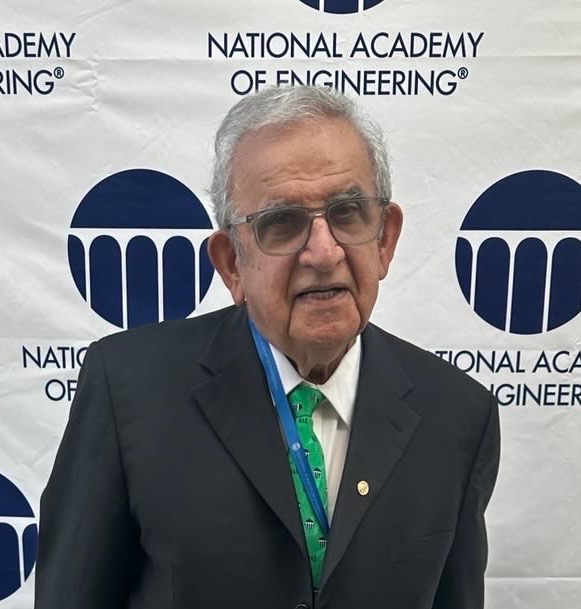
 Dr. Iraj Ershaghi in 2025 |
|
| Occupations | Petroleum engineer, researcher, and academic |
| Awards | |
| Education |
|
| Discipline | Petroleum engineer |
| Institutions | University of Southern California |
| Main interests | Reservoir characterization, digital oilfield technology |
Iraj Ershaghi is an Iranian-American petroleum engineer and academic who serves as the Omar B. Milligan Professor of Petroleum Engineering at the University of Southern California (USC). His research focuses on reservoir characterization, fractured reservoir systems, digital and smart oilfield technologies, and low-carbon energy transition strategies.
Ershaghi was elected to the National Academy of Engineering in 2014 “for contributions to the characterization of complex fractured reservoirs and for leadership in university-industry collaboration.” He has received industry honors including the American Institute of Mining, Metallurgical, and Petroleum Engineers (AIME)’s Honorary Membership, and the SPE John Franklin Carll Award.
Early life and education
[edit]
Ershaghi was born in Iran.[1] He received a bachelor’s degree in petroleum engineering from the University of Tehran in 1965, and later earned both his master’s (1968) and Ph.D. (1972) in petroleum engineering from the University of Southern California.[2]
In the early part of his career, Ershaghi worked as an engineer in the Bahregansar oil field in Iran.[3] He also worked for AGIP-SIRIP, Signal Oil and Gas Company, and the California State Lands Commission prior to joining the University of Southern California (USC) faculty in 1972.[4]
Ershaghi holds the Omar B. Milligan chair in Petroleum Engineering at USC and directs the university’s Petroleum Engineering program. He also serves as executive director of the Ershaghi Center for Energy Transition (E-CET), as well as the Center for Interactive Smart Oilfield Technologies (CiSoft), which in 2008 was described as “the university’s biggest industry partnership.”[5] His research spans low-carbon engineering, greenhouse gas monitoring, complex reservoir well-testing, pattern recognition for waterflood and EOR monitoring, reservoir characterization, unconventional resources, and soft-computing approaches to digital oilfield design.[2]
In 2020, Ershaghi argued that repurposed idle wells could provide “subsurface energy storage” and reduce the environmental and economic costs of abandonment.[6][7]
In April 2022, USC launched the Ershaghi Center on Energy Transition (E-CET), named in his honor and supported by a gift from his former student Gary Buntmann and his wife.[8] The center focuses on advancing technologies for lowering the carbon footprint of oil and gas development and for converting idle wells into subsurface energy and geothermal storage sites.[9]
Awards and recognitions
[edit]
In 2012, Ershaghi received Honorary Membership in the American Institute of Mining, Metallurgical, and Petroleum Engineers for more than four decades of contributions to the advancement of reservoir characterization and the evaluation of hydrocarbon and geothermal reservoirs.[10][11]
Ershaghi has been awarded Honorary Membership in the Society of Petroleum Engineers (SPE).[12] His awards and recognitions from the organization include the Distinguished Achievement Award for Petroleum Engineering Faculty (1983), Distinguished Member Award (1996),[2][12] Western North America Distinguished Service Award (2005), Technology Transfer Award (2006), North America Western Region Reservoir Description and Dynamics Award (2007),[2][11] Distinguished Lecturer (2006–2007),[11] John Franklin Carll Award (2010),[12] and Legion of Honor (2016).[13] In 2022, he was awarded the U.S. Colonel Edwin L. Drake Oilman Award by the Petroleum History Institute.[14]
In 2014, Ershaghi was elected to the National Academy of Engineering for “contributions to characterization of complex fractured reservoirs, and for leadership in university-industry collaboration.”[15]
Selected publications
[edit]
- Ershaghi, I., & Omorigie, O. (1978). “A method for extrapolation of cut vs recovery curves.” Journal of Petroleum Technology, 30(2), 203–204.
- Ucok, H., Ershaghi, I., & Olhoeft, G. R. (1980). “Electrical resistivity of geothermal brines.” Journal of Petroleum Technology, 32(4), 717–727.
- Abdassah, D., & Ershaghi, I. (1986). “Triple-porosity systems for representing naturally fractured reservoirs.” SPE Formation Evaluation, 1(2), 113–127.
- Acuna, J. A., Ershaghi, I., & Yortsos, Y. C. (1995). “Practical application of fractal pressure-transient analysis in naturally fractured reservoirs.” SPE Formation Evaluation, 10(3), 173–179.
- Al-Ghamdi, A., & Ershaghi, I. (1996). “Pressure transient analysis of dually fractured reservoirs.” SPE Journal, 1(1), 93–100.
- Ershaghi, Iraj (2019). “17 – Ethical Issues Facing Engineers in Oil and Gas Operations”. In Ali E. Abbas (ed.). Ethical Issues Facing Engineers in Oil and Gas Operations. Cambridge University Press. pp. 245–257. doi:10.1017/9781108616188.017.
- ^ “Iranian Engineer Elected by US’s National Academy of Engineering”. Shana. 2014-03-08. Retrieved 2025-11-23.
- ^ a b c d “USC – Viterbi School of Engineering – Viterbi Faculty Directory – Iraj Ershaghi”. viterbi.usc.edu. Retrieved 2025-11-23.
- ^ “What is a ‘top kill’?”. BBC News. 2010-05-26. Retrieved 2025-12-04.
- ^ “Waterflooding Concepts, Design Prediction and Optimization”. Society of Petroleum Engineers.
- ^ “Challenges To Environmentally Responsible Energy Use In Today’s Society”. ScienceDaily. Retrieved 2025-11-23.
- ^ “Repurposed Oil and Gas Wells Can Be Used to Store Sustainable Energy Underground”. Engineering.com. October 2023. Retrieved 2025-11-06.
- ^ “Q&A: Oil and Gas Wells for Energy Storage”. Tech Briefs. 2021-02-01. Retrieved 2025-11-23.
- ^ “Ershaghi Center on Energy Transition Launches”. USC Viterbi | School of Engineering. April 13, 2022. Retrieved 2025-11-23.
- ^ “USC Viterbi School of Engineering Establishes Ershaghi Center for Energy Transition”. Journal of Petroleum Technology. 2022-03-21. Retrieved 2025-11-23.
- ^ “AIME Honorary Membership | The American Institute of Mining, Metallurgical, and Petroleum Engineers”. American Institute of Mining, Metallurgical, and Petroleum Engineers. Retrieved 2025-11-23.
- ^ a b c “Iraj Ershaghi | The American Institute of Mining, Metallurgical, and Petroleum Engineers”. American Institute of Mining, Metallurgical, and Petroleum Engineers. Retrieved 2025-11-23.
- ^ a b c “Past International SPE Award Recipients”. Society of Petroleum Engineers.
- ^ “Legion of Honor Inductees”. Society of Petroleum Engineers.
- ^ Barrett, Mary L.; Silverman, Matthew R.; Leech, Maureen (2023). “Front Matter: Oil-Industry History – A publication of the Petroleum History Institute, Volume 24 (2023)”. Oil-Industry History. 24 (1) – via 227-231.
- ^ “Professor Iraj Ershaghi”. National Academy of Engineering. Retrieved 2025-11-23.



