


== Description ==
== Description ==
IRAS 17208−0014 is categorized as an advanced [[galaxy merger]], a result of two [[Disc galaxy|disk galaxies]] colliding with one another. It is known to display two [[Tidal tail|tidal tails]] that are protruding out from the galaxy by 20 [[Parsec|kiloparsecs]] with a distorted central body.<ref name=”:1″>{{Cite journal |last1=Jogee |first1=S. |last2=Reddy |first2=N. |last3=Scoville |first3=N. Z. |date=2003 |title=IRAS 17208: An Advanced Merger with a Gas-Rich Starburst Evolving towards an Eliptical Galaxy? |url=https://ui.adsabs.harvard.edu/abs/2003ASPC..290..513J/abstract |journal=Active Galactic Nuclei: From Central Engine to Host Galaxy |language=en |volume=290 |pages=513 |bibcode=2003ASPC..290..513J |issn=1050-3390}}</ref><ref>{{Cite journal |last1=Murphy |first1=T. W. |last2=Armus |first2=L. |last3=Matthews |first3=K. |last4=Soifer |first4=B. T. |last5=Mazzarella |first5=J. M. |last6=Shupe |first6=D. L. |last7=Strauss |first7=M. A. |last8=Neugebauer |first8=G. |date=March 1996 |title=Visual and Near-Infrared Imaging of Ultraluminous Infrared Galaxies: The IRAS 2 Jy Sample |url=https://articles.adsabs.harvard.edu/pdf/1996AJ….111.1025M |journal=The Astronomical Journal |language=en |volume=111 |pages=1025 |doi=10.1086/117849 |bibcode=1996AJ….111.1025M |issn=0004-6256}}</ref> The outer disk of the galaxy is disturbed and it has an extended nucleus when shown in [[Infrared|near-infrared]] imaging bands, captured by the [[Hubble Space Telescope]] NICMOS camera.<ref>{{Cite journal |last1=Scoville |first1=N. Z. |last2=Evans |first2=A. S. |last3=Thompson |first3=R. |last4=Rieke |first4=M. |last5=Hines |first5=D. C. |last6=Low |first6=F. J. |last7=Dinshaw |first7=N. |last8=Surace |first8=J. A. |last9=Armus |first9=L. |date=March 2000 |title=NICMOS Imaging of Infrared-Luminous Galaxies |journal=The Astronomical Journal |language=en |volume=119 |issue=3 |pages=991–1061 |doi=10.1086/301248 |arxiv=astro-ph/9912246 |bibcode=2000AJ….119..991S |issn=0004-6256}}</ref> The nucleus of the galaxy is compact and elongated along the [[position angle]] of 90° to 110°.<ref>{{Cite journal |last1=Genzel |first1=R. |last2=Tacconi |first2=L. J. |last3=Rigopoulou |first3=D. |last4=Lutz |first4=D. |last5=Tecza |first5=M. |date=2001-12-20 |title=Ultraluminous Infrared Mergers: Elliptical Galaxies in Formation? |url=https://iopscience.iop.org/article/10.1086/323772/fulltext/ |journal=The Astrophysical Journal |volume=563 |issue=2 |pages=527–545 |doi=10.1086/323772 |arxiv=astro-ph/0106032 |bibcode=2001ApJ…563..527G |issn=0004-637X}}</ref> It is surrounded by both absorption features and condensations.<ref>{{Cite journal |last1=Duc |first1=P.-A. |last2=Mirabel |first2=I. F. |last3=Maza |first3=J. |date=September 1997 |title=Southern ultraluminous infrared galaxies: an optical and infrared database |url=https://aas.aanda.org/articles/aas/pdf/1997/12/ds1299.pdf |journal=Astronomy and Astrophysics Supplement Series |language=en |volume=124 |issue=3 |pages=533–557 |doi=10.1051/aas:1997205 |bibcode=1997A&AS..124..533D |issn=0365-0138}}</ref> Observations also showed it has a buried [[active galactic nucleus]] (AGN) in the western disk of the galaxy.<ref name=”:0″ /> The galaxy has a [[supermassive black hole]] located in the center, with a mass of 2.3 x 10<sup>8</sup> M<sub>ʘ</sub> based on a stellar velocity dispersion.<ref>{{Cite journal |last1=Arribas |first1=Santiago |last2=Colina |first2=Luis |date=2003-07-10 |title=INTEGRAL Spectroscopy of IRAS 17208−0014: Implications for the Evolutionary Scenarios of Ultraluminous Infrared Galaxies |url=https://iopscience.iop.org/article/10.1086/375417/fulltext/ |journal=The Astrophysical Journal |volume=591 |issue=2 |pages=791–800 |doi=10.1086/375417 |arxiv=astro-ph/0304138 |bibcode=2003ApJ…591..791A |hdl=10261/199251 |issn=0004-637X}}</ref>
IRAS 17208−0014 is categorized as an advanced [[galaxy merger]], a result of two [[Disc galaxy|disk galaxies]] colliding with one another. It is known to display two [[Tidal tail|tidal tails]] that are protruding out from the galaxy by 20 [[Parsec|kiloparsecs]] with a distorted central body.<ref name=”:1″>{{Cite journal |last1=Jogee |first1=S. |last2=Reddy |first2=N. |last3=Scoville |first3=N. Z. |date=2003 |title=IRAS 17208: An Advanced Merger with a Gas-Rich Starburst Evolving towards an Eliptical Galaxy? |url=https://ui.adsabs.harvard.edu/abs/2003ASPC..290..513J/abstract |journal=Active Galactic Nuclei: From Central Engine to Host Galaxy |language=en |volume=290 |pages=513 |bibcode=2003ASPC..290..513J |issn=1050-3390}}</ref><ref>{{Cite journal |last1=Murphy |first1=T. W. |last2=Armus |first2=L. |last3=Matthews |first3=K. |last4=Soifer |first4=B. T. |last5=Mazzarella |first5=J. M. |last6=Shupe |first6=D. L. |last7=Strauss |first7=M. A. |last8=Neugebauer |first8=G. |date=March 1996 |title=Visual and Near-Infrared Imaging of Ultraluminous Infrared Galaxies: The IRAS 2 Jy Sample |url=https://articles.adsabs.harvard.edu/pdf/1996AJ….111.1025M |journal=The Astronomical Journal |language=en |volume=111 |pages=1025 |doi=10.1086/117849 |bibcode=1996AJ….111.1025M |issn=0004-6256}}</ref> The outer disk of the galaxy is disturbed and it has an extended nucleus when shown in [[Infrared|near-infrared]] imaging bands, captured by the [[Hubble Space Telescope]] NICMOS camera.<ref>{{Cite journal |last1=Scoville |first1=N. Z. |last2=Evans |first2=A. S. |last3=Thompson |first3=R. |last4=Rieke |first4=M. |last5=Hines |first5=D. C. |last6=Low |first6=F. J. |last7=Dinshaw |first7=N. |last8=Surace |first8=J. A. |last9=Armus |first9=L. |date=March 2000 |title=NICMOS Imaging of Infrared-Luminous Galaxies |journal=The Astronomical Journal |language=en |volume=119 |issue=3 |pages=991–1061 |doi=10.1086/301248 |arxiv=astro-ph/9912246 |bibcode=2000AJ….119..991S |issn=0004-6256}}</ref> The nucleus of the galaxy is compact and elongated along the [[position angle]] of 90° to 110°.<ref>{{Cite journal |last1=Genzel |first1=R. |last2=Tacconi |first2=L. J. |last3=Rigopoulou |first3=D. |last4=Lutz |first4=D. |last5=Tecza |first5=M. |date=2001-12-20 |title=Ultraluminous Infrared Mergers: Elliptical Galaxies in Formation? |url=https://iopscience.iop.org/article/10.1086/323772/fulltext/ |journal=The Astrophysical Journal |volume=563 |issue=2 |pages=527–545 |doi=10.1086/323772 |arxiv=astro-ph/0106032 |bibcode=2001ApJ…563..527G |issn=0004-637X}}</ref> It is surrounded by both absorption features and condensations.<ref>{{Cite journal |last1=Duc |first1=P.-A. |last2=Mirabel |first2=I. F. |last3=Maza |first3=J. |date=September 1997 |title=Southern ultraluminous infrared galaxies: an optical and infrared database |url=https://aas.aanda.org/articles/aas/pdf/1997/12/ds1299.pdf |journal=Astronomy and Astrophysics Supplement Series |language=en |volume=124 |issue=3 |pages=533–557 |doi=10.1051/aas:1997205 |bibcode=1997A&AS..124..533D |issn=0365-0138}}</ref> Observations also showed it has a buried [[active galactic nucleus]] (AGN) in the western disk of the galaxy.<ref name=”:0″ /> The galaxy has a [[supermassive black hole]] located in the center, with a mass of 2.38 M<sub>ʘ</sub> based on a stellar velocity dispersion.<ref>{{Cite journal |last1=Arribas |first1=Santiago |last2=Colina |first2=Luis |date=2003-07-10 |title=INTEGRAL Spectroscopy of IRAS 17208−0014: Implications for the Evolutionary Scenarios of Ultraluminous Infrared Galaxies |url=https://iopscience.iop.org/article/10.1086/375417/fulltext/ |journal=The Astrophysical Journal |volume=591 |issue=2 |pages=791–800 |doi=10.1086/375417 |arxiv=astro-ph/0304138 |bibcode=2003ApJ…591..791A |hdl=10261/199251 |issn=0004-637X}}</ref>
IRAS 17208−0014 is described as a [[Low-ionization nuclear emission-line region|LINER]]. It has an [[X-ray astronomy|X-ray]] luminosity measured as 1 x 10<sup>42</sup> [[erg]] s<sup>-1</sup> when observed by [[BeppoSAX]].<ref>{{Cite journal |last1=González-Martín |first1=O. |last2=Masegosa |first2=J. |last3=Márquez |first3=I. |last4=Guerrero |first4=M. A. |last5=Dultzin-Hacyan |first5=D. |date=December 2006 |title=X-ray nature of the LINER nuclear sources |journal=Astronomy and Astrophysics |language=en |volume=460 |issue=1 |pages=45–57 |doi=10.1051/0004-6361:20054756 |arxiv=astro-ph/0605629 |bibcode=2006A&A…460…45G |issn=0004-6361}}</ref> There are several [[Star cluster|star clusters]] located within the inner region of the galaxy, said to be proto [[Globular cluster|globular systems]].<ref name=”:1″ /> The galaxy is powered by intense starbursts with a [[star formation]] of 84 ± 13 M<sub>ʘ</sub> per year; fueled by a [[Molecule|molecular]] gas reservoir.<ref>{{Cite journal |last1=Momjian |first1=Emmanuel |last2=Romney |first2=Jonathan D. |last3=Carilli |first3=Christopher L. |last4=Troland |first4=Thomas H. |last5=Taylor |first5=Gregory B. |date=2003-04-10 |title=Very Long Baseline Array Continuum and H I Absorption Observations of the Ultraluminous Infrared Galaxy IRAS 17208−0014 |url=https://doi.org/10.1086/367722 |journal=The Astrophysical Journal |volume=587 |issue=1 |pages=160–170 |doi=10.1086/367722 |arxiv=astro-ph/0212091 |bibcode=2003ApJ…587..160M |issn=0004-637X}}</ref><ref>{{Cite journal |last1=Wilson |first1=Christine D. |last2=Petitpas |first2=Glen R. |last3=Iono |first3=Daisuke |last4=Baker |first4=Andrew J. |last5=Peck |first5=Alison B. |last6=Krips |first6=Melanie |last7=Warren |first7=Bradley |last8=Golding |first8=Jennifer |last9=Atkinson |first9=Adam |last10=Armus |first10=Lee |last11=Cox |first11=T. J. |last12=Ho |first12=Paul |last13=Juvela |first13=Mika |last14=Matsushita |first14=Satoki |last15=Mihos |first15=J. Christopher |date=October 2008 |title=Luminous Infrared Galaxies with the Submillimeter Array. I. Survey Overview and the Central Gas to Dust Ratio |url=https://iopscience.iop.org/article/10.1086/590910/pdf |journal=The Astrophysical Journal Supplement Series |language=en |volume=178 |issue=2 |pages=189–224 |doi=10.1086/590910 |arxiv=0806.3002 |bibcode=2008ApJS..178..189W |issn=0067-0049}}</ref> [[Carbon monoxide]] line emission was also detected mainly originating from a molecular disk, found as spatially resolved and measuring a diameter of 2.7 x 1.8 kiloparsecs.<ref>{{Cite journal |last1=Planesas |first1=P. |last2=Mirabel |first2=I. F. |last3=Sanders |first3=D. B. |date=1991-03-20 |title=High-resolution CO observations of luminous infrared galaxies with large L(ir)/L(B) ratios – IRAS 10173 + 0828, Zw 049.057, IRAS 17208 – 0014 |url=https://ntrs.nasa.gov/citations/19910042440 |journal=Astrophysical Journal, Part 1 |language=en |volume=370 |page=172 |doi=10.1086/169801 |bibcode=1991ApJ…370..172P |issn=0004-637X|url-access=subscription }}</ref><ref name=”:2″>{{Cite journal |last1=García-Burillo |first1=S. |last2=Combes |first2=F. |last3=Usero |first3=A. |last4=Aalto |first4=S. |last5=Colina |first5=L. |last6=Alonso-Herrero |first6=A. |last7=Hunt |first7=L. K. |last8=Arribas |first8=S. |last9=Costagliola |first9=F. |last10=Labiano |first10=A. |last11=Neri |first11=R. |last12=Pereira-Santaella |first12=M. |last13=Tacconi |first13=L. J. |last14=van der Werf |first14=P. P. |date=2015-07-23 |title=High-resolution imaging of the molecular outflows in two mergers: IRAS 17208-0014 and NGC 1614 |url=https://www.aanda.org/articles/aa/pdf/2015/08/aa26133-15.pdf |journal=Astronomy & Astrophysics |language=en |volume=580 |pages=A35 |doi=10.1051/0004-6361/201526133 |issn=0004-6361}}</ref> There is also evidence of a detached clump and three faint protrusions pushing the disk’s emission out to 1.8 kiloparsecs. The mass of the molecular gas outflow is estimated to be 2 x 10<sup>8</sup> [[Solar mass|M<sub>ʘ</sub>]].<ref name=”:2″ />
IRAS 17208−0014 is described as a [[Low-ionization nuclear emission-line region|LINER]]. It has an [[X-ray astronomy|X-ray]] luminosity measured as 142 [[erg]] s<sup></sup> when observed by [[BeppoSAX]].<ref>{{Cite journal |last1=González-Martín |first1=O. |last2=Masegosa |first2=J. |last3=Márquez |first3=I. |last4=Guerrero |first4=M. A. |last5=Dultzin-Hacyan |first5=D. |date=December 2006 |title=X-ray nature of the LINER nuclear sources |journal=Astronomy and Astrophysics |language=en |volume=460 |issue=1 |pages=45–57 |doi=10.1051/0004-6361:20054756 |arxiv=astro-ph/0605629 |bibcode=2006A&A…460…45G |issn=0004-6361}}</ref> There are several [[Star cluster|star clusters]] located within the inner region of the galaxy, said to be proto [[Globular cluster|globular systems]].<ref name=”:1″ /> The galaxy is powered by intense starbursts with a [[star formation]] of 84 ± 13 M<sub>ʘ</sub> per year; fueled by a [[Molecule|molecular]] gas reservoir.<ref>{{Cite journal |last1=Momjian |first1=Emmanuel |last2=Romney |first2=Jonathan D. |last3=Carilli |first3=Christopher L. |last4=Troland |first4=Thomas H. |last5=Taylor |first5=Gregory B. |date=2003-04-10 |title=Very Long Baseline Array Continuum and H I Absorption Observations of the Ultraluminous Infrared Galaxy IRAS 17208−0014 |url=https://doi.org/10.1086/367722 |journal=The Astrophysical Journal |volume=587 |issue=1 |pages=160–170 |doi=10.1086/367722 |arxiv=astro-ph/0212091 |bibcode=2003ApJ…587..160M |issn=0004-637X}}</ref><ref>{{Cite journal |last1=Wilson |first1=Christine D. |last2=Petitpas |first2=Glen R. |last3=Iono |first3=Daisuke |last4=Baker |first4=Andrew J. |last5=Peck |first5=Alison B. |last6=Krips |first6=Melanie |last7=Warren |first7=Bradley |last8=Golding |first8=Jennifer |last9=Atkinson |first9=Adam |last10=Armus |first10=Lee |last11=Cox |first11=T. J. |last12=Ho |first12=Paul |last13=Juvela |first13=Mika |last14=Matsushita |first14=Satoki |last15=Mihos |first15=J. Christopher |date=October 2008 |title=Luminous Infrared Galaxies with the Submillimeter Array. I. Survey Overview and the Central Gas to Dust Ratio |url=https://iopscience.iop.org/article/10.1086/590910/pdf |journal=The Astrophysical Journal Supplement Series |language=en |volume=178 |issue=2 |pages=189–224 |doi=10.1086/590910 |arxiv=0806.3002 |bibcode=2008ApJS..178..189W |issn=0067-0049}}</ref> [[Carbon monoxide]] line emission was also detected mainly originating from a molecular disk, found as spatially resolved and measuring a diameter of 2.7×1.8 kiloparsecs.<ref>{{Cite journal |last1=Planesas |first1=P. |last2=Mirabel |first2=I. F. |last3=Sanders |first3=D. B. |date=1991-03-20 |title=High-resolution CO observations of luminous infrared galaxies with large L(ir)/L(B) ratios – IRAS 10173 + 0828, Zw 049.057, IRAS 17208 – 0014 |url=https://ntrs.nasa.gov/citations/19910042440 |journal=Astrophysical Journal, Part 1 |language=en |volume=370 |page=172 |doi=10.1086/169801 |bibcode=1991ApJ…370..172P |issn=0004-637X|url-access=subscription }}</ref><ref name=”:2″>{{Cite journal |last1=García-Burillo |first1=S. |last2=Combes |first2=F. |last3=Usero |first3=A. |last4=Aalto |first4=S. |last5=Colina |first5=L. |last6=Alonso-Herrero |first6=A. |last7=Hunt |first7=L. K. |last8=Arribas |first8=S. |last9=Costagliola |first9=F. |last10=Labiano |first10=A. |last11=Neri |first11=R. |last12=Pereira-Santaella |first12=M. |last13=Tacconi |first13=L. J. |last14=van der Werf |first14=P. P. |date=2015-07-23 |title=High-resolution imaging of the molecular outflows in two mergers: IRAS 17208-0014 and NGC 1614 |url=https://www.aanda.org/articles/aa/pdf/2015/08/aa26133-15.pdf |journal=Astronomy & Astrophysics |language=en |volume=580 |pages=A35 |doi=10.1051/0004-6361/201526133 |issn=0004-6361}}</ref> There is also evidence of a detached clump and three faint protrusions pushing the disk’s emission out to 1.8 kiloparsecs. The mass of the molecular gas outflow is estimated to be 28 [[Solar mass|M<sub>ʘ</sub>]].<ref name=”:2″ />
Three nuclear regions have been identified in IRAS 17208−0014, found aligned in a linear pattern along east to west. When imaged by matched resolution at 15 and 33 [[Hertz|GHz]] [[Frequency|frequencies]] by [[Very Large Array]], they are combined into a larger region.<ref>{{Cite journal |last1=Song |first1=Y. |last2=Linden |first2=S. T. |last3=Evans |first3=A. S. |last4=Barcos-Muñoz |first4=L. |last5=Murphy |first5=E. J. |last6=Momjian |first6=E. |last7=Díaz-Santos |first7=T. |last8=Larson |first8=K. L. |last9=Privon |first9=G. C. |last10=Huang |first10=X. |last11=Armus |first11=L. |last12=Mazzarella |first12=J. M. |last13=U |first13=V. |last14=Inami |first14=H. |last15=Charmandaris |first15=V. |date=2022-11-01 |title=Characterizing Compact 15–33 GHz Radio Continuum Sources in Local U/LIRGs |journal=The Astrophysical Journal |volume=940 |issue=1 |pages=52 |doi=10.3847/1538-4357/ac923b |doi-access=free |arxiv=2209.04002 |bibcode=2022ApJ…940…52S |issn=0004-637X}}</ref> A deep study on the OH megamaser in IRAS 17208−0014 showed it having an area of around 170 x 110 parsecs in diameter and mainly found in two dominant regions.<ref>{{Citation |last1=Momjian |first1=E. |title=Sensitive Very Long Baseline Interferometry Studies of the OH Megamaser Emission from IRAS 17208−0014 |date=2006-08-29 |id=arXiv:astro-ph/0608629 |last2=Romney |first2=J. D. |last3=Carilli |first3=C. L. |last4=Troland |first4=T. H.|journal=The Astrophysical Journal |volume=653 |issue=2 |pages=1172–1179 |doi=10.1086/508699 |arxiv=astro-ph/0608629 |bibcode=2006ApJ…653.1172M }}</ref> The galaxy also shows HCO<sup>+</sup> emission.<ref>{{Cite journal |last1=Imanishi |first1=Masatoshi |last2=Nakanishi |first2=Kouichiro |last3=Kohno |first3=Kotaro |date=June 2006 |title=Millimeter Interferometric Investigations of the Energy Sources of Three Ultraluminous Infrared Galaxies, UGC 5101, Markarian 273, and IRAS 17208-0014, Based on HCN-to-HCO<sup>+</sup>Ratios |url=https://doi.org/10.1086/503527 |journal=The Astronomical Journal |volume=131 |issue=6 |pages=2888–2899 |doi=10.1086/503527 |arxiv=astro-ph/0602227 |bibcode=2006AJ….131.2888I |issn=0004-6256}}</ref>
Three nuclear regions have been identified in IRAS 17208−0014, found aligned in a linear pattern along east to west. When imaged by matched resolution at 15 and 33 [[Hertz|GHz]] [[Frequency|frequencies]] by [[Very Large Array]], they are combined into a larger region.<ref>{{Cite journal |last1=Song |first1=Y. |last2=Linden |first2=S. T. |last3=Evans |first3=A. S. |last4=Barcos-Muñoz |first4=L. |last5=Murphy |first5=E. J. |last6=Momjian |first6=E. |last7=Díaz-Santos |first7=T. |last8=Larson |first8=K. L. |last9=Privon |first9=G. C. |last10=Huang |first10=X. |last11=Armus |first11=L. |last12=Mazzarella |first12=J. M. |last13=U |first13=V. |last14=Inami |first14=H. |last15=Charmandaris |first15=V. |date=2022-11-01 |title=Characterizing Compact 15–33 GHz Radio Continuum Sources in Local U/LIRGs |journal=The Astrophysical Journal |volume=940 |issue=1 |pages=52 |doi=10.3847/1538-4357/ac923b |doi-access=free |arxiv=2209.04002 |bibcode=2022ApJ…940…52S |issn=0004-637X}}</ref> A deep study on the OH megamaser in IRAS 17208−0014 showed it having an area of around 170×110 parsecs in diameter and mainly found in two dominant regions.<ref>{{Citation |last1=Momjian |first1=E. |title=Sensitive Very Long Baseline Interferometry Studies of the OH Megamaser Emission from IRAS 17208−0014 |date=2006-08-29 |id=arXiv:astro-ph/0608629 |last2=Romney |first2=J. D. |last3=Carilli |first3=C. L. |last4=Troland |first4=T. H.|journal=The Astrophysical Journal |volume=653 |issue=2 |pages=1172–1179 |doi=10.1086/508699 |arxiv=astro-ph/0608629 |bibcode=2006ApJ…653.1172M }}</ref> The galaxy also shows HCO<sup>+</sup> emission.<ref>{{Cite journal |last1=Imanishi |first1=Masatoshi |last2=Nakanishi |first2=Kouichiro |last3=Kohno |first3=Kotaro |date=June 2006 |title=Millimeter Interferometric Investigations of the Energy Sources of Three Ultraluminous Infrared Galaxies, UGC 5101, Markarian 273, and IRAS 17208-0014, Based on HCN-to-HCO<sup>+</sup>Ratios |url=https://doi.org/10.1086/503527 |journal=The Astronomical Journal |volume=131 |issue=6 |pages=2888–2899 |doi=10.1086/503527 |arxiv=astro-ph/0602227 |bibcode=2006AJ….131.2888I |issn=0004-6256}}</ref>
== References ==
== References ==
Galaxy in the constellation of Ophiuchus
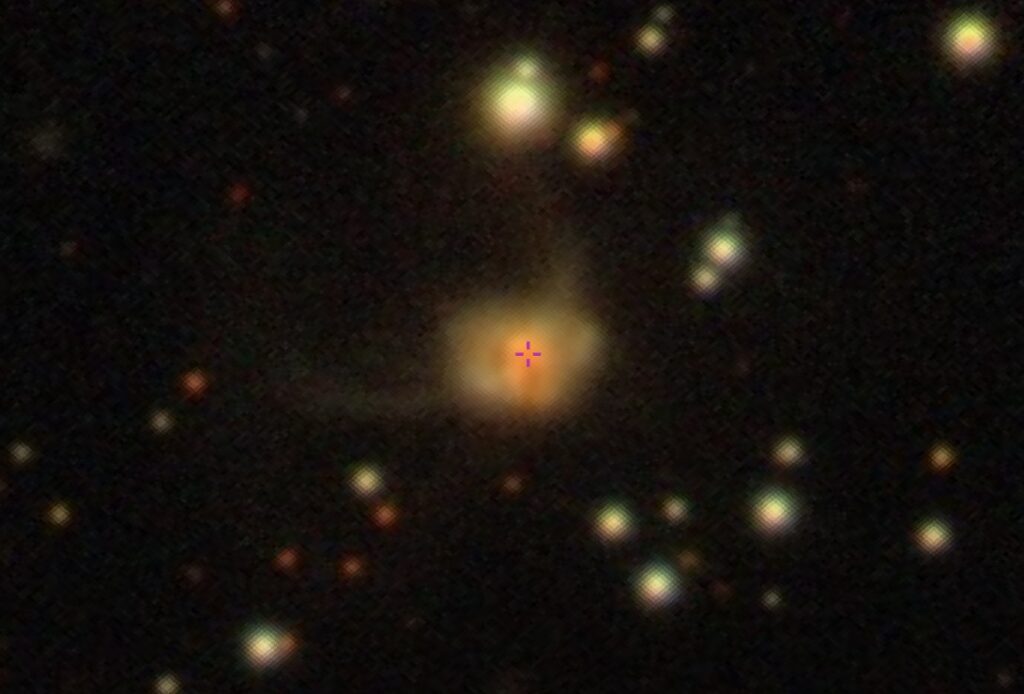
IRAS 17208−0014 is an ultraluminous infrared galaxy located about 617 million light-years from Earth in the southern constellation of Ophiuchus.[1] This is a well-studied galaxy hosting an hydroxyl (OH) megamaser,[2] first discovered by the Nancay radio telescope in 1985.[3] The redshift of the galaxy is (z) 0.0428 and it has a total infrared luminosity of 1012.4 Lʘ.[4]
IRAS 17208−0014 is categorized as an advanced galaxy merger, a result of two disk galaxies colliding with one another. It is known to display two tidal tails that are protruding out from the galaxy by 20 kiloparsecs with a distorted central body.[5][6] The outer disk of the galaxy is disturbed and it has an extended nucleus when shown in near-infrared imaging bands, captured by the Hubble Space Telescope NICMOS camera.[7] The nucleus of the galaxy is compact and elongated along the position angle of 90° to 110°.[8] It is surrounded by both absorption features and condensations.[9] Observations also showed it has a buried active galactic nucleus (AGN) in the western disk of the galaxy.[4] The galaxy has a supermassive black hole located in the center, with a mass of 2.3×10⁸ Mʘ based on a stellar velocity dispersion.[10]
IRAS 17208−0014 is described as a LINER. It has an X-ray luminosity measured as 1×1042 erg s–1 when observed by BeppoSAX.[11] There are several star clusters located within the inner region of the galaxy, said to be proto globular systems.[5] The galaxy is powered by intense starbursts with a star formation of 84 ± 13 Mʘ per year; fueled by a molecular gas reservoir.[12][13] Carbon monoxide line emission was also detected mainly originating from a molecular disk, found as spatially resolved and measuring a diameter of 2.7 × 1.8 kiloparsecs.[14][15] There is also evidence of a detached clump and three faint protrusions pushing the disk’s emission out to 1.8 kiloparsecs. The mass of the molecular gas outflow is estimated to be 2×10⁸ Mʘ.[15]
Three nuclear regions have been identified in IRAS 17208−0014, found aligned in a linear pattern along east to west. When imaged by matched resolution at 15 and 33 GHz frequencies by Very Large Array, they are combined into a larger region.[16] A deep study on the OH megamaser in IRAS 17208−0014 showed it having an area of around 170 × 110 parsecs in diameter and mainly found in two dominant regions.[17] The galaxy also shows HCO+ emission.[18]
- ^ a b c d e f g h “Results for IRAS 17208-0014”. NASA/IPAC Extragalactic Database. Retrieved 2025-04-27.
- ^ Martin, J. M.; Bottinelli, L.; Dennefeld, M.; Gouguenheim, L.; Le Squeren, A. M. (January 1989). “A detailed study of the OH megamaser galay IRAS 17208-0014”. Astronomy and Astrophysics. 208: 39–46. Bibcode:1989A&A…208…39M. ISSN 0004-6361.
- ^ Bottinelli, L.; Gouguenheim, L.; Le Squeren, A. M.; Dennefeld, M.; Paturel, G. (September 1985). “IRAS 17208-0014”. International Astronomical Union Circular (4106): 2. Bibcode:1985IAUC.4106….2B. ISSN 0081-0304.
- ^ a b Baba, Shunsuke; Imanishi, Masatoshi; Izumi, Takuma; Kawamuro, Taiki; Nguyen, Dieu D.; Nakagawa, Takao; Isobe, Naoki; Onishi, Shusuke; Matsumoto, Kosei (April 2022). “The Extremely Buried Nucleus of IRAS 17208–0014 Observed at Submillimeter and Near-infrared Wavelengths”. The Astrophysical Journal. 928 (2): 184. arXiv:2202.11105. Bibcode:2022ApJ…928..184B. doi:10.3847/1538-4357/ac57c2. ISSN 0004-637X.
- ^ a b Jogee, S.; Reddy, N.; Scoville, N. Z. (2003). “IRAS 17208: An Advanced Merger with a Gas-Rich Starburst Evolving towards an Eliptical Galaxy?”. Active Galactic Nuclei: From Central Engine to Host Galaxy. 290: 513. Bibcode:2003ASPC..290..513J. ISSN 1050-3390.
- ^ Murphy, T. W.; Armus, L.; Matthews, K.; Soifer, B. T.; Mazzarella, J. M.; Shupe, D. L.; Strauss, M. A.; Neugebauer, G. (March 1996). “Visual and Near-Infrared Imaging of Ultraluminous Infrared Galaxies: The IRAS 2 Jy Sample”. The Astronomical Journal. 111: 1025. Bibcode:1996AJ….111.1025M. doi:10.1086/117849. ISSN 0004-6256.
- ^ Scoville, N. Z.; Evans, A. S.; Thompson, R.; Rieke, M.; Hines, D. C.; Low, F. J.; Dinshaw, N.; Surace, J. A.; Armus, L. (March 2000). “NICMOS Imaging of Infrared-Luminous Galaxies”. The Astronomical Journal. 119 (3): 991–1061. arXiv:astro-ph/9912246. Bibcode:2000AJ….119..991S. doi:10.1086/301248. ISSN 0004-6256.
- ^ Genzel, R.; Tacconi, L. J.; Rigopoulou, D.; Lutz, D.; Tecza, M. (2001-12-20). “Ultraluminous Infrared Mergers: Elliptical Galaxies in Formation?”. The Astrophysical Journal. 563 (2): 527–545. arXiv:astro-ph/0106032. Bibcode:2001ApJ…563..527G. doi:10.1086/323772. ISSN 0004-637X.
- ^ Duc, P.-A.; Mirabel, I. F.; Maza, J. (September 1997). “Southern ultraluminous infrared galaxies: an optical and infrared database” (PDF). Astronomy and Astrophysics Supplement Series. 124 (3): 533–557. Bibcode:1997A&AS..124..533D. doi:10.1051/aas:1997205. ISSN 0365-0138.
- ^ Arribas, Santiago; Colina, Luis (2003-07-10). “INTEGRAL Spectroscopy of IRAS 17208−0014: Implications for the Evolutionary Scenarios of Ultraluminous Infrared Galaxies”. The Astrophysical Journal. 591 (2): 791–800. arXiv:astro-ph/0304138. Bibcode:2003ApJ…591..791A. doi:10.1086/375417. hdl:10261/199251. ISSN 0004-637X.
- ^ González-Martín, O.; Masegosa, J.; Márquez, I.; Guerrero, M. A.; Dultzin-Hacyan, D. (December 2006). “X-ray nature of the LINER nuclear sources”. Astronomy and Astrophysics. 460 (1): 45–57. arXiv:astro-ph/0605629. Bibcode:2006A&A…460…45G. doi:10.1051/0004-6361:20054756. ISSN 0004-6361.
- ^ Momjian, Emmanuel; Romney, Jonathan D.; Carilli, Christopher L.; Troland, Thomas H.; Taylor, Gregory B. (2003-04-10). “Very Long Baseline Array Continuum and H I Absorption Observations of the Ultraluminous Infrared Galaxy IRAS 17208−0014”. The Astrophysical Journal. 587 (1): 160–170. arXiv:astro-ph/0212091. Bibcode:2003ApJ…587..160M. doi:10.1086/367722. ISSN 0004-637X.
- ^ Wilson, Christine D.; Petitpas, Glen R.; Iono, Daisuke; Baker, Andrew J.; Peck, Alison B.; Krips, Melanie; Warren, Bradley; Golding, Jennifer; Atkinson, Adam; Armus, Lee; Cox, T. J.; Ho, Paul; Juvela, Mika; Matsushita, Satoki; Mihos, J. Christopher (October 2008). “Luminous Infrared Galaxies with the Submillimeter Array. I. Survey Overview and the Central Gas to Dust Ratio”. The Astrophysical Journal Supplement Series. 178 (2): 189–224. arXiv:0806.3002. Bibcode:2008ApJS..178..189W. doi:10.1086/590910. ISSN 0067-0049.
- ^ Planesas, P.; Mirabel, I. F.; Sanders, D. B. (1991-03-20). “High-resolution CO observations of luminous infrared galaxies with large L(ir)/L(B) ratios – IRAS 10173 + 0828, Zw 049.057, IRAS 17208 – 0014”. Astrophysical Journal, Part 1. 370: 172. Bibcode:1991ApJ…370..172P. doi:10.1086/169801. ISSN 0004-637X.
- ^ a b García-Burillo, S.; Combes, F.; Usero, A.; Aalto, S.; Colina, L.; Alonso-Herrero, A.; Hunt, L. K.; Arribas, S.; Costagliola, F.; Labiano, A.; Neri, R.; Pereira-Santaella, M.; Tacconi, L. J.; van der Werf, P. P. (2015-07-23). “High-resolution imaging of the molecular outflows in two mergers: IRAS 17208-0014 and NGC 1614” (PDF). Astronomy & Astrophysics. 580: A35. doi:10.1051/0004-6361/201526133. ISSN 0004-6361.
- ^ Song, Y.; Linden, S. T.; Evans, A. S.; Barcos-Muñoz, L.; Murphy, E. J.; Momjian, E.; Díaz-Santos, T.; Larson, K. L.; Privon, G. C.; Huang, X.; Armus, L.; Mazzarella, J. M.; U, V.; Inami, H.; Charmandaris, V. (2022-11-01). “Characterizing Compact 15–33 GHz Radio Continuum Sources in Local U/LIRGs”. The Astrophysical Journal. 940 (1): 52. arXiv:2209.04002. Bibcode:2022ApJ…940…52S. doi:10.3847/1538-4357/ac923b. ISSN 0004-637X.
- ^ Momjian, E.; Romney, J. D.; Carilli, C. L.; Troland, T. H. (2006-08-29), “Sensitive Very Long Baseline Interferometry Studies of the OH Megamaser Emission from IRAS 17208−0014”, The Astrophysical Journal, 653 (2): 1172–1179, arXiv:astro-ph/0608629, Bibcode:2006ApJ…653.1172M, doi:10.1086/508699, arXiv:astro-ph/0608629
- ^ Imanishi, Masatoshi; Nakanishi, Kouichiro; Kohno, Kotaro (June 2006). “Millimeter Interferometric Investigations of the Energy Sources of Three Ultraluminous Infrared Galaxies, UGC 5101, Markarian 273, and IRAS 17208-0014, Based on HCN-to-HCO+Ratios”. The Astronomical Journal. 131 (6): 2888–2899. arXiv:astro-ph/0602227. Bibcode:2006AJ….131.2888I. doi:10.1086/503527. ISSN 0004-6256.



