


From Wikipedia, the free encyclopedia
Content deleted Content added
| Line 27: | Line 27: | ||
|
John was a private security contractor during the [[War of 1812]] and served briefly as a private for the [[United States Rangers in the War of 1812|Missouri Rangers]] in the dying days of the war. Likely Including the [[Battle of the Sink Hole]] near the mouth of the [[Cuivre River]] in 1815.<ref>{{cite web |author1=Roger Bartel |title=FACT CHECK: COL. SHAW |url=https://princetonhistory.com/2021/06/21/fact-check-col-shaw/ |website=Bartel’s History of Princeton |access-date=August 3, 2025 |date=June 21, 2021}}</ref><ref>{{cite web |author1=John Shaw |title=Indian chiefs and pioneers of the Northwest |url=https://content.wisconsinhistory.org/digital/collection/tp/id/42078/#:~:text=Colonel%20John%20Shaw%2C%20an%20early,Sauk%20chief%20Keokuck%2C%20and%20others. |website=Wisconsin Historical Society |publisher=State Historical Society of Wisconsin |access-date=August 3, 2025 |date=1888}}</ref> This is likely where John acquired the title of [[colonel]], despite it possibly only being honorary. By 1816, it is known that John was a local trader with business ties in [[St. Louis|St. Louis, Missouri]].<ref>{{cite web |author1=Turner, Jennie McMullin |title=Wisconsin pioneers : some lessons on Wisconsin |url=https://search.library.wisc.edu/digital/AURBAACRSH5FIT8K/pages/A62UG5RPGPOW6O9C?as=text&view=scroll |website=University of Wisconsin–Madison Libraries |publisher=Appleton, Wisconsin: The Wisconsin Magazine and C. C. Nelson Pub. Co. |access-date=August 3, 2025 |page=7 |date=1929}}</ref> Throughout John’s travels, he came into contact with various native figures including Chief [[Black Hawk (Sauk leader)|Black Hawk]] of the [[Sauk people|Sauk]] and Chief [[Red Bird]] of the [[Ho-Chunk]], among others.<ref>{{cite web |author1=John Shaw |title=Indian chiefs and pioneers of the Northwest |url=https://dp.la/item/4a0693b991e51595dc0c0bcc88ec815a |website=Digital Public Library of America |access-date=August 3, 2025 |date=1815–1848}}</ref> Some of his interactions would ultimately result in legal problems. |
John was a private security contractor during the [[War of 1812]] and served briefly as a private for the [[United States Rangers in the War of 1812|Missouri Rangers]] in the dying days of the war. Likely Including the [[Battle of the Sink Hole]] near the mouth of the [[Cuivre River]] in 1815.<ref>{{cite web |author1=Roger Bartel |title=FACT CHECK: COL. SHAW |url=https://princetonhistory.com/2021/06/21/fact-check-col-shaw/ |website=Bartel’s History of Princeton |access-date=August 3, 2025 |date=June 21, 2021}}</ref><ref>{{cite web |author1=John Shaw |title=Indian chiefs and pioneers of the Northwest |url=https://content.wisconsinhistory.org/digital/collection/tp/id/42078/#:~:text=Colonel%20John%20Shaw%2C%20an%20early,Sauk%20chief%20Keokuck%2C%20and%20others. |website=Wisconsin Historical Society |publisher=State Historical Society of Wisconsin |access-date=August 3, 2025 |date=1888}}</ref> This is likely where John acquired the title of [[colonel]], despite it possibly only being honorary. By 1816, it is known that John was a local trader with business ties in [[St. Louis|St. Louis, Missouri]].<ref>{{cite web |author1=Turner, Jennie McMullin |title=Wisconsin pioneers : some lessons on Wisconsin |url=https://search.library.wisc.edu/digital/AURBAACRSH5FIT8K/pages/A62UG5RPGPOW6O9C?as=text&view=scroll |website=University of Wisconsin–Madison Libraries |publisher=Appleton, Wisconsin: The Wisconsin Magazine and C. C. Nelson Pub. Co. |access-date=August 3, 2025 |page=7 |date=1929}}</ref> Throughout John’s travels, he came into contact with various native figures including Chief [[Black Hawk (Sauk leader)|Black Hawk]] of the [[Sauk people|Sauk]] and Chief [[Red Bird]] of the [[Ho-Chunk]], among others.<ref>{{cite web |author1=John Shaw |title=Indian chiefs and pioneers of the Northwest |url=https://dp.la/item/4a0693b991e51595dc0c0bcc88ec815a |website=Digital Public Library of America |access-date=August 3, 2025 |date=1815–1848}}</ref> Some of his interactions would ultimately result in legal problems. |
||
|
[[File:1851 plat of St. Marie, Wisconsin.webp|thumb|The original plat of St. Marie filed on June 27, 1851.]]The very next year, on July 27 his mother Mary would pass away aged 60. |
[[File:1851 plat of St. Marie, Wisconsin.webp|thumb|The original plat of St. Marie filed on June 27, 1851.]]The very next year, on July 27 his mother Mary would pass away aged 60. |
||
|
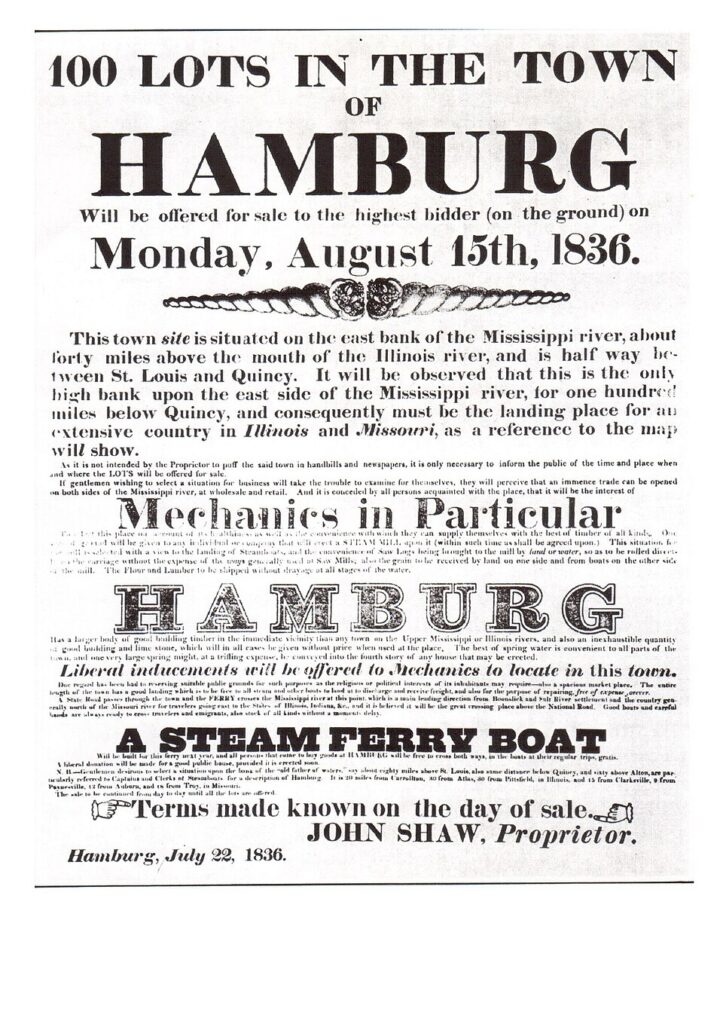
In 1818, John was responsible for the first flour mill in, what was at the time, the northwest of the United States, being built in the city of [[Prairie du Chien, Wisconsin|Prairie du Chien]].<ref>{{cite web |title=First flour mill in Northwest was erected near Prairie du Chien by John Shaw in 1818 |url=https://www.wisconsinhistory.org/Records/Newspaper/BA11366 |website=Wisconsin Historical Society |publisher=La Crosse Tribune |access-date=August 3, 2025 |date=February 3, 1929}}</ref> In 1836, John purchased 100 plots of land in the small village of [[Hamburg, Illinois]]. This would include what would later be called the [[John Shaw Cabin]], built c. 1822.<ref>{{cite web |title=100 Lots in the town of Hamburg |url=https://nebula.wsimg.com/28b6b2a8565f63e4717140e759154211?AccessKeyId=EAD50C0BD8C417DB44E9&disposition=0&alloworigin=1 |website=nebula |access-date=August 3, 2025 |date=July 22, 1836}}</ref> This land is located roughly 30 miles south of [[El Dara, Illinois|El Dara]]. The village is home to the Shaw Cemetery where two of John’s brothers are buried, Daniel and Comfort Shaw, as well as their relatives. John is known to have left Hamburg and traveled north up the [[Mississippi River]] by 1841. |
In 1818, John was responsible for the first flour mill in, what was at the time, the northwest of the United States, being built in the city of [[Prairie du Chien, Wisconsin|Prairie du Chien]].<ref>{{cite web |title=First flour mill in Northwest was erected near Prairie du Chien by John Shaw in 1818 |url=https://www.wisconsinhistory.org/Records/Newspaper/BA11366 |website=Wisconsin Historical Society |publisher=La Crosse Tribune |access-date=August 3, 2025 |date=February 3, 1929}}</ref> In 1836, John purchased 100 plots of land in the small village of [[Hamburg, Illinois]]. This would include what would later be called the [[John Shaw Cabin]], built c. 1822.<ref>{{cite web |title=100 Lots in the town of Hamburg |url=https://nebula.wsimg.com/28b6b2a8565f63e4717140e759154211?AccessKeyId=EAD50C0BD8C417DB44E9&disposition=0&alloworigin=1 |website=nebula |access-date=August 3, 2025 |date=July 22, 1836}}</ref> This land is located roughly 30 miles south of [[El Dara, Illinois|El Dara]]. The village is home to the Shaw Cemetery where two of John’s brothers are buried, Daniel and Comfort Shaw, as well as their relatives. John is known to have left Hamburg and traveled north up the [[Mississippi River]] by 1841. |
||
Revision as of 18:09, 12 November 2025
Settler
John Shaw (January 1, 1783 – August 31, 1871) was a 19th-century businessman, soldier, and settler of the Midwestern United States.
Biography
John was born on New Year’s Day in 1783, to his father Comfort Shaw and mother Mary Hollinbeck in Montgomery County, New York. Likely Johnstown, where both his father and mother would later pass away. Very little is known of his early life, but it is said that he had six brothers prior to his father’s death in 1799 at the age of 40.
John was a private security contractor during the War of 1812 and served briefly as a private for the Missouri Rangers in the dying days of the war. Likely Including the Battle of the Sink Hole near the mouth of the Cuivre River in 1815.[1][2] This is likely where John acquired the title of colonel, despite it possibly only being honorary. By 1816, it is known that John was a local trader with business ties in St. Louis, Missouri.[3] Throughout John’s travels, he came into contact with various native figures including Chief Black Hawk of the Sauk and Chief Red Bird of the Ho-Chunk, among others.[4] Some of his interactions would ultimately result in legal problems.

The very next year, on July 27 his mother Mary would pass away aged 60.
In 1818, John was responsible for the first flour mill in, what was at the time, the northwest of the United States, being built in the city of Prairie du Chien.[5] In 1836, John purchased 100 plots of land in the small village of Hamburg, Illinois. This would include what would later be called the John Shaw Cabin, built c. 1822.[6] This land is located roughly 30 miles south of El Dara. The village is home to the Shaw Cemetery where two of John’s brothers are buried, Daniel and Comfort Shaw, as well as their relatives. John is known to have left Hamburg and traveled north up the Mississippi River by 1841.
Life in Wisconsin
John would later claim to have moved to Princeton in the Wisconsin Territory in 1845, but Marquette County census records don’t show him living there until 1846. (Marquette County once included the land now known as Green Lake County from 1836-1858.) There, in 1851, he filled a plat for the town of St. Marie, in an area formerly known as Shaw’s Landing along the Fox River, he would subsequently become the founder. Of the estimated 30 buildings that were constructed, including a post office and a small wooden bridge across the river during the town’s height, not a single one remains. By the 1850s, John was in worsening health and was legally blind by 1854.[7]
John would pass away in Princeton on August 31, 1871, at the age of 88. He was buried on what is now private property in the small La Cote Sainte Marie Cemetery.
References
- ^ Roger Bartel (June 21, 2021). “FACT CHECK: COL. SHAW”. Bartel’s History of Princeton. Retrieved August 3, 2025.
- ^ John Shaw (1888). “Indian chiefs and pioneers of the Northwest”. Wisconsin Historical Society. State Historical Society of Wisconsin. Retrieved August 3, 2025.
- ^ Turner, Jennie McMullin (1929). “Wisconsin pioneers : some lessons on Wisconsin”. University of Wisconsin–Madison Libraries. Appleton, Wisconsin: The Wisconsin Magazine and C. C. Nelson Pub. Co. p. 7. Retrieved August 3, 2025.
- ^ John Shaw (1815–1848). “Indian chiefs and pioneers of the Northwest”. Digital Public Library of America. Retrieved August 3, 2025.
- ^ “First flour mill in Northwest was erected near Prairie du Chien by John Shaw in 1818”. Wisconsin Historical Society. La Crosse Tribune. February 3, 1929. Retrieved August 3, 2025.
- ^ “100 Lots in the town of Hamburg”. nebula. July 22, 1836. Retrieved August 3, 2025.
- ^ Roger Bartel (April 29, 2022). “In Search of St. Marie, the History”. Bartel’s History of Princeton. Retrieved August 3, 2025.




