
* ”[[Faustina (1957 film)|Faustina]]” (1957)
* ”[[Faustina (1957 film)|Faustina]]” (1957)
* ”[[Ten Ready Rifles|Diez fusiles esperan]]” (1959)
* ”[[Ten Ready Rifles|Diez fusiles esperan]]” (1959)
* ”[[The Reprieve (1961 film)|El Indulto]]” (1960)
* ”[[The Reprieve (1961 film)|El Indulto]]” ()
* ”[[The Mustard Grain|El grano de mostaza]]” (1962)
* ”[[The Mustard Grain|El grano de mostaza]]” (1962)
* ”Los derechos de la mujer” (1963)
* ”Los derechos de la mujer” (1963)
Spanish film director (1911–1992)
|
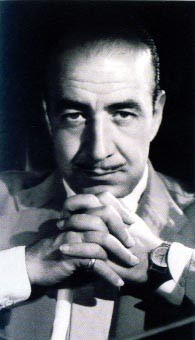
José Luis Sáenz de Heredia |
|
|---|---|
 |
|
| Born | 10 April 1911 |
| Died | 4 November 1992 (aged 81) |
| Years active | 1934 – 1975 |
José Luis Sáenz de Heredia (10 April 1911 – 4 November 1992) was a Spanish film director and screenwriter whose career spanned four decades. He is regarded as one of the central figures of 20th‑century Spanish cinema, noted both for his contributions to Francoist propaganda films and for his influential comedies of the 1940s and 1950s.[1][2][3][4]
Early life
José Luis Sáenz de Heredia was the fourth of the seven children born to the Venezuelan Nieves Osío y Espar and the Riojan Ángel Sáenz de Heredia y Suárez-Argudín. He came from an aristocratic family closely connected to politics, as he was a first cousin of José Antonio Primo de Rivera y Sáenz de Heredia, the founder of the Falange, and thus a nephew of General Miguel Primo de Rivera.[1][2]
From an early age, Sáenz de Heredia showed an interest in theatre, writing plays in his spare time and staging them during summer holidays with friends in San Lorenzo de El Escorial. He began studying architecture but later left his studies to work in various occupations, while continuing to write stage plays and, after the Spanish Civil War, scripts for musical revues starring Celia Gámez.[3]
Career
Sáenz de Heredia began his film career in the early 1930s under the auspices of Luis Buñuel, who at the time was head of production at the Filmófono company. He initially worked as a subtitler of foreign films and soon made his debut as a screenwriter with Patricio miró una estrella (1934). When the film’s original director left the project, Sáenz de Heredia took over the direction, marking his first experience as a film director.[4] He subsequently directed La hija de Juan Simón (1935) and ¿Quién me quiere a mí? (1936), both produced by Filmófono under Buñuel’s supervision. Later, Buñuel would admit he actually directed both films.[1][3][5][6]
At the outbreak of the Spanish Civil War, Sáenz de Heredia was briefly detained but released shortly thereafter, reportedly with Buñuel’s assistance.[7]He actively fought on the Francoist side and ended the conflict with the rank of lieutenant. In 1939 he was appointed head of production at the National Department of Cinematography, where he oversaw the production of newsreels while also directing short films and documentaries.[3]
In the early 1940s he directed ¡A mí no me mire usted! (1941), followed by Raza (1942), an epic propaganda film based on a story credited to Jaime de Andrade, a pseudonym used by Francisco Franco. The film firmly associated Sáenz de Heredia with the Franco regime and established his reputation as one of its principal cinematic figures. After the Allied victory in World War II and the regime’s subsequent political realignment, Raza was withdrawn from circulation and later re-released in a censored version under the title Espíritu de una raza.[3]
[5][6]
Throughout the 1940s, his work alternated between films aligned with official ideological expectations and adaptations of 19th-century literary works, often produced by his own company, Chapalo Films. Notable titles from this period include El Escándalo (1943), Mariona Rebull (1947), Las aguas bajan negras (1948), La mies es mucha (1948), and Don Juan (1950). In the 1950s, frequently collaborating with screenwriter Carlos Blanco Hernández, he broadened his thematic range to include crime films and comedies. Among his most successful works were Los ojos dejan huella (1952), Todo es posible en Granada (1954), and especially Historias de la radio (1955), a popular episodic comedy that later influenced elements of Woody Allen’s Radio Days.[3][8]
Despite remaining closely associated with official cinema, Sáenz de Heredia was respected across the Spanish film industry for his technical competence. In 1959 he was appointed director of the Institute of Cinematographic Research and Experiments (later the Official School of Cinematography), a position he held until 1963, during which time he taught and influenced a generation of filmmakers who would later form part of the New Spanish Cinema and the cinema of the democratic Transition.[3][9]
From the 1960s onward, his film output declined in critical reception, although he remained prolific. His later works included adaptations such as El indulto (1960), comedies starring actors like Concha Velasco, Manolo Escobar, Paco Martínez Soria, and documentaries such as Franco, ese hombre (1964). His final films as a director were Cuando los niños vienen de Marsella (1974) and Solo ante el streaking (1975). Alongside his film work, he also directed several theatrical productions, particularly during the 1960s.[1][3][8]
Legacy
Although his association with the Franco regime has shaped critical debates around his work, scholars have increasingly emphasized his technical skill, narrative versatility, and influence on later generations of filmmakers. Academic studies highlight his ability to move between propaganda, melodrama, and comedy while maintaining a distinctive visual and narrative style.[10]
Sáenz de Heredia received multiple professional distinctions during his career, including several awards from the Círculo de Escritores Cinematográficos—among them Best Director (1947, 1949, 1950, 1952) and Best Original Screenplay (1955, 1962).[11] In 1965 he was granted the Grand Cross of the Order of Civil Merit, one of the highest civilian honors awarded by the Spanish state.[12]
Sáenz de Heredia died in Madrid on November 4 1992 at age 81 due to pulmonary edema.[13]

