


From Wikipedia, the free encyclopedia
Content deleted Content added
|
|
|||
| Line 40: | Line 40: | ||
|
== Gallery == |
== Gallery == |
||
|
<gallery> |
<gallery> |
||
|
File:Lord Vishnu Idol at kakatiya trikutalayam Mutharam.jpg|Vishnu idol at Mutharam Trikutalayam |
File:Lord Vishnu Idol at kakatiya trikutalayam Mutharam.jpg|Vishnu idol at Mutharam Trikutalayam |
||
|
File:Shiva linga at Kakatiya trikutalayam Mutharam.jpg|Shiva linga at Mutharam Trikutalayam |
File:Shiva linga at Kakatiya trikutalayam Mutharam.jpg|Shiva linga at Mutharam Trikutalayam |
||
Latest revision as of 05:03, 25 November 2025
12th-13th century Indian temple

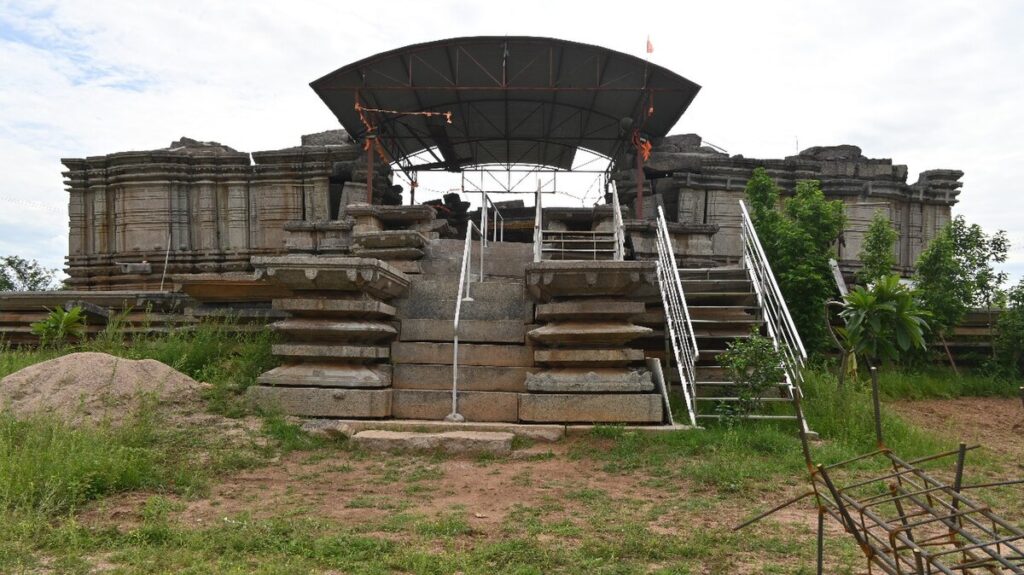
The Kakatiya Trikutalayam, Mutharam is a 12th–13th century trikutalayam temple located in Mutharam village of Bheemadevarpally mandal, Hanamkonda district, Telangana, India. Built during the Kakatiya dynasty, the temple is considered a miniature version of the Thousand Pillar Temple in Warangal, featuring about 500 intricately carved pillars. It consists of three sanctums: two dedicated to Shiva as Mahamrityunjaya and Suryeshwara, and one to Vishnu, which enshrines a six to seven feet tall idol. The temple stands on a star-shaped platform and reflects the architectural style of the Kakatiyas.[1]
The temple is believed to have been constructed during the Kakatiya dynasty in the 12th–13th centuries CE.[1]
Mutharam was an important religious and cultural site during the Kakatiya period.
The temple was also constructed following the Kakatiya TTT model (tank–temple–town concept), wherein a tank was built first to meet the water needs, followed by the temple, around which the settlement developed.[1]
- The temple is a trikutalayam built on an elevated star-shaped platform.[1]
- A common hall connects the three garbhagrihas (sanctums).
- Two of the shrines enshrine carved lingams named *Mahamrityunjaya* and *Suryeshwara*, dating back to the Kakatiya era.[1]
- The third shrine, dedicated to Vishnu, is currently closed. It houses a 6–7 feet tall intricately carved idol of Vishnu, with Brahma and Garuda at his feet, and attendants (paricharikas) standing on either side. Vishnu holds a conch (shankha), discus (chakra), and mace (gada) in his four hands, symbolising Kakatiya iconography.[1]
- The temple comprises about 500 pillars, each bearing unique carvings.
- The temple is regarded as a miniature version of the Thousand Pillar Temple.[1]
- Similar trikutalayam temples once existed at *Nidigonda* and *Kondaparthy*, though many have been reduced to ruins.[2][3]
Cultural significance
[edit]
- Festivals such as Maha Shivaratri are celebrated here.[1]
- It remains a local pilgrimage centre of importance.




