


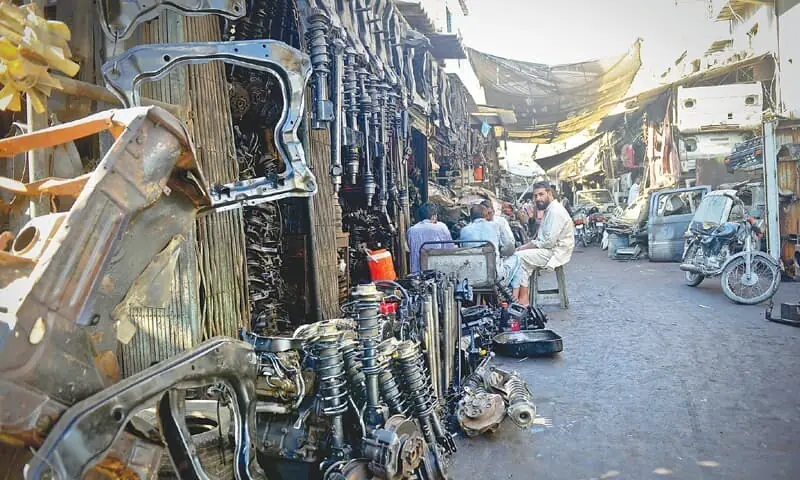
The decades-old Shershah Market, the hub of imported used items, especially auto parts and engines, continues to face a dearth of consumers despite a surge in imports of used cars up to three years old and millions of vehicles already on the roads.
According to an importer, 40,000 imported used cars, mainly from Japan, landed in the country during the previous fiscal year, with 660cc vehicles making up 98 per cent. Around 18,000 more arrived in July-December 2025.
Local car assemblers and their vendors feel threatened, claiming that the share of used cars is 25 per cent of all automobile sales, posing a serious risk to local assemblers and jobs in the industry.
With more imported used cars on the roads, Shershah traders say footfall should have increased as owners search for axles, suspension and old engines. But market traders say they have been sitting idle as high prices of parts have been keeping buyers away from one of Asia’s biggest and oldest markets, located close to Lyari and the old SITE industrial area of the port city.
Traders say the market’s slowdown is being driven by a mix of factors like rising prices, easier alternatives in other markets and long-standing problems in access and basic facilities. These have pushed many buyers away from Shershah even as the number of used cars grows.
Why buyers go elsewhere
One of the reasons for the low turnout of buyers, traders said, is the availability of axles, suspension parts and shock absorbers in other small and medium-sized markets at lower prices. They say engines remain Shershah’s core line, but for most other components, buyers can now shop elsewhere.
Another problem is the lack of parking on main roads and even inside the market, traders said. Damaged, narrow internal roads, which they say have not been repaired for decades, further restrict access.
Many consumers prefer buying axle- and suspension-related items from other markets, which they feel are hassle-free and appear cheaper than Shershah Market. Some axle and suspension dealers also pay visits to Dubai and Far East countries to directly import parts instead of procuring them from Shershah.
Traders and repairers say the differences become more obvious when comparing rates across markets. Consumers witness price disparity in axle, suspension and shock absorbers in different markets, which, they say, points to the presence of smuggled parts compared to duty-paid parts that cost more. Chinese parts are also present, they added.
Kabuli vs Chinese
A suspension and axle maker in F.B. Area said that “car owners mainly prefer Kabuli front axle to a Chinese-made one”.
Kabuli parts, which refer to imported used parts regarded as higher quality, “are repairable due to their good quality even after usage for two to three years. Chinese parts lack satisfaction and are unable to be repaired. They can only be replaced”, he said.
For example, a Chinese-made front axle boot pair for a Suzuki Alto 2004 (1,000cc) sells for Rs7,000-8,000, while traders at Plaza Market demand Rs4,000-5,000.
Chinese parts are a one-time risk, he said, as they cannot be repaired and need to be replaced with a new pair after developing a fault. He added that axle makers also provide a six-month guarantee, while others ask consumers to check performance within a week.
Another axle-and-suspension repairer in North Nazimabad, who said his brother visits Dubai to bring duty-paid parts, put the price of the rear axle (Kabuli) of old models of Suzuki Alto 1,000cc, Suzuki Margalla, Suzuki Cultus and Suzuki Mehran in the range of Rs12,000-14,000, including labour charges.
“The rates of front axles have increased by Rs2,000 in the last year but have doubled in the last five years,” he said, adding that dealers provide a six-month to one-year warranty on the above parts.
Repairing charges for a Kabuli axle pair, he said, are Rs5,000, which provides temporary relief for six months to one year depending on the owners’ driving style.
On the contrary, axle and suspension dealers at Plaza Market near Regal Chowk offered to replace the Suzuki Alto 1,000cc (2004) front-axle pair at Rs8,000-9,000, including labour charges, claiming them as “Kabuli and almost new”. They said the parts arrive from the Chaman border from cars that are partially destroyed in accidents.
“I do not know whether they are duty paid or not, but they are definitely cheaper than other markets,” they said, adding that they can be repaired at Rs3,500.
Repairers say buyers tend to check for axle-related issues early, especially when purchasing an older vehicle. They say many buyers first look for a troubling sound that emerges while taking a deep right or left turn. It is also a common sight on the roads that an old car is seen breaking up either the left or right front axle if owners delay in repairing and removing worn axles.
Price differences are also visible in other components.
A dealer at Shershah market said that the price of gaadri (located beneath the engine) for an old Toyota Passo and Daihatsu Mira costs Rs35,000-40,000 (duty paid) compared to Rs10,000-15,000 five years ago.
“After knowing the rates, buyers prefer to move on and they expect more bargaining, on which the shopkeepers do not agree as they are already offering wholesale rates,” he said, adding that “our daily trading of spare parts has shrunk to only 10 per cent”.
However, dealers at Regal Chowk said the gaadri rate of an old Mira 660cc model costs Rs12,000-15,000, including labour charges, as the part is Kabuli and was procured from the Chaman border.
Engines still draw buyers
While traders say buyers have drifted to alternative markets for several parts, Shershah has traditionally been known as a centre for engines. But even this segment, traders say, has been hit by rising prices.
Mohammad Saeed, dealing specifically in small car engines, said a 660cc engine is available for not less than Rs150,000 versus Rs25,000-30,000 five years back.
While complaining of surviving on only two per cent sales for the last four to five years, he said higher import duties on parts and accessories have pushed prices to the ceiling, thus keeping buyers away from the Shershah market.
When asked how a buyer feels satisfied that an imported used 660cc engine is in mint condition, he said importers and big traders own godowns, where imported items reach from the port.
“We just inspect the engines at godowns by removing their cover only,” Mr Saeed said. “If the engine is highly clean inside, it means it is in perfect condition.”
Traders are not allowed to check engines by starting them physically at the godown, he said, adding that this kind of business or deal has been going on for decades on mutual trust between godown owners and traders.
How engine buyers at Shershah Market shops feel satisfied over engine condition, he said, is largely the same approach. “We also use the same formula by asking to see the engine from the engine oil cover cap,” he added.
Buyers are given three to four days’ time to check engine performance in their vehicles, he said, adding that they can exchange it in case the engine does not perform up to the mark.
Syed Wali, who deals in heavy vehicle engines, said an Isuzu 2,500cc engine is available at Rs350,000 compared to Rs130,000 four years back, while a Hyundai Shehzore 2,400cc engine is priced at Rs400,000 compared to Rs160,000.
A Toyota Hilux 2,200-2,800cc engine is now priced at Rs300,000 as compared to Rs150,000.
“From morning to evening, we have been waiting for the buyers to turn up as trading activities have been at the lowest ebb of five per cent for the last many years,” he said.
A troubled past
Apart from prices and access, traders say the market’s past still affects how people view Shershah.
A wave of fear had gripped the market owing to the killing of 13 to 14 people, including traders and customers, in October 2010, as Karachi was in the grip of rising ethnic and political violence.
According to media reports, the incident was linked with an extortion dispute with the market association, coupled with ethnic conflict between two political parties at that time.
In June 2012, a prominent trader was shot dead in the market after he refused to pay extortion money.
However, traders agreed that the security situation had improved in the market after these incidents and after the government’s crackdown, and they said no mass killing has taken place since 2010. Still, they argue that buyers and traders remain cautious and that the market’s working conditions continue to create a sense of discomfort.
Zahid Malik Dehalvi, president of Anjuman Welfare Shershah Kabari Market, said that the Shershah market has been free of any smuggled parts and accessories for decades, as traders are paying heavy duties and taxes on imported used items.
Most of the traders, he said, regularly visit various countries, especially Dubai, Hong Kong, Japan and other Far East markets, to directly import used auto parts.
“We pay over Rs10 million as duties and taxes on one container carrying a load of 26 tonnes while smugglers clear the same by paying just Rs1.5 million to Rs2 million,” he said, adding that this is the main reason that the prices of auto parts in Shershah market are costlier than smuggled parts.
Mr Dehalvi, along with other traders, claimed that they sell only duty-paid items instead of smuggled parts in Shershah market, which comprises 4,500 shops and 3,000 small to large-sized godowns. These godowns also house small rented stalls, called theas in popular jargon.
Despite the fact that other cities also have used auto parts markets, Mr Dehalvi said Shershah, being one of the biggest markets in Asia, excels due to its size and because it feeds upcountry auto markets.
He said the working conditions in Shershah appear alarming due to the lack of a proper road network, security-related gaps, no cameras, no street lights, load-shedding and water scarcity.
Rangers and the police have provided security to the market traders after the killing incidents in which many people and traders were gunned down. Before these incidents, traders used to pull down their shutters by 4pm, he said.
“We have seen a time during 2002-04 when the traders did not have time to talk owing to the huge rush of buyers as prices of auto parts were also low,” he said, adding that the high prices of auto parts after the imposition of heavy duties and taxes have restricted buyers’ presence in the market.
“In heavy rains, the biggest used items’ market closes down for two to three days as rainwater submerges on the already dilapidated roads and enters the shops,” he said.
He said it was the government’s responsibility to provide basic amenities to the six-decade-old market as well as full security, as buyers and even traders still feel unsafe to even carry Rs50,000. He urged the Sindh government to ensure the setting up of police pickets in the market.



