
| birth_date = {{circa|1771}}
| birth_date = {{circa|1771}}
| birth_place = [[Tearce]], [[Ottoman Empire]]
| birth_place = [[Tearce]], [[Ottoman Empire]]
| death_date = {{Death date|1845|3|7|df=y}}
| death_date = {{Death date|1845|3||df=y}}
| death_place = [[Lešok]], [[Ottoman Empire]]
| death_place = [[Lešok]], [[Ottoman Empire]]
| occupation = Cleric and writer
| occupation = Cleric and writer
Bulgarian writer and clergyman (c. 1770–1845)
|
Kiril Peychinovich |
|
|---|---|
 |
|
| Born | c. 1771 |
| Died | 12 March 1845 |
| Pen name | “Tetoec” |
| Occupation | Cleric and writer |
| Genre | Religion |
| Notable works | Ogledalo and Utešenie Grešnim |
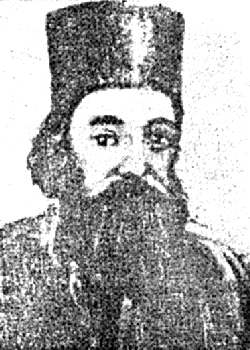
Kiril Peychinovich or Kiril Pejčinović (Bulgarian: Кирил Пейчинович, Serbian: Кирил Пејчиновић, Macedonian: Кирил Пејчиновиќ, Church Slavonic: Күриллъ Пейчиновићь; c. 1770 – 12 March 1845) was a Bulgarian cleric, writer and enlightener. He was one of the figures of the Bulgarian National Awakening.


Peychinovich was born in the large Polog village of Tearce in the Ottoman Empire (present-day North Macedonia) in 1771.[1][2][3] He studied in the nearby village of Lešok.[4] Together with his father Peychin and his uncle Dalmant, he went to Mount Athos, at the monastery of Hilandar, where all three became monks.[3] Afterwards, he returned to Tetovo and worked in the Kičevo Monastery.[5] In 1801, he became abbot of Marko’s Monastery near Skopje.[3][4] He had the neglected monastery restored. After visiting his father and uncle in Hilandar, he left the monastery and returned to his native village with the goal to restore the monastery of St. Athanasius in Lešok.[3] In 1818, he moved to the monastery, which he restored with funding from the Serbian prince Miloš Obrenović.[2] Here he opened a school and made an attempt to create a printing house.[5] Peychinovich developed educational activities, guiding and encouraging younger monks to education, delivering sermons, and writing books. He assisted Theodosius of Sinai in restoring his printing house in Thessaloniki with funds, which had been burnt down.[4][3] Peychinovich died on 12 March 1845 in the Lešok Monastery and was buried in the churchyard.[1][3]
Peychinovich authored three books, two printed and one manuscript (Zhitie i Sluzhba na Tsar Lazar), all three devoted to religion.[2] He also authored one of the first Bulgarian books.[6] Peychinovich wrote in the Tetovo dialect and with less Church Slavonicisms than fellow contemporary Yoakim Karchovski.[7] His Sermon for the Holidays (Slovo za praznicite) was written in a vernacular with a high amount of Turkisms, although there are many Church Slavonic words. According to Slavist Peter Hill, his purpose was to promote religious works among believers, thus Peychinovich’s aims were religious, rather than linguistic.[8] With his teachings, he wanted, among other things, to protect his readers from so-called superstition, i.e. from non-Christian mythical beliefs and rituals.[4]
Peychinovich used the term “našinski” (our) to refer to his compatriots.[9][10] Per Blaže Koneski, he and his contemporaries lacked a clear sense of national belonging.[3]

Ogledalo (“Mirror”) has a form of a sermon with a liturgical-ascetical character. It is an original work, inspired by the Kolivari (also called Filokalist) movement on Mount Athos, that was fighting for a liturgical renewal within the Eastern Orthodox Church on the Balkans. For this aim the Kolivari were using the spoken language of the people, according to the region where they were translating and writing. The most important topics of the work are: the significance of the liturgical life, the preparation for the Holy Communion, the regularly receiving of the Holy Communion. Especially important is his argumentation against the superstition and on the importance of the individual ascetic life and the participation in the liturgical life of the Church. In addition, a collection of Christian prayers and instructions, some of which were written by him were added in the end of the work.[11][12] It was printed in 1816 in Budapest.[1] The prayers and verses from the Bible were written in Church Slavonic, while the sermons were written mainly in the Tetovo dialect.[8]
Per him, it was written “because of the need and the use in the simplest and not literary Bulgarian language of lower Moesia” (“ради потреби и ползования препростейшим и не книжним eзиком болгарским долния Миссии”).[1][13] Apart from defining his language as Bulgarian, he defined the region he lived in as Lower Moesia.[14] At the end of the book, he honoured Serbian saints Simeon and Sava.[3]
Utesheniе Greshnim
[edit]
Peychinovich’s second book, Utesheniе Greshnim (“Solace of the sinner”), much like his first, is a Christian collection of instructions — including advice on how weddings should be organised and how those who had sinned should be consoled, as well as a number of instructive tales.


Utesheniе Greshnim was ready to be printed in 1831, as specified by him in a note in the original manuscript. Peychinovich sent three letters to Obrenović. In the first letter, he requested material support for the book.[15] In the third letter, Peychinovich wrote that he dared to address the Serbian prince “because of spiritual love and our Serbian fatherland”.[3][16] The book was sent to Kragujevac to be printed,[3] but this did not happen because it contained many Turkish loanwords and formal weaknesses, and became a subject of Church censorship.[17] The Metropolitanate of Belgrade also disliked the simple terms that Peychinovich used about divine matters. At the beginning of 1836, Peychinovich was informed that his book will not be published.[3] Тhe book was sent to be printed in Thessaloniki four years later, in 1840, by Theodosius of Sinai.[17] In the preface, Theodosius expressed his gratitude for the assistance he received from Peychinovich,[3] while Peychinovich referred to the language of the work as the ‘common Bulgarian language of Lower Moesia, Skopje and Tetovo’ (простїй Ѧзыкъ болгарский долнїѦ Мүссїи Скопсский и Тетовский).[9]
In 1835, Peychinovich composed an epitaph for himself, which was engraved on his tombstone.[8] His epitaph commemorates the main moments of his life, expressing his resignation with death. It is written in rhyming verses.[4]
Теарце му негово рождение
Пречиста и Хилендар пострижение
Лешок му е негоо воспитание
Под плочава негоо почивание
От негово свое отшествие
До Христово второ пришествие
Молит вас бракя негои любимия
Хотящия прочитати сия
Да речете Бог да би го простил
Зере у гроб цръвите ги гостил[18](Tearce is his birth
Prechista and Hilendar monasticism
Leshok is his upbringing
Under the slab his resting
From his own departure
Until the second coming of Christ
I beg you, his beloved brothers
Whoever wants to read this
Say that God would forgive him
Because at the grave worms visited him)
Овде лежи Кирилово тело
У манастир и у Лешок село
Да Бог за доброе дело[18](Here lies Kiril’s body
At the monastery and at the village of Leshok
May God be for a good deed)
In 1934, the village of Burumli in Ruse Province, Bulgaria, was renamed Peychinovo in his honour. Peychinovich is considered as part of the Bulgarian National Awakening.[19][20] He is considered an ethnic Macedonian and a founder of modern Macedonian literature in North Macedonia.[2][7][21] His original tombstone was destroyed and replaced with an inscription in Macedonian.[14] In October 2022, he was canonised by the Macedonian Orthodox Church as a saint under the name Kiril Lešočki.[22]
References and notes
[edit]
- ^ a b c d Chris Kostov (2010). Contested Ethnic Identity: The Case of Macedonian Immigrants in Toronto, 1900-1996. Peter Lang. p. 58. ISBN 9783034301961.
- ^ a b c d Dimitar Bechev (2009). Historical Dictionary of the Republic of Macedonia. Scarecrow Press. p. 171. ISBN 0810855658.
- ^ a b c d e f g h i j k l Blaže Koneski (2020). Katica Kulavkova (ed.). Македонскиот XIX век (PDF) (in Macedonian). Skopje: Macedonian Academy of Sciences and Arts. pp. 131–133, 138.
- ^ a b c d e Емил Георгиев (1980). “Йоаким Кърчовски и Кирил Пейчинович. Техните заслуги за развитието на печатната книга и за утвърждаването на простонародния език в литературата”. Люлка на старата и новата българска писменост (in Bulgarian). Sofia: Държавно издателство Народна просвета. pp. 147–148, 152.
- ^ a b Македонска енциклопедија [Macedonian Encyclopedia] (in Macedonian). Skopje: Macedonian Academy of Sciences and Arts. 2009. p. 1127.
- ^ James Franklin Clarke; Dennis P. Hupchick (1988). The Pen and the Sword: Studies in Bulgarian History. Columbia University Press. p. 221. ISBN 0-88033-149-6.
Peichinovich of Tetovo, Macedonia, author of one of the first Bulgarian books.
- ^ a b Victor Roudometof, ed. (2000). The Macedonian Question: Culture, Historiography, Politics. East European Monographs. pp. 177–178. ISBN 9780880334518.
- ^ a b c John Shea (1997). Macedonia and Greece: The Struggle to Define a New Balkan Nation. McFarland, Incorporated, Publishers. pp. 200–201. ISBN 9781476621760.
- ^ a b Michael Seraphinoff (1996). The 19th Century Macedonian Awakening: A Study of the Life and Works of Kiril Pejcinovich. Bloomsbury Academic. pp. 92, 134. ISBN 9780761800125.
- ^ Andrew Rossos (2013). Macedonia and the Macedonians: A History. Hoover Press. p. 90. ISBN 9780817948832.
- ^ Милан Ѓорѓевиќ, Агиоритското просветителство на преподобен Кирил Пејчиновиќ I (The Hagioretic Enlightenment of Venerable Kiril Pejcinovic), study, in: “Премин”, бр. 41-42, Скопје 2007
- ^ Милан Ѓорѓевиќ, Агиоритското просветителство на преподобен Кирил Пејчиновиќ II (The Hagioretic Enlightenment of Venerable Kiril Pejcinovic), study, in: “Премин”, бр. 43-44, Скопје 2007
- ^ Janette Sampimon (2006). Becoming Bulgarian: The Articulation of Bulgarian Identity in the Nineteenth Century in Its International Context: an Intellectual History. Pegasus. p. 10. ISBN 9061433118.
Indeed most of the Bulgarians in Buda and Pešt, who were seen as part of the Serb community there, were adherents of this idea. Kiril Pejčinovič, for example, mentioned on the title page of his book Ogledalo (Mirror, 1816), published in Buda, that the book was written in simple Bulgarian, as opposed to the literary, archaic, version…
- ^ a b Vlado Treneski; Dejan Tančovski (2021). White Book about the Language Dispute Between Bulgaria and the Republic of North Macedonia. Orbel. pp. 84–85. ISBN 9789544961497.
- ^ Građa za istoriju makedonskog naroda iz Arhiva Srbije Tom 1. Archive of Serbia. 1979. p. 17.
…Пејчиновић чуо да је Крагујевачка штампарија отпочела с радом, одмах је упутио писмо кнезу Милошу Обреновићу молећи за да му помогне да у Србији штампа своје книге.
[…Pejčinović heard that the Kragujevac printing house had begun work, he immediately sent a letter to Prince Miloš Obrenović asking him to help him print his book in Serbia.] - ^ Građa za istoriju makedonskog naroda iz Arhiva Srbije Tom 1 (in Serbian). From a copy of the original letter. Archive of Serbia. 1979. p. 102.
Того ради дерзнухь писати: аще не со равнень Вашего светлаго Величества обаче любве ради духовнія и нашея србскія отечествь…
{{cite book}}: CS1 maint: others (link) - ^ a b Polenakovikj, Haralampie (1989). Izbrani dela: Nikulcite na novata makedonska kniževnost (in Macedonian). p. 112.
На црковната цензура јазикот на Утјешение – со многубројни турцизми – и извесни формални слабости и се причина за одбивање на делото. Пејчиновиќ го зема делото назад и кога се обновува печатницата во Солун, го испраќа таму.
[For the church censorship the language of Consolation – with its numerous Turkisms – and certain formal weaknesses were the reason for the rejection of the work. Pejčinovikj took the work back and when the printing house in Thessaloniki was being renovated, he sent it there.] - ^ a b Yordan Ivanov (1970). Български старини из Македония (in Bulgarian). Наука и изкуство. pp. 97–99.
- ^ Mateja Matejić; Karen L. Black (1981). A Biobibliographical Handbook of Bulgarian Authors. Slavica Publishers. p. 25. ISBN 0-89357-091-5.
- ^ Jørgen S. Nielsen, ed. (2012). Religion, Ethnicity and Contested Nationhood in the Former Ottoman Space. Brill. p. 234. ISBN 9789004211339.
- ^ Blaže Koneski (1967). Граматика на македонскиот литературен jазик. Skopje: Kultura. p. 30.
- ^ “Canonization of the new Macedonian saint Kiril Lesochki”. Sloboden Pečat. 16 October 2022. Retrieved 2022-10-18.

