
From Wikipedia, the free encyclopedia
Content deleted Content added
|
|
|||
| Line 28: | Line 28: | ||
|
== Works == |
== Works == |
||
|
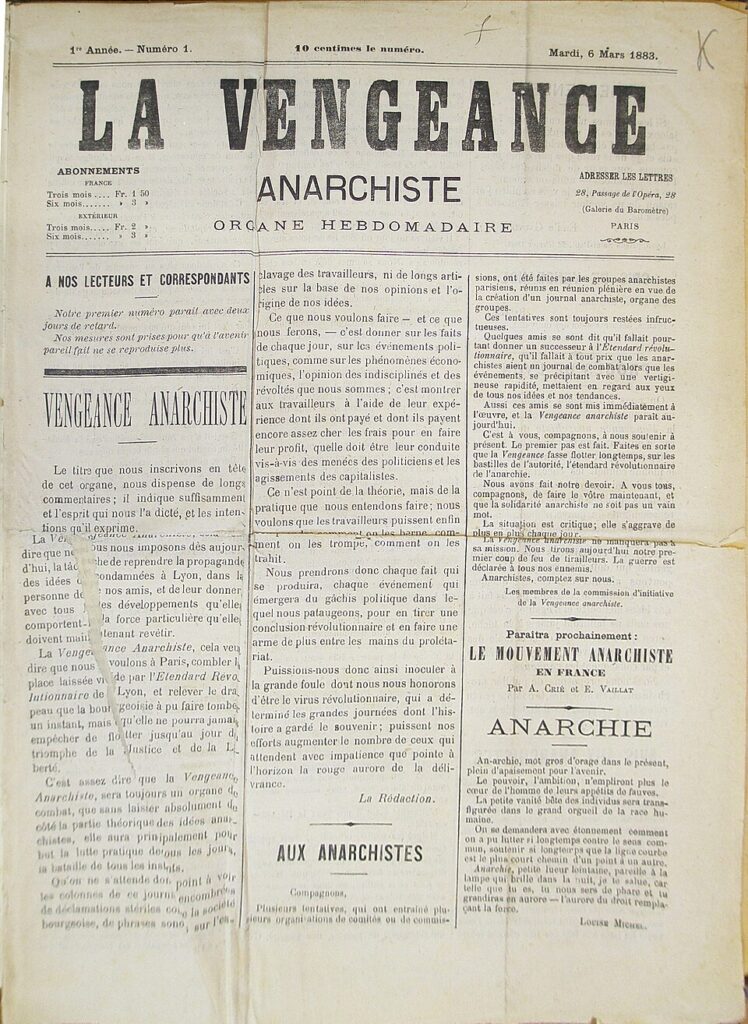
*[[commons:Category:Collection_of_Archives_Anarchistes|Collections from the archive site Archives Anarchistes]] that they shared to Commons, covering the [[commons:Category:La_Vengeance_Anarchiste|first and only issue]]. Transliteration of all newspaper articles available [https://fr.wikisource.org/wiki/La_Vengeance_Anarchiste on Wikisource] (French original). |
|||
|
=== 1st issue (courtesy of ”Archives anarchistes”) === |
|||
|
* ”[https://fr.wikisource.org/wiki/Vengeance_Anarchiste Vengeance Anarchiste]”, explanation of the journal’s motivations and support for [[Propaganda of the deed|propaganda by the deed]] |
|||
|
* ”[https://fr.wikisource.org/wiki/Aux_anarchistes Aux Anarchistes]”, call for support of anarchists and “declaration of war” on the [[bourgeoisie]] |
|||
|
* ”[https://fr.wikisource.org/wiki/Anarchie Anarchie]” by [[Louise Michel]], poetic and philosophical text providing a definition of [[anarchy]] |
|||
|
* ”[https://fr.wikisource.org/wiki/Une_pens%C3%A9e Une pensée]” by [[Émile Gautier]], short text on anarchism from his prison cell |
|||
|
* ”[https://fr.wikisource.org/wiki/Cris_de_vengeance Cris de vengeance]”, excerpts from [[François Rabelais|Rabelais]] and [[Anacharsis Cloots]] supporting propaganda by the deed |
|||
|
* ”[https://fr.wikisource.org/wiki/Proc%C3%A8s_de_Lyon Procès de Lyon]”, support for the “vengeful justice of the people” against state justice |
|||
|
* ”[https://fr.wikisource.org/wiki/Avis_aux_anarchistes Avis aux anarchistes]”, call for a “very important and very urgent” meeting |
|||
|
* ”[https://fr.wikisource.org/wiki/Le_Capitalicide Le Capitalicide]”, theory text on the basic tenets of anarchism and call to kill [[Capitalism|capitalists]] |
|||
|
* ”[https://fr.wikisource.org/wiki/Johann_Most Johann Most]”, revisiting the trajectory of [[Johann Most]], theorist of propaganda by the deed |
|||
|
* ”[https://fr.wikisource.org/wiki/Mouvement_international Mouvement international]”, support for peasants revolting in Spain and the situation in Italy |
|||
|
* ”[https://fr.wikisource.org/wiki/La_femme_anarchiste La femme anarchiste]” by Marguerite Leloup, [[first-wave feminism]] and criticism of the role and place of women in anarchist organizations |
|||
|
* ”[https://fr.wikisource.org/wiki/Nos_amis Nos amis]”, correspondence from several anarchist groups supporting the publication (Saint-Pierre-les-Martigues, Amiens, Villequier, Robiac) |
|||
|
* ”[https://fr.wikisource.org/wiki/La_Tribune_des_Jeunes La Tribune des Jeunes]”, support for the anarchist revolution by the youth |
|||
|
=== External links === |
|||
|
* First issue on ”Archives anarchistes” : [https://anarchiv.wordpress.com/2019/08/26/la-vengeance-anarchiste-paris-1883/ (1)] |
|||
|
== References == |
== References == |
||
Latest revision as of 23:39, 13 November 2025
La Vengeance Anarchiste (‘The Anarchist Vengeance’) was an anarchist newspaper published in the early part of 1883 by various anarchists. This paper, presented as the successor to L’Étendard révolutionnaire (‘The Revolutionary Standard’), brought together figures such as Louise Michel and Émile Gautier. It ceased publication after its second issue.
In its first issue, Marguerite Leloup published a notable article on women and the anarchist struggle.
La Vengeance Anarchiste
[edit]
La Vengeance Anarchiste was founded in March 1883 in Paris by a group of anarchists.[1] The newspaper presented itself as the successor to L’Étendard révolutionnaire from Lyon.[1] It was published for only two issues before ceasing publication.[1] The only signed articles in the paper were by Louise Michel, Émile Gautier, and Marguerite Leloup.[1] Louis Duprat was in charge of receiving the funds destined to create the publication.[2]
This publication is notable as one of the rare political publications in history to embrace the term “vengeance” with a positive connotation. René Bianco, a historian of the anarchist press, specifically highlighted the articles on Johann Most and La femme anarchiste (‘The anarchist woman’) by Marguerite Leloup.[1]
La femme anarchiste
[edit]

In her thesis on women anarchists from this period, historian Marie-Pierre Tardif notes that Leloup’s text is one of the first anarchist texts written by a woman anarchist who was not Louise Michel. Furthermore, in this article, Leloup highlighted several elements that Tardif points out, such as her mention of the differentiated place of women within anarchist circles of the period.
Tardif observes that Leloup highlights how “the role of women remains limited due to gender prejudices that exclude them from politics”, and also that women are less educated than men, which places them in a situation of intellectual inferiority. However, Leloup doesn’t resign herself to this situation and argues that several anarchists are demanding their rights and a place within the movement. From the author’s perspective, the “anarchist woman” is presented as “an activist who engages alongside men in the revolutionary struggle while seeking to improve her own social situation”.

