


Content deleted Content added
| Line 39: | Line 39: | ||
|
{{Reflist}} |
{{Reflist}} |
||
|
[[Category: |
[[Category: buildings and structures in Georgia (country)]] |
||
|
[[Category:Religious buildings and structures in Abkhazia]] |
[[Category:Religious buildings and structures in Abkhazia]] |
||
|
[[Category:Churches in Abkhazia]] |
[[Category:Churches in Abkhazia]] |
||
Revision as of 07:33, 7 December 2025
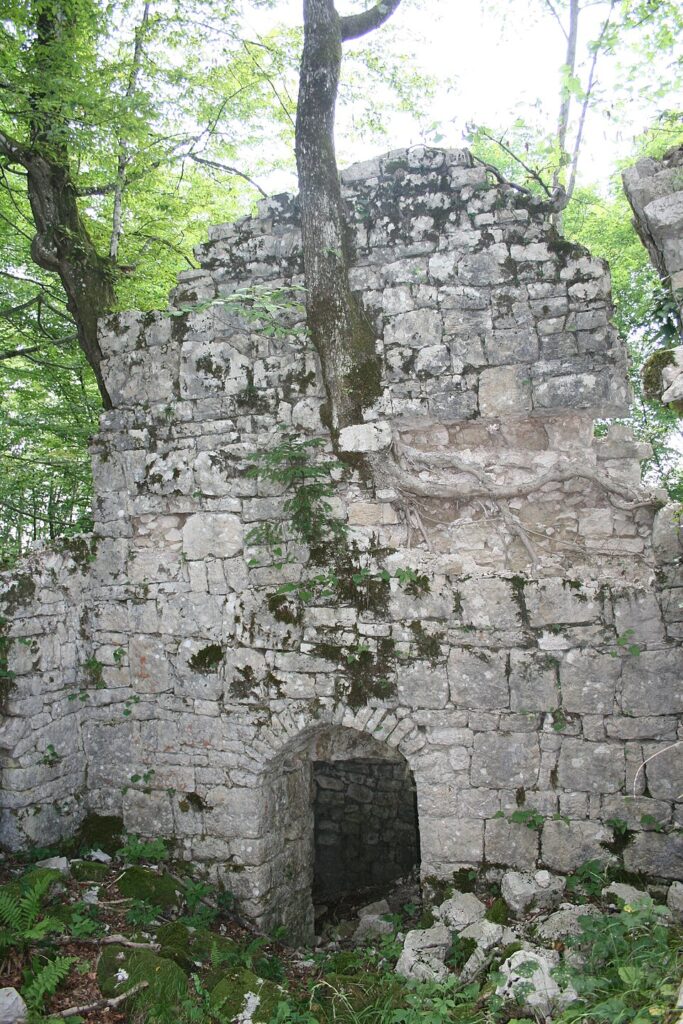
Ruined medieval church on Mount Lashkendar in Abkhazia
Lashkendari Church (Georgian: ლაშქენდარის ეკლესია, romanized: lashkendaris ek’lesia) is a ruined medieval church on Mount Lashkendar in Abkhazia, a breakaway region of Georgia.[1] It is located near the small village of Khuhkuni in the Ochamchire Municipality/Tkvarcheli District, some 5-6 km south-east of the town of Tkvarcheli. The site is revered as a holy shrine by both Abkhaz and Georgians.
Description
The church is a complex building, consisting of a main domed edifice to which a smaller church with a semi-circular apse is attached on the north. The whole complex is surrounded by a 100-meter-long protective fence. The two churches communicate through a doorway. The complex can be entered through four doors. The central entrance, located on the south side of the fence, is surmounted with an arch with a Christian cross curved in relief. Above the western door is a bas-relief with two stylized animals facing each other. This piece of arts has its closest parallel to the depiction of two deer on a tympanum above the northern portal of the 7th-century Ateni Sioni Church in eastern Georgia. The remaining two doors are on the northern side of the wall.[2]
The dome of the main church has collapsed. The gate of the church — apparently a later addition — is well-preserved. The church is surrounded by an artificial platform with burials. Archaeological excavations revealed several items, such as: bronze lion figures, candlesticks, different types of ritual items, bearing similarities with other examples of medieval Georgian Christian art.[3] The complex has been variously dated to the period from the 7th to the 11th centuries.[4]




