
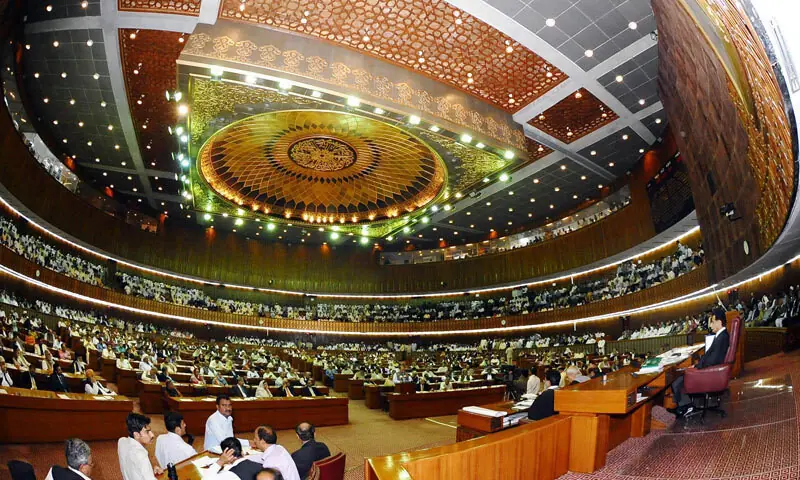
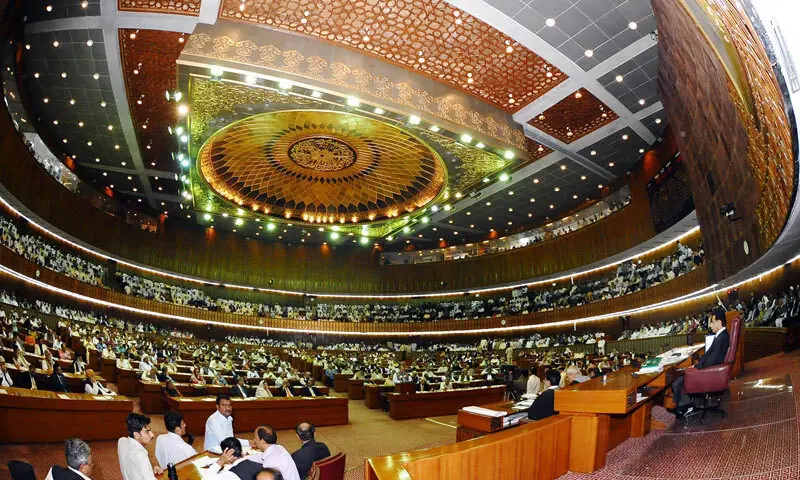
Law Minister Azam Nazeer Tarar tabled the bill for the 27th Constitutional Amendment in the National Assembly (NA) on Tuesday, a day after the government succeeded in manoeuvring it through the Senate.
The bill needs a two-thirds majority in order to be passed by the NA, which the ruling coalition has in the 336-member house as compared to the opposition’s 103. Within the coalition, the PML-N has 125 seats, the PPP has 74, the Muttahida Qaumi Movement-Pakistan (MQM-P) has 22, the Pakistan Muslim League-Quaid has five, the Istehkam-i-Pakistan Party has four, and the PML-Z, the Balochistan Awami Party, and the National Peoples Party have one seat each.
The NA session today began with a prayer for PML-N Irfan Siddiqui, who passed away yesterday.
NA Speaker Ayaz Sadiq then asked Tarar to move the bill for the constitutional amendment to be taken into consideration, as stated in the house’s agenda for today.
Bill sails through Senate
The PML-N-led coalition government on Monday succeeded in manoeuvring the passage of the controversial 27th Constitutional Amendment Bill through the Senate, securing a two-thirds majority with the unexpected support of two opposition senators who voted against their party lines.
The bill, seeking crucial changes to a number of articles mostly dealing with the judiciary and the military leadership, was presented before the upper house of parliament for a final vote by Law Minister Azam Nazeer Tarar amid a noisy protest by opposition senators.
As soon as Senate Chairman Yousuf Raza Gilani started putting up the bill for a clause-by-clause vote, the opposition senators started gathering in front of his dais and chanted anti-government slogans. They tore up copies of the bill and agenda and some of them were seen hurling the documents towards the law minister, prompting the sergeants-at-arm to make a human wall at the aisle between the treasury and the opposition benches to prevent any possible physical clash.
After staying in the house for a few minutes, the opposition senators belonging to the Pakistan Tehreek-i-Insaf (PTI) and the Jamiat Ulema-i-Islam (JUI-F) staged a walkout from the house, providing the government with an opportunity to proceed smoothly.
After holding the vote on the bill by division, Senate Chairman Gilani announced that the 27th Amendment bill had been passed with 64 votes, which is not less than a two-thirds majority in the 96-member house.
After casting his vote against the party line, PTI’s Saifullah Abro announced his resignation from the house. Speaking on the floor, Senator Abro said he had “voted only for [Field Marshal] Gen Asim Munir”, adding that the Pakistani armed forces made the nation proud by defeating India in the May war.
He added that during the [passage of the] 26th Amendment, “my 10 family members were abducted, but my party [PTI] did not come to the rescue.
Interestingly, when he tendered his resignation, Senate Chairman Gilani said, “We will make you a senator again”.
Meanwhile, the Jamiat Ulema-i-Islam Fazl (JUI-F) expelled Senator Ahmed Khan for voting for the bill against party direction.
Changes in the bill
During yesterday’s Senate session, PPP Senator Farooq Naek presented the final report on the bill, approved by the standing committees on the law and justice of the two houses, highlighting three to four changes that had been suggested by members.
About the changes incorporated into the bill on recommendation of the parliamentary committees, Senator Naek said the Federal Constitutional Court (FCC) would have equal representation of all provinces besides a representative from the Islamabad High Court. He said the initial draft of the bill stated a judge having served for seven years in the high court could be nominated for the FCC, but this qualification merit has been curtailed to five years on the recommendation.
Moreover, he said, the committees agreed that if an appointment was made to the FCC from among sitting Supreme Court judges, the inter-se seniority of the appointee would remain the same as at the time of the appointment. On the other hand, in the case of a fresh appointment of a lawyer or a high court judge, the seniority would be reckoned from the date on which they would assume office. However, he added, if multiple judges would take the oath the same day, their seniority would be determined on the basis of their age.
Also, the parliamentary committees suggested a change in the nomination for the reconstituted Judicial Commission of Pakistan (JCP), he said. The 26th Amendment had authorised the speaker to nominate a woman or a non-Muslim candidate for the JCP, he explained. However, the committees proposed that the nominee should be a technocrat, he added.
The PPP senator said the suo motu powers of judges had not been taken away, but the court would exercise these powers only when an application was submitted. “The case will be taken up for hearing after the FCC decides whether the application for exercising suo motu powers is valid and needed,” he said.
The PPP senator, who was part of the committee that examined the initial draft of the bill, said that an interim stay order in matters of revenue remained valid until the case was decided under Article 199 of the Constitution. Since this created a huge backlog, the amendment suggested that interim order would be vacated automatically after one year if no decision on the case was made, he explained.
Referring to the procedure of judges’ transfer, Mr Naek said previously, even when the 26th Amendment was passed, the President could transfer judges with their consent and after consultation with the chief justices of both relevant high courts.
However, this procedure has been amended, he said. “Now a judge refusing his transfer would be given an opportunity of presenting his reasons for the decline before the JCP. And if the JCP finds the reasons invalid, he would have to retire,” the senator explained.
About the provision of lifetime immunity to the president from facing criminal trial or arrest under Article 248, he said it was suggested that this immunity would not be available if the President holds a public office after the end of his term, but as soon as he ceases that public office he would again be entitled to this immunity.
According to a proposed amendment in Article 243, this type of lifetime immunity has also been provided to the field marshal, marshal of the air force and admiral of the navy.

