


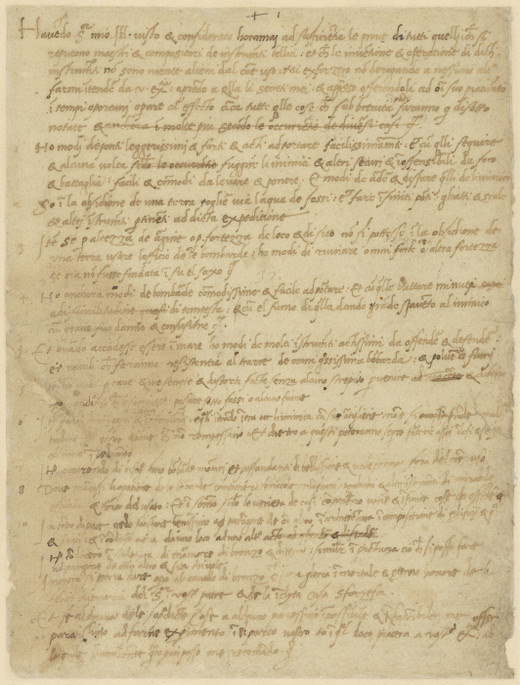

The letter from Leonardo da Vinci to Ludovico Sforza is a handwritten document by Leonardo da Vinci written in 1482, addressed to the ruler of Milan, Ludovico Sforza. The purpose of the letter was to present Leonardo’s knowledge and experience to serve the Milanese court. Today, it is preserved in the Codex Atlanticus at the Biblioteca Ambrosiana in Milan. In terms of textual structure and purpose, it is considered the earliest known example of a curriculum vitae (CV).[1][2]
In the letter, preserved in the Codex Atlanticus at the Biblioteca Ambrosiana, Leonardo initially presents himself as a military engineer, emphasizing his ability to design war machines, siege engines, and innovative defensive systems capable of ensuring security and strategic superiority in battle.[2] Only towards the end of the letter does Leonardo mention his civil and artistic skills, highlighting his ability to execute works of architecture, sculpture, and painting.[1][2]
The document not only helped Leonardo secure a position at the Milanese court—where he remained for almost twenty years—but also represents an early example of personal branding and strategic career management, in which the artist constructed his professional profile according to the patron’s needs, balancing technical innovation and artistic prestige.[2] The effectiveness of this strategy is evidenced by Leonardo’s rapid acceptance at Ludovico’s court and the prominent role he assumed there, with significant artistic, scientific, and engineering commissions.[1][2]
In 1482, at just over thirty years old, Leonardo da Vinci was in a transitional phase of his career: after working in Florence in the workshop of Verrocchio and in the cultural circle of Lorenzo the Magnificent, he sought new opportunities to expand his artistic and engineering activities. Milan under the rule of Ludovico il Moro was then a center of great political and cultural prestige, where military, architectural, and artistic works were commissioned and valued.[1][2] In this context, Leonardo sent the Duke a letter that can be considered one of the first historical examples of a structured professional curriculum, aimed at presenting his skills and obtaining a prominent role at the Sforza court.[1][2]
In the letter, preserved in the Codex Atlanticus at the Biblioteca Ambrosiana, Leonardo initially presents himself as a military engineer, emphasizing his ability to design war machines, siege engines, and innovative defensive systems capable of ensuring security and strategic superiority in battle.[2] Using clear, direct, and confident language, the artist highlights his superiority over other alleged inventors of war devices, stressing that he possessed knowledge and secrets no one else could claim.[2] Only towards the end of the letter does Leonardo mention his civil and artistic skills, highlighting his ability to execute works of architecture, sculpture, and painting, as well as proposing a bronze equestrian monument dedicated to Francesco Sforza, Ludovico’s father.[1][2] This arrangement reflects a strategic choice: Leonardo knew that in that turbulent period, the Duke would primarily value military and engineering capabilities, while his artistic talents were already recognized and could be revealed later.[2]
The letter is characterized by clarity of expression and formal simplicity, with a numbered list structure that facilitates reading and understanding of the skills offered. Leonardo also invites Ludovico to directly verify the feasibility of his projects, providing tangible proof of his abilities—a practice that today could be described as a trial period or practical demonstration.[2]
The content of the letter, translated to English, is as follows:
Most Illustrious Lord: Having now sufficiently seen and considered the proofs of all those who count themselves masters and inventors in the instruments of war, and finding that their invention and use does not differ in any respect from those in common practice, I am emboldened… to put myself in communication with your Excellency, in order to acquaint you with my secrets. I can construct bridges which are very light and strong and very portable with which to pursue and defeat an enemy… I can also make a kind of cannon, which is light and easy of transport, with which to hurl small stones like hail… I can noiselessly construct to any prescribed point subterranean passages — either straight or winding — passing if necessary under trenches or a river… I can make armored wagons carrying artillery, which can break through the most serried ranks of the enemy. In time of peace, I believe I can give you as complete satisfaction as anyone else in the construction of buildings, both public and private, and in conducting water from one place to another. I can execute sculpture in bronze, marble or clay. Also, in painting, I can do as much as anyone, whoever he may be. If any of the aforesaid things should seem impossible or impractical to anyone, I offer myself as ready to make a trial of them in your park or in whatever place shall please your Excellency, to whom I commend myself with all possible humility.[3]



