


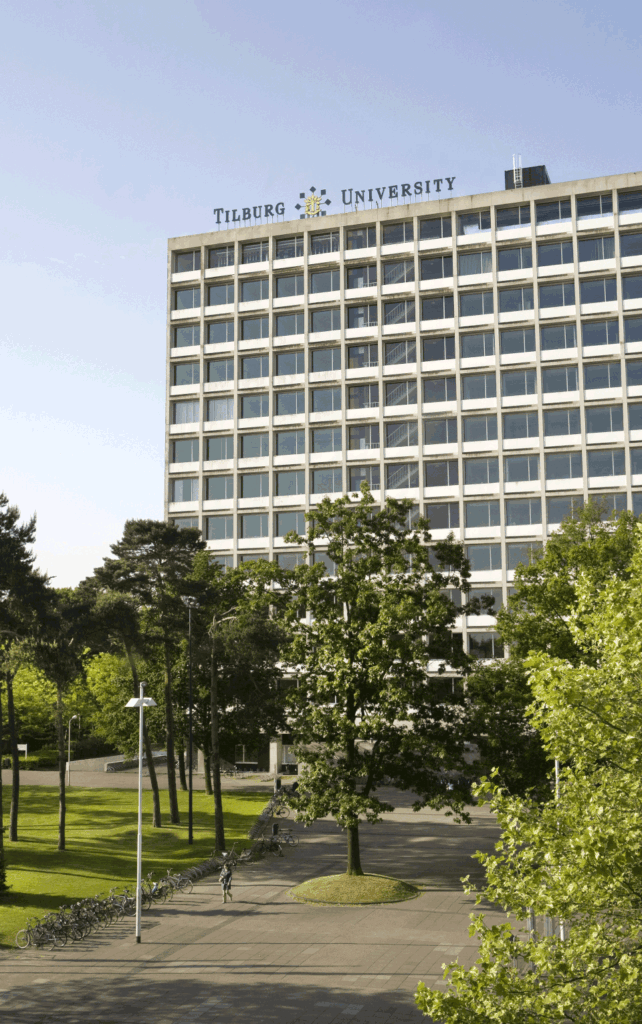
University College in Tilburg, Netherlands
University College Tilburg is a small-scale Liberal Arts and Sciences College within Tilburg University in the Netherlands. It offers an interdisciplinary undergraduate program, focused on critical thinking, bridging disciplines and challenging norms. UC Tilburg was founded in 2008,[2] and enrolls approximately 300 students from the Netherlands and abroad.[3] At UC Tilburg, students specialize in one of the three majors: Interdisciplinary Social Sciences, Cognitive Neuroscience and Behavior, or Law, Politics, and Culture.
The Liberal Arts and Sciences program at UC Tilburg is a three-year bachelor’s program (180 ECTS).[4] It combines a shared academic core with specialization through majors and interdisciplinary themes.[5]
In the first year, students are offered a broad range of core subjects, to develop important academic skills such as rhetorical analysis, philosophy, history, and social sciences.[6] These core courses are shared among all students, and form an introduction to key disciplines. In the second semester of the first year, students choose one of the following majors:
– The Interdisciplinary Social Sciences major focusses on understanding how people and communities organize, interact, and drive change. It combines sociology with perspectives from economics and business to explore topics such as inequality, migration, diversity, and polarization. Students develop both qualitative and quantitative research skills, preparing them to analyze and address social challenges that shape today’s world.
– The Cognitive Neuroscience and Behavior major expores how the human brain shapes thought, emotion, and behavior. It integrates cognitive neuroscience and psychology to examine how people perceive, decide, and interact with the world. Students gain a solid foundation in theory, research design, and statistical methods, developing the tools to investigate how the brain and mind connect across everyday and societal contexts.
– The Law, Politics, and Culture major examines how laws, ideas, and cultural values shape societies. It bridges law, philosophy, political theory, and cultural studies to study how democratic systems, justice, and meaning are created. Students learn to interpret texts, analyze concepts, and compare perspectives, equipping them to think critically about power, institutions, and societal resilience.
In addition to the major, students select an interdisciplinary societal theme in the second year. Themes are independent of the chosen major and bring together students from different academic backgrounds to address complex societal challenges from multiple perspectives.
– The Transformations to Sustainability theme allows students to engage in interdisciplinary exporation of transformative pathways to sustainability, critically examining current governance approaches from multiple perspectives and exploring solutions for a more sustainable world.
– The Democracy and Justice theme examines how justice is defined, practiced, and challenged in democratic societies. Students engage with philosophical, legal, and political perspectives to analyze pressing global issues, from inequality to climate change, and reflect on how individuals and institutions can contribute to fairer, more resilient democracies.
– The Technology and Society theme investigates how emerging technologies transform culture, politics, and everyday life. Drawing from law, social sciences, and digital culture studies, students explore issues such as AI ethics, online behavior, and digital regulation, and learn to assess how innovation reshapes what it means to be human in a connected world.
In the third year, students may complete a minor program at Tilburg University, another Dutch university, or at a partner university abroad as part of an exchange program. Finally, students complete a bachelor’s thesis within their chosen major, which involves independently conducting academic research and applying the knowledge and skills developed during the program. In addition to the thesis, students complete a Societal Capstone Project, which focuses on applying academic insights to a real-world issue. This project is carried out in collaboration with external partners.
Degree and Future Prospects
[edit]
Depending on their major, graduates of this program are awarded either a Bachelor of Arts (BA) or Bachelor of Science (BSc) degree. This degree is internationally recognized and qualifies graduates for admission to a range of master’s programs. Most graduates continue into postgraduate education at Tilburg University or other research universities in the Netherlands and abroad. Others pursue careers in private, public, or non-profit sectors.

Campus and Student Body
[edit]
UCT is housed in the Dante Building, in the middle of the campus of Tilburg University. The building includes a Common Room for Liberal Arts and Sciences students, designed as a shared space for studying, meeting, and informal activities. University College Tilburg enrolls an international and diverse student body. Classes are small-scale and are taught by lecturers from Tilburg University, University College Tilburg, and external institutions. Teaching emphasizes discussion-based learning and interdisciplinary perspectives.
Selection and Admission
[edit]
Admission to the Liberal Arts and Sciences program at University College Tilburg takes place through a selective matching procedure. Applicants apply in the spring and are assessed based on a written application and an interview, with the aim of determining whether the program and the applicant are a good mutual fit.



