


From Wikipedia, the free encyclopedia
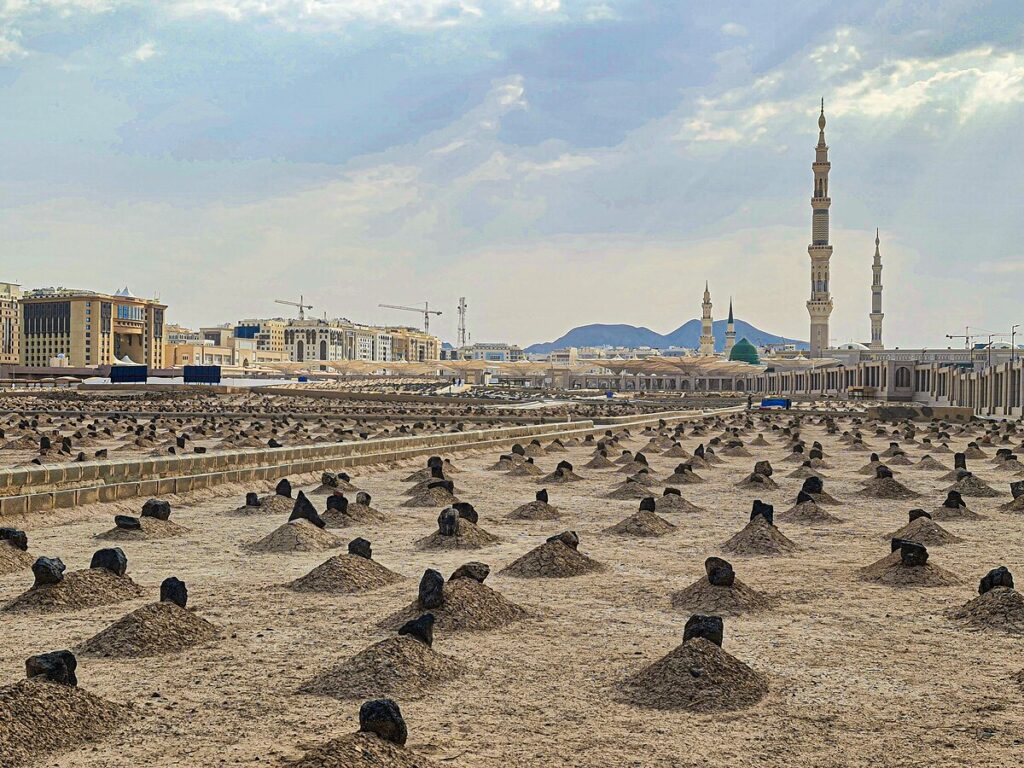
Cemetery in Medina, Saudi Arabia.

This is a list of notable people buried at Jannat al-Baqi Cemetery in Medina, Saudi Arabia.
Al-Baqi Cemetery (Arabic: ٱلْبَقِيْع) is the oldest and the first Islamic cemetery founded by the Prophet Muhammad. Also known as Baqi al-Gharqad (Arabic: بَقِيْع الْغَرْقَد, lit. ‘The remaining (cemetry) of the Boxthorn‘).
Chronological List of Ahl al-Bayt Burials at Jannat al-Baqī:
| Name | Death year (CE) | Notes |
|---|---|---|
| Immediate Family (Ahl al-Kisa, wives, and children) | ||
| Ruqayya bint Muhammad | March 624 | Daughter of the Prophet and wife of Uthman. |
| Zaynab bint Khuzayma | 625 | Fifth wife of the Prophet, also known as Umm al-Masakin (mother of the poor). |
| Zainab bint Muhammad | 629 | Eldest daughter of the Prophet. |
| Umm Kulthum bint Muhammad | 630 | Daughter of the Prophet and also wife of Uthman. |
| Rayhana bint Zayd | c. 631 | Wife or concubine of the Prophet, was a Jewish convert to Islam from the Banu Nadir |
| Ibrahim ibn Muhammad | c. 27 January 632 | Son of the Prophet Muhammad; died in infancy |
| Fatima bint Muhammad | 632 | Daughter of Muhammad, wife of Ali.
The exact burial place is not known, though many traditions hold that her grave is in Jannat al-Baqī. |
| Maria al-Qibtiyya | c. 637 | Twelfth wife of the Prophet. She was an Egyptian (Copt) woman gifted to Muhammad in 628 as a slave. |
| Zaynab bint Jahsh | 640 / 641 | Seventh wife of the Prophet. |
| Sawdah bint Zam’ah | c. 644 or 674 | Second wife of the Prophet. |
| Umm Habiba | 664 | Ninth wife of the Prophet. |
| Safiyya bint Huyayy | c. 664 – c. 672 | Tenth wife of the Prophet, originating from a Jewish tribe Banu Nadir. |
| Hafsa bint Umar | c. 665 | Fourth wife of Muhammad and daughter of Umar |
| Hasan ibn Ali | 670 | Grandson of the Prophet and son of Ali and Fatima.
Briefly caliph in early Islamic history. |
| Juwayriya bint al-Harith | 676 | Eighth wife of the Prophet. |
| Aisha | c. 678 | Third and youngest wife of Prophet Muhammad and daughter of first caliph Abu Bakr. |
| Umm Salama | c. 680 or 682/683 | Sixth wife of the Prophet. |
| Extended Family (uncles, aunts, cousins and notable direct descendants of the Prophet) | ||
| Abd Allah ibn Uthman | 625 | Died in early childhood; grandson of the Prophet through Ruqayya and Uthman |
| Fatimah bint Asad | c. 626 | Mother of Ali, aunt of the prophet, known for her care for him. |
| Ali ibn Abi al-As | 630 | Died in early childhood; grandson of the Prophet through Zainab. |
| Safiyya bint Abd al-Muttalib | c. 640 | Paternal aunt of the Prophet and mother of Zubayr ibn al-Awwam. |
| Lubaba bint al-Harith | c. 650 | Sister-in-law of the Prophet and wife of Abbas ibn Abd al-Muttalib. |
| Abu Sufyan ibn al-Harith | c. 641 or 652 | Cousin and foster-brother of the Prophet. |
| Abbas ibn Abd al-Muttalib | c. 653 | Paternal uncle of the Prophet. |
| Fatima bint Hasan | c. 7th-Century | Daughter of Hasan ibn Ali and wife of Ali al-Zayn al-Abidin |
| Atika bint Abd al-Muttalib | 7th-Century | Aunt of the Prophet. |
| Aqil ibn Abi Talib | 670 or 683 | Cousin of the Prophet and elder brother of Ali. |
| Umm al-Banin | c. 684 | Wife of Ali and mother of Abbas ibn Ali |
| Abd Allah ibn Ja’far | c. 699 or 702/704 | Nephew and son-in-law of Ali and cousin once removed of the Prophet. |
| Muhammad ibn al-Hanafiyya | c. 700 or 701 | Son of Ali ibn Abi Talib, was an effective lieutenant for his father during his caliphate. |
| Ali al-Sajjad | c. 712 – c. 714 | 4th Shia Imam; great-grandson of Prophet Muhammad. |
| Hasan ibn Hasan | c. 715 | Son of Hasan ibn Ali, also known as Hasan al-Mu’thannā. |
| Muhammad al-Baqir | c. 732 | 5th Shia Imam, known for transmitting knowledge. |
| Isma’il ibn Ja’far | c. 765 or 775 | 7th Ismaili Shia Imam; son of Ja’far al-Sadiq. Isma’ili sources hold that he was buried in Salamiyah, while other sources place his burial in al-Baqī[1] |
| Ja’far al-Sadiq | 765 | 6th Shia Imam, renowned scholar of hadith, Fiqh, and science. |
Companions of the Prophet Muhammad
[edit]
Chronological List of Prophet Muhammad’s Companions Burials at Jannat al-Baqī:
| Name | Death year (CE) | Notes |
|---|---|---|
| As’ad ibn Zurara | 623 | He suffered from an illness resembling diphtheria or meningitis. He is reported to be the first man buried in al-Baqi[2] |
| Uthman ibn Maz’un | 624 | Was either the first Companion or the first Muhajir to be buried in the al-Baqi’ |
| Khunays ibn Hudhafa | c. 624 | Died 25 months after the Hijra. His funeral prayer was led by Muhammad.[3] |
| Abu Salama | 625 | He was also a cousin and a foster-brother of Muhammad. |
| Sa’d ibn Mu’adh | c. 627 | Chief of the Aws tribe in Medina and a prominent companion of Prophet. He died shortly after the Battle of the Trench |
| Usayd ibn Hudayr | c. 620s / 630s | Was a leader of the Banū Aws tribe of Medina before his conversion to Islam. |
| Halima bint Abi Dhu’ayb | c. 635 | Foster-mother and Wet nurse of the Prophet. |
| Ubayy ibn Ka’b | c. 649 | He is notable for the Quran codex he compiled. |
| Abd Allah ibn Mas’ud | c. 653 | Regarded by Sunni tradition as one of the greatest early interpreters of the Quran.[4][5]He was buried at night in al-Baqi[6] |
| Abu Sufyan ibn Harb | c. 653 | A prominent opponent-turned companion of the Prophet. |
| Abd al-Rahman ibn Awf | c. 654 | One of the wealthiest among the companions, he is known for being one of the ten to whom Paradise was promised. |
| Abu ‘Abs ibn Jabr | 654 | Participated in military campaigns alongside the Prophet. |
| Uthman | 656 | Son-in-law of the Prophet and the 3rd Caliphate.
He was initially reportedly to be buried in al-Baqī, but due to local resistance, was instead interred in a Jewish cemetery, which was later incorporated into al-Baqī by the Umayyads. |
| Ṣuhayb ibn Sinan | 659 | Former slave in the Byzantine Empire, raised speaking Greek, who became an early companion of Prophet Muhammad.[7] |
| Abd Allah ibn Salam | 663 | A Jew who converted to Islam. He participated in the conquest of Syria, but died in Medina. |
| Zayd ibn Thabit | c. 665 | Personal scribe of the prophet Muhammad, serving as the chief recorder of the Quranic text. |
| Sa’id ibn Zayd | 671 | Companion of prophet Muhammad and a brother-in-law of Umar.[8] |
| Sa’d ibn Abi Waqqas | 674 | Military Commander and Governer of Kufa.[8] |
| Hakim ibn Hizam | c. 674 | Respected merchant and a key figure in the Quraysh tribe and nephew of Khadija bint Khuwaylid |
| Hassan ibn Thabit | c. 674 | Arabian poet, who was best known for poems in defence of the prophet. |
| Abu Hurayra | 679 | Companion of the prophet and considered the most prolific hadith narrator.[9] |
| Abu Sa’īd al-Khūdrī | 7th-Century | Prominent companion of the Prophet and prolific hadith narrator, He is believed to have died around 693, though some sources suggest 683. |
| Usama ibn Zayd | 680 | Son of Zayd ibn Haritha, Muhammad’s adopted son. |
| Ka’b ibn Zuhayr | 7th-Century | Arab poet, wrote Bānat Suʿād, a qasida in praise of Muhammad. Which was the original Burdah, moved by the poem, Muhammad placed his mantle over him. |
Other Notable Burials
[edit]
List of all other Burials at Al-Baqi Cemetery in alphabetical order:
- Some of the graves of Ahl al-Bayt and companions of the Prophet in Al-Baqi Cemetery
-
, Hasan, Zain al-Abideen, Muhammad al-Baqir and Jafar as-Sadiq and ‘Abbas ibn ‘Abd al-Muttalib](https://upload.wikimedia.org/wikipedia/commons/thumb/b/b8/Al-Baqi_Graves_of_Ahlul_Bayt.jpg/250px-Al-Baqi_Graves_of_Ahlul_Bayt.jpg)
-
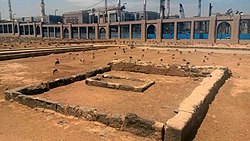
 The grave of Ibrahim ibn Muhammad
 -
 Grave of wives of Muhammad, left to right: Maria al-Qibtiyya, Juwayriyya bint al-Harith, Umm Salama, Zaynab bint Jahsh, Zaynab bint Khuzayma, Sawda bint Zamʿa, Hafsa, Safiyya bint Huyayy, Umm Habiba, Aisha.
 -
-
-
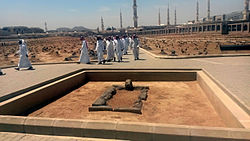
 Graves of Abdullah ibn Ja’far and Aqeel ibn Abi Talib


_nabi_1.JPG)


and_Akil_bin_abi_Talib.jpg)
- ^ Buyukkara, Mehmet Ali (1997). The Imāmi Shi’i movement in the time of Mūsā al-Kāẓim and ‘Ali al-Riḍa. Edinburgh: Edinburgh University Press.
- ^ Muhammad ibn Saad. Kitab al-Tabaqat al-Kabir vol. 3. Translated by Bewley, A. (2013). The Companions of Badr. London: Ta-Ha Publishers.
- ^ Ibn Saad/Bewley vol. 3 p. 307.
- ^ “‘Abd Allah ibn al-‘Abbas”. Encyclopædia Britannica. Vol. I: A-Ak – Bayes (15th ed.). Chicago, Illinois: Encyclopædia Britannica, Inc. 2010. pp. 16. ISBN 978-1-59339-837-8.
- ^ Ludwig W. Adamec (2009), Historical Dictionary of Islam, p.134. Scarecrow Press. ISBN 0810861615.
- ^ Muhammad ibn Saad. Kitab al-Tabaqat al-Kabir vol. 3. Translated by Bewley, A. (2013). The Companions of Badr. Loon:TaHa Publishers.
- ^ Efendioğlu, Mehmet (2009). Türkiye Diyanet Vakfı, Centre for Islamic Studies (ed.). SUHEYB b. SİNÂN (in Turkish). Vol. 37 (Sevr Antlaşması – Suveylîh). Istanbul. pp. 476–477. ISBN 978-975-389-589-7.
{{cite book}}: CS1 maint: location missing publisher (link) - ^ a b al-Basri, Muhammad ibn Saʿd (1990). Al-Ṭabaqāt al-Kubrā. Vol. 3. Beirut: Dār al-Kutub al-‘Ilmīyah. pp. 109–110.
- ^ Abgad Elulm, pp.2, 179.
- ^ Zîser, Eyāl (2001). Asad’s Legacy: Syria in Transition. C. Hurst & Co. p. 196.
- ^ Karpat, Kemal H (2017). “Inside the Seraglio: Private Lives of the Sultans in İstanbul”. International Journal of Turkish Studies. 23 (1/2): 102–104. ProQuest 1985562940.
- ^ Peirce, Leslie (2017). “Ottoman Women in Public Space”. International Journal of Turkish Studies. 23 (1/2): 104–108. ProQuest 1985569314.
- ^ “ترجمة (إمام المسجد النبوي ) فضيلة الشيخ أبو بكر جابر الجزائري”. saaid.org. Retrieved 2025-09-21.
- ^ Lambden, Stephen (2016-05-26). “Twin Shining Lights, Part 1: Shaykh Ahmad ibn Zayn al-Din al-Ahsa’i”. Lights of ‘Irfán: Papers Presented at the ‘Irfán Colloquia and Seminars. 17.
- ^ Shāhid Sahāranpuri (2005), Ulama e Mazahir Uloom aur unki Ilmi wa tasnīfi khidmāt (in Urdu), vol. 1 (2005 ed.), Saharanpur: Maktaba Yādgār-e-Shaykh, p. 318
- ^ Akbarabadi, Saeed Ahmad, ed. (November 1965). “Nazarāt”. Monthly Burhan (in Urdu). Vol. 55, no. 5. Delhi: Nadwatul Musannifeen. p. 3. Archived from the original on 7 January 2024. Retrieved 7 January 2024.
- ^ “ČOBĀN – Encyclopaedia Iranica”. www.iranicaonline.org. Retrieved 2020-04-06.
- ^ Dorsey, James (2022). “Saudi Arabia: A South Asian Wrecking Ball”. In Mandaville, Peter (ed.). Wahhabism and the World: Understanding Saudi Arabia’s Global Influence on Islam. Oxford University Press. p. 195.
- ^ Baqa, Muhammad Mazhar (April 2006). Hayat-e-Baqa awr Kuchh Yaadein (in Urdu). Karachi: Zawwar Academy Publications. p. 333.
- ^ “Former king of Libya dies – UPI Archives”. UPI. Retrieved 2025-09-20.
- ^ Zakariyya Kandhlawi (1973). حضرت اقدس مولانا الحاج صاحب نور الله مرقده [Hadrat Aqdas Maulana al-Haj Khalil Ahmad Sahib Nawwar Allahu Marqadah] (in Urdu).
- ^ Ahmad, Ishtiaque (2020). Ulama E Deoband Ki Swaneh Umriyon Ka Tanqeedi Tajziya Azadi Se Qabl (PhD thesis) (in Urdu). India: Department of Urdu, Maulana Azad National Urdu University. pp. 250–264. hdl:10603/338413.
- ^ Network, KL News (2018-09-04). “Saudi Kingdom Loses Its Top Kashmiri Qari”. Kashmir Life. Retrieved 2025-09-13.
- ^ Taj, Ejaz (2018-09-06). “Shaykh Khalīl ʿAbdul-Raḥmān al-Qāriʾ: A Qurʾānic Legacy”. Islam21c. Retrieved 2025-09-13.
- ^ “وفاة إمام مسجد القبلتين في المدينة بعد وعكة صحية”. 25 June 2022. Archived from the original on 2022-06-27.
- ^ “Saudi Arabia.. Death misses the former imam of the Prophet’s Mosque”. 26 June 2022. Archived from the original on 2 July 2022. Retrieved 1 July 2022.
- ^ Schacht, J. “Mālik b. Anas”. In Bearman; Bianquis; Bosworth; van Donzel; Heinrichs (eds.). Encyclopaedia of Islam, Second Edition. Brill Online.
- ^ Yarshater, Ehsan (1985–2007). The History of al-Ṭabarī (40vols.). SUNY Series in Near Eastern Studies. Albany, New York: State University of New York Press. ISBN 978-0-7914-7249-1.
- ^ Douglas Jehl (March 14, 1996). “Mohammed al-Ghazali, 78, An Egyptian Cleric and Scholar”. The New York Times.
- ^ Abjad al-‘Ulum by Siddiq Hasan Khan al-Qanauji. أبجد العلوم. Noor Digital Library. 1420.
- ^ Muhammad Isḥāq, Professor of Islamic Studies (1955). India’s Contribution to the Study of Hadith Literature. University of Dacca. p. 242. ISBN 9789840690169.
- ^ “Syaikh Samman: Pendiri Tarekat Sammaniyah” [Shaykh Samman: Founder of the Sammaniyah Order]. Pejalan Ruhani. 9 January 2021.
- ^ “Imam of Prophet’s Mosque Passes Away”. About Islam. 2016-04-17. Retrieved 2024-09-18.
- ^ “Former imam of Prophet’s Mosque laid to rest in Madinah”. Arab News. 2016-04-17. Retrieved 2024-09-18.
- ^ Voll, John (1975). “Muḥammad Ḥayyā al-Sindī and Muḥammad ibn ‘Abd al-Wahhab: An Analysis of an Intellectual Group in Eighteenth-Century Madīna”. Bulletin of the School of Oriental and African Studies, University of London. 38 (1): 32–39. doi:10.1017/S0041977X00047017. Retrieved 26 April 2015.
- ^ Hussain, Shaik Zakeer (2021-07-15). “Dr. Muhammad Muhsin Khan, Renowned Translator Of The Quran And Sahih Al-Bukhari Passes Away At 97”. The Cognate. Retrieved 2021-07-15.
- ^ “Dr. Muhammad Muhsin Khan passes away”. 15 July 2021.
- ^ Khan, Ghazanfar Ali (11 March 2010). “Al-Azhar head Tantawi buried in Madinah”. Arab News. Archived from the original on 23 July 2011. Retrieved 11 March 2010.
- ^ الوسط, بوابة. “وفاة الشيخ ربيع المدخلي و«أوقاف طرابلس» تنعيه”. alwasat.ly (in Arabic). Retrieved 2025-07-10.
- ^ “سبب وفاة الشيخ ربيع المدخلي وموعد جنازته وسيرته الذاتية الكاملة – النصر الإخباري” (in Arabic). 2025-07-09. Retrieved 2025-07-10.
- ^ The Great Shamil, Imam of Daghestan and Chechnya, Shaykh of Naqshbandi tariqah
- ^ Başman, Sevgi. Şeyh Şamil (in Turkish). Zafer Basin Yayin Ve Turizm Ve Bilg.ürünleri San.tic. Ltd. şti. ISBN 978-975-261-372-0.
- ^ “Imam Shamil: The Lion Of Dagestan | Complete Documentary | – смотреть видео онлайн от «Звездные истории» в хорошем качестве, опубликованное 2 июля 2024 года в 5:38:03”. rutube.ru (in Russian). Retrieved 2025-04-03.
- ^ Özşenel, Mehmet (1988–2016). “KANDEHLEVÎ, Muhammed Zekeriyyâ”. TDV Encyclopedia of Islam (44+2 vols.) (in Turkish). Istanbul: Turkiye Diyanet Foundation, Centre for Islamic Studies.
- ^ Kazmi, Syed Ahmed Saeed. Life of Prophet PBUH: Leader of all Prophets (in Urdu). Urdu-Books. Archived from the original on 19 December 2023. Retrieved 19 December 2023.
- ^ “Tunisia ex-president Ben Ali buried in Muslim holy city of Medina”. France 24. 21 September 2019.
- ^ “Lawyer: Tunisia’s toppled ruler Zine El Abidine Ben Ali dies”. CNBC. 19 September 2019. Archived from the original on 21 September 2019. Retrieved 19 September 2019.
- Raza Ghadeeri, Hassan (2020). Tareekh E Jannatul Baqi (in Urdu). Lahore, Pakistan: Idhara Mnahaj al-Saliheen.
- Ibn Shabba, ʿUmar ibn Shabba al-Numayri (1990). Tārīkh al-Madīna al-Munawwara (in Arabic). Beirut: Dar al-Fikr.
- al-Sakhawi, Shams al-Din Muhammad (1993). al-Tuhfa al-Latifah fi Tarikh al-Madina al-Sharifah (in Arabic). Beirut: Dar al-Kutub al-‘Ilmiyya.
- Bearman, P.; Bianquis, Th.; Bosworth, C.E.; van Donzel, E.; Heinrichs, W.P., eds. (1960–2007). Encyclopaedia of Islam, Second Edition. Leiden: Brill.




