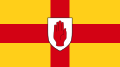
A red cross on a golden field. The arms of the historic province of Ulster is a composite achievement, combining the heraldic symbols of two of that province’s best known families; namely the cross of the de Burgh family, Earls of Ulster, and the dexter hand of O’Neill (Ua Néill, later Ó Néill) Kings of Ailech and Tír Eoghan.
Since 1919
Flag of the Republic of Ireland was originally designed to represent all of Ireland, but is currently only the official flag of the Republic of Ireland. Often seen flying from lampposts and homes in nationalist areas of Northern Ireland.
A Tricolour, with three equal vertical bands of green (hoist side), white and orange. The Flag is a metaphor for the peace, equality and co-operation (white) between Catholics (green) and Protestants (orange).
1916
On 24 April 1916, a flag with the inscription ‘Irish Republic’ was hoisted alongside the Irish tricolour over the General Post Office, Dublin during the 1916 Easter Rising as a proclamation of the Irish Republic, which claimed the entire island of Ireland as its territory. The flag is still used by Irish nationalists.
The flag features a green field with the inscription “Irish Republic” written in white and yellow (gold) letters in the form of Gaelic script. It measures 4 feet 3 inches by 5 feet 6 inches and is now on display at the National Museum of Ireland – Decorative Arts and History.
Blue background with an orange sun showing partially in the lower hoist.
Since 1930s
The starry plough flag succeeded the starry plough banner; the flag used to represent Irish nationalist socialism. Used by socialists, trade unionists and nationalists.
Flag of a proposed independent Ulster nation. Used by Ulster nationalists, although it has now been adopted as an Ulster-Scots flag.
St Patrick’s Saltire with the background of St Andrew’s Saltire, defaced with a golden six pointed star representing the six counties of Northern Ireland, containing the red hand of Ulster.
Flag of the Ulster Volunteer Force. Often seen flying from lampposts and homes in loyalist areas.
Similar to Boyne Standard. Purple background with orange border and English flag in the canton and a UVF emblem in the lower fly. The letters”U.V.F.” and “1912” are shown diagonally in the centre of the flag.
Light blue background with red border and UDA emblem on the hoist (left-hand) side and the words “ULSTER DEFENCE ASSOCIATION” on the fly (right-hand) side.
Flag of the Ulster Freedom Fighters. Often seen flying from lampposts and homes in loyalist areas.
Black background with yellow border and UFF emblem in the centre.
Black background with white border and LVF emblem in the centre with three of the six counties of Northern Ireland on both sides. Two yellow banner one at the top and one at the bottom, Top banner says “Loyalist Volunteer Force” and bottom says “In defence of our heritage and culture”.
Orange background with a St. George’s Cross in the canton and defaced with a purple Williamite five-pointed star in the lower fly.
The Purple Standard, used by some Orange Order marching groups.
Purple background with a St. George’s Cross in the canton and defaced with an orange five-pointed star in the lower fly. Effectively an inverted version of the primary Orange Order flag.
Saint Patrick’s saltire surrounded by a lightship sailing on the sea (in both the top and bottom sections) and a lighthouse standing on a rock in the sea (in both the left and right sections).[10]
pre–1970
Flag of the Commissioners of Irish Lights
Saint George’s cross surrounded by a lighthouse standing on a rock in the sea (in both the first and fourth quarters) and a lightship sailing on the sea (in both the second and third quarters).[11]




.svg)