


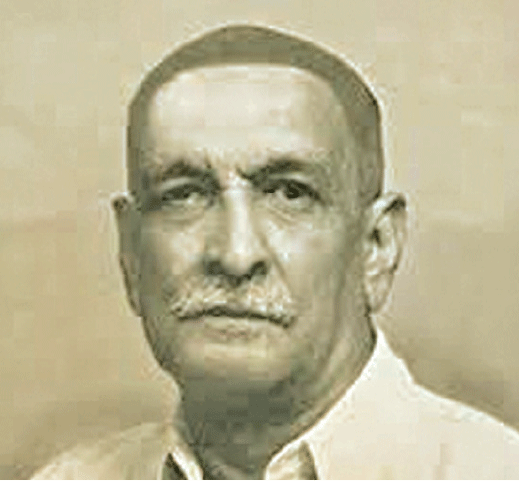
ZAFAR Umar was a writer and police officer in British India. He is sometimes credited with writing Urdu’s first-ever detective novel Neeli Chhatri (the blue umbrella). But some critics say Neeli Chhatri was not an original work and, being a translation, it cannot be considered Urdu’s first detective novel. Other writers often mentioned as pioneers of detective novels in Urdu are Teerath Ram Ferozpuri (1885-1954) and Ibn-i-Safi (1928-1980).
As mentioned by C. M. Naim (1936-2025) in his article included in his book Muntakhab Mazaameen, Neeli Chhatri first appeared in 1916 from Badayun and instantly became so popular that it had to be reprinted many times over within a short span of time. For the next 50 years or so, the novel remained popular. Naim says that Neeli Chhatri was a translation of The Hollow Needle, a thriller by Maurice Leblanc (1846-1941), the French novelist.
In other words, Neeli Chhatri was an Urdu translation of an English novel, which itself was a translation from French. Zafar Umar had made so many changes in the novel that it was a kind of creative translation, often called transcreation, retaining the main theme and tone but adapting the norms and cultural atmosphere to suit the local tastes and sensitivities.
The main character in the original was named Arsene Lupin, a “noble thief” and detective. Zafar Umar named him Behraam and the heroine Ramonde was renamed as Feroza, making them sound local but not Muslim as these were common names among Parsees in the subcontinent.
This made the romance in the novel a little more acceptable as Parsees were considered comparatively more modern by the standards of the yore.
One of the factors that had made the French and English versions very popular in the West was the setting of the story: the historic royal residences and magnificent treasures in and around Paris. Zafar Umar localised it and set the story in Delhi’s historical buildings of the Mughal era, hence making it more relatable to the readers in the subcontinent. This was one of the reasons why Neeli Chhatri’s subtitle was Shahan-i-Dehli Ka Posheeda Khazana, or the hidden treasure of Delhi kings. Zafar Umar adapted the novel to the local cultural environment so well that readers never felt they were reading the translation of a European novel. Neeli Chhatri was a smashing success by all accounts. When Zafar Umar got his own house constructed, he named it Neeli Chhatri. Behraam’s character was so popular that to cash in on its popularity, many imitated and wrote detective novels based on a main character named Behraam.
Zafar Umar was born in Muzaffarnagar, UP, on April 27, 1883. He graduated from M.A.O. College, Aligarh, in 1902 and worked as private secretary, first to Nawab Mohsinul Mulk and then Begum Bhopal. Zafar Umar passed competitive exams and joined Indian Police Service. He translated, with permission from the author, the last chapter of Western Culture in Eastern Lands, a book by Armin Vambery (1832-1913), under the title Mustaqbil-i-Islam, or the future of Islam. In 1911, Zafar Umar published Policeman, a pioneering work in Urdu, a manual for the training of police constables. The book became quite popular. He himself translated it into English and soon it was made a part of Punjab Police’s curriculum.
In 1913, Zafar Umar published a few short stories in Urdu magazines, notably Al-‘Asr, published from Lucknow. These were abridged versions of English novels by Henry Augustus Hering (1864-1945), a popular writer in those days. Translating these thrillers was helpful for Zafar Umar in honing his skills for translating and adapting English works into Urdu at a novel length. Then Zafar Umar found Leblanc’s The Hollow Needle and he turned it into a creative work by modifying the main character and naming him Behraam. In 1919, Zafar Umar published Behraam Ki Giriftaari, a translation of another novel by Leblanc. Choron Ka Club was a collection of stories and appeared in 1922. The book contained four of Hering’s stories that Zafar Umar had published earlier.
Zafar Umar published Laal Kathor, his last work, in 1929, and as put by Naim, despite the absence of any acknowledgement we know it was a translation of The Three Just Men, an adventure by Edgar Wallace (1875-1932).
Some believed Zafar Umar was born in 1884, died in Aligarh and never migrated to Pakistan. But Prof Muhammad Aslam disagreed and wrote in his article on the topic, published in the October 1994 issue of Qaumi Zaban, that he was able to find Zafar Umar’s grave in Lahore’s Miani Sahib Graveyard. The tombstone, according to Prof Aslam, read “born April 27, 1883, Muzaffarnagar, died Dec 4, 1949, Lahore”.
Published in Dawn, December 1st, 2025



