
From Wikipedia, the free encyclopedia
Content deleted Content added
|
|
|||
| Line 14: | Line 14: | ||
|
| equivalents = Ll ll |
| equivalents = Ll ll |
||
|
| letter = Љ љ |
| letter = Љ љ |
||
|
| language = [[Macedonian language|Macedonian]], [[Bosnian language|Bosnian]], [[ |
| language = [[Macedonian language|Macedonian]], [[Bosnian language|Bosnian]], [[ language|]], [[ language|]] [[Itelmen language|Itelmen]] |
||
|
}} |
}} |
||
Latest revision as of 22:20, 21 November 2025
Cyrillic letter representing /ʎ/ in Macedonian, Serbian, and other languages
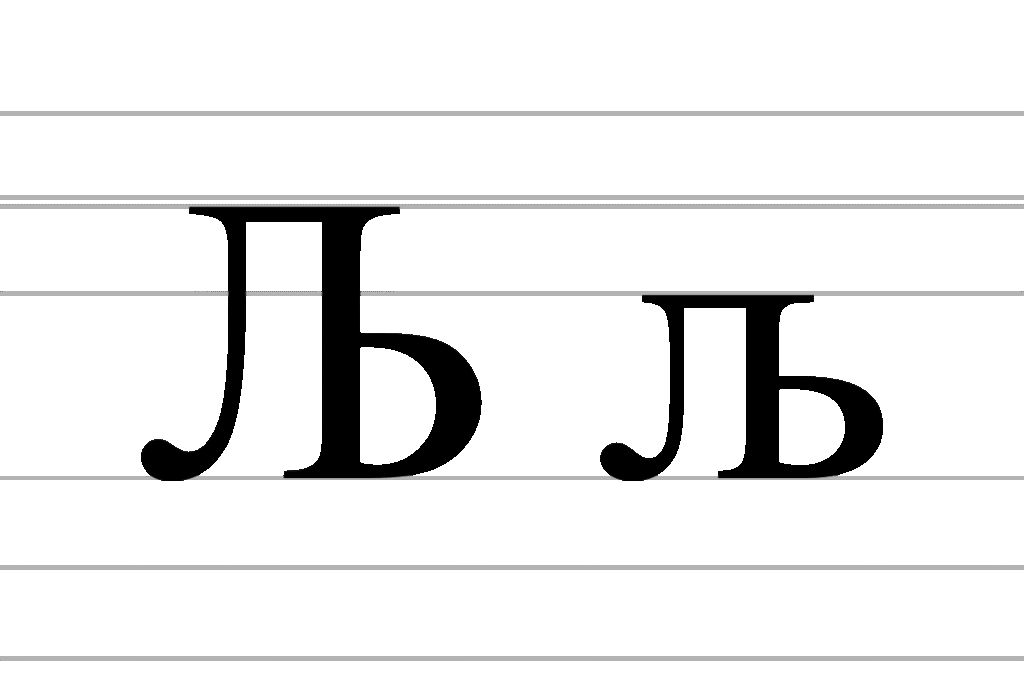
Lje, or Lle (Љ љ; italics: Љ љ; also called lye) is a letter of the Cyrillic script.

Lje represents a palatal lateral /ʎ/, a sound similar (but not identical) to the palatalized alveolar lateral approximant /lʲ/, which is in some languages represented by the digraph ⟨ль⟩ and pronounced /lʲ/ like the ⟨ll⟩ in “million”. Compare Latvian ⟨ļ⟩, Slovak ⟨ľ⟩, Hungarian ⟨ly⟩, Portuguese ⟨lh⟩, Spanish ⟨ll⟩ and Italian ⟨gl⟩.
Lje is a ligature of ⟨л⟩ and ⟨ь⟩.[1] It was invented by Vuk Stefanović Karadžić for use in his 1818 dictionary, replacing the earlier digraph ⟨ль⟩.[1] It corresponds to the digraph ⟨Lj⟩ in Gaj’s Latin alphabet for Serbo-Croatian.[1]
It is today used in Macedonian, variants of Serbo-Croatian when written in Cyrillic (Bosnian, Montenegrin and Serbian), and Itelmen.
It was also once used in the Udege language, in the Lithuanian Cyrillic alphabet, and in the Albanian Cyrillic alphabet.
Lje is commonly transliterated as lj but can also be transliterated as ľ, or ļ.
 The dictionary definition of Љ at Wiktionary
- The dictionary definition of љ at Wiktionary
- Audio samples of the letter Lje


