


Content deleted Content added
|
|
|||
| Line 8: | Line 8: | ||
|
== Mineral sands extraction == |
== Mineral sands extraction == |
||
|
In recent years, parts of the Lompoul desert and the surrounding coastal strip have been affected by ”heavy mineral sands mining”, particularly for [[zircon]], [[ilmenite]] and [[rutile]], under a concession operated by the French mining company [[Eramet]] through its subsidiary |
In recent years, parts of the Lompoul desert and the surrounding coastal strip have been affected by ”heavy mineral sands mining”, particularly for [[zircon]], [[ilmenite]] and [[rutile]], under a concession operated by the French mining company [[Eramet]] through its subsidiary Eramet Grande Côte of has .<ref name=””>{{cite web |
||
|
|title=Grande Cote (GCO) Operation |
|||
|
|url=https://miningdataonline.com/property/663/Grande-Cote-GCO-Operation.aspx |
|||
|
|website=MiningDataOnline |
|||
|
|access-date=7 February 2026 |
|||
|
|publisher=MiningDataOnline |
|||
|
|quote=Grande Cote (GCO) Operation is located approximately 100 km northeast of Dakar, Senegal, and is classified as an active open pit mineral sands mine producing heavy minerals including zircon, rutile, and ilmenite. |
|||
|
}}</ref> The use of large dredging equipment has altered dune landscapes and generated local concerns about environmental impacts and changes to traditional land uses in the region.<ref name=”NAI-PolicyNote-GameOfMinerals”>{{cite web |
|||
|
|title=Game of minerals in the sands of Senegal: Trade-offs between growth, sustainability and justice in Senegal’s “desert” mining |
|title=Game of minerals in the sands of Senegal: Trade-offs between growth, sustainability and justice in Senegal’s “desert” mining |
||
|
|url=https://nai.uu.se/stories-and-events/news/2026-02-06-game-of-minerals-in-the-sands-of-senegal.html |
|url=https://nai.uu.se/stories-and-events/news/2026-02-06-game-of-minerals-in-the-sands-of-senegal.html |
||
Latest revision as of 14:15, 7 February 2026
Desert in Senegal

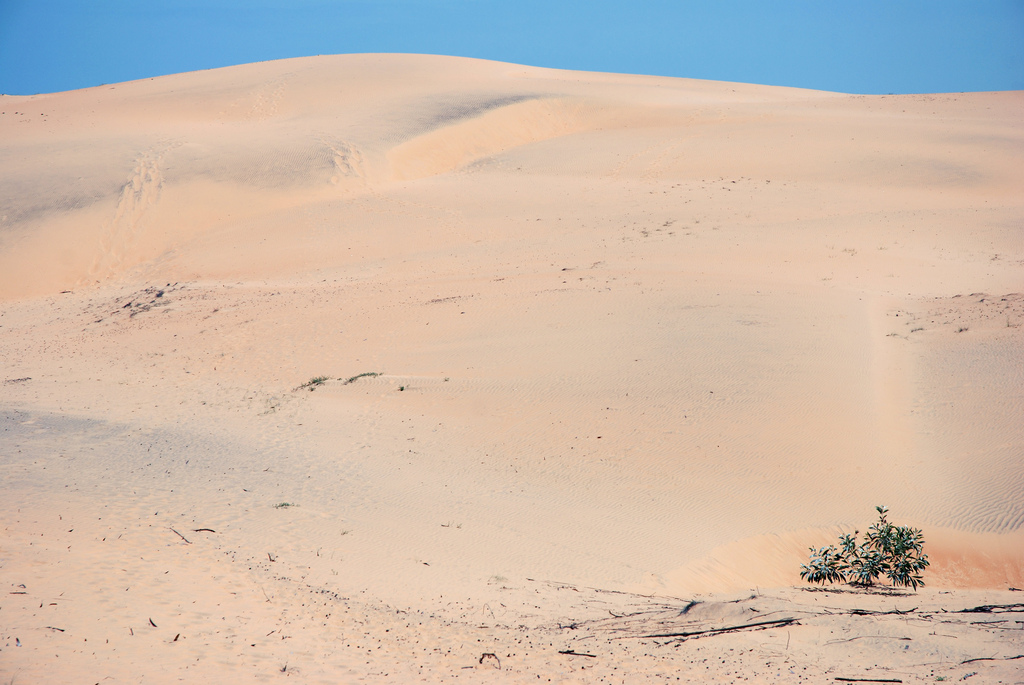
The Lompoul desert (sometimes spelled Lumpoul; in French: désert de Lompoul) is a small desert (about 18 km2) located 145 km south of Saint-Louis, Senegal.[1] It is characterized by orange sand dunes forming a landscape that is more akin to those of the Sahara and Mauritania than those of the surrounding area of Senegal (the Grande Côte),[2] and is a popular tourist attraction of Senegal. The desert is named after the closest settlement, i.e., the village of Lompoul.
Since 2009, a music festival named “Festival du Sahel” take place in the desert.[3]
Mineral sands extraction
[edit]
In recent years, parts of the Lompoul desert and the surrounding coastal strip have been affected by heavy mineral sands mining, particularly for zircon, ilmenite and rutile, under a concession operated by the French mining company Eramet through its subsidiary Eramet Grande Côte, in which the Government of Senegal also has an indirect equity (10%).[4] The use of large dredging equipment has altered dune landscapes and generated local concerns about environmental impacts and changes to traditional land uses in the region.[5]
15°27′00″N 16°41′00″W / 15.4500°N 16.6833°W / 15.4500; -16.6833




